

TL;DR:
- Reducing false positives is essential in computational drug discovery due to low typical hit rates.
- Layered methods, including consensus scoring, pose filtering, and AI tools, significantly improve screening reliability.
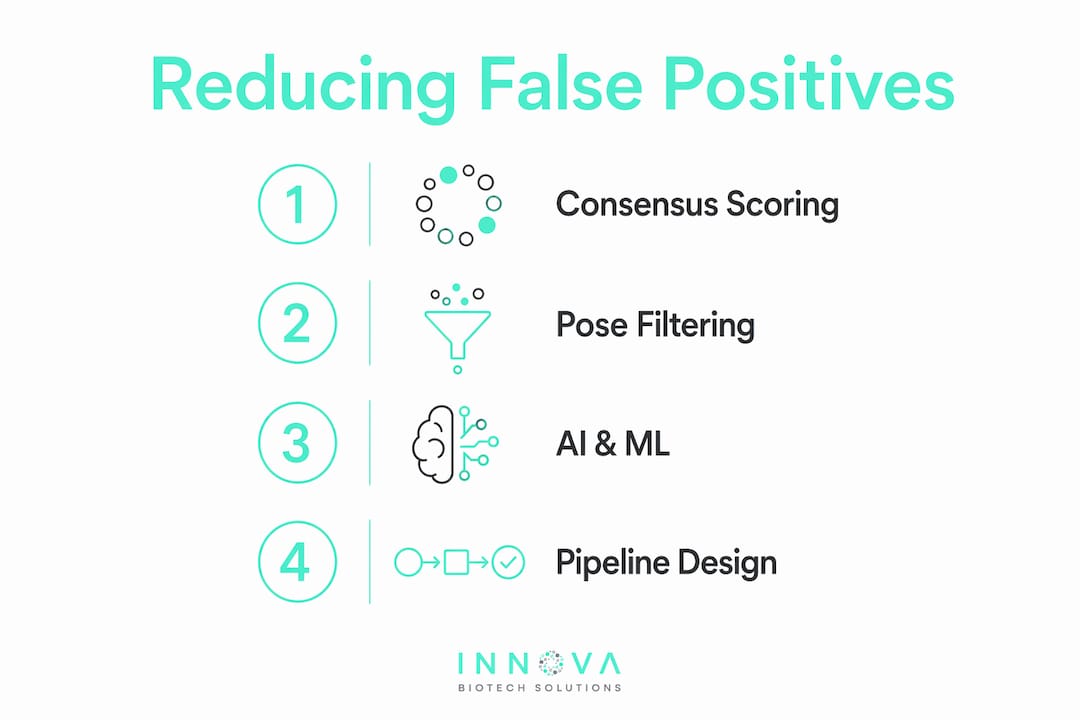
Reducing false positives in virtual screening is the defining challenge of computational drug discovery, where standard hit rates of 1–5% mean most compounds flagged by docking are noise, not signal. The industry term for this problem is false positive enrichment, and it costs teams weeks of wet-lab time chasing dead ends. Advanced methods including consensus scoring, pose convergence filtering, and AI frameworks like DrugCLIP and AlphaFold3 now push validated hit rates to 15–17.5%. This guide breaks down each technique, explains where conventional docking fails at a physics level, and gives you a practical workflow to improve screening reliability today.
How does consensus scoring reduce false positives in virtual screening?
Consensus scoring is the practice of running two or more independent docking algorithms on the same compound library and retaining only hits that score well across all methods. Single docking methods yield hit rates of 5–15%, while consensus scoring pushes that range to 15–25%. The logic is straightforward: different docking algorithms fail in different ways, so a compound that scores well in AutoDock Vina, DiffDock, and Glide simultaneously is far less likely to be an artifact of any single scoring function.
The workflow breaks into three steps:
- Run independent docking runs. Use at least two structurally distinct algorithms. AutoDock Vina and DiffDock represent a good pairing because one is physics-based and the other is diffusion-based, giving you orthogonal failure modes.
- Rank compounds within each method. Normalize scores within each run before comparing. Raw score scales differ between programs, so direct comparison without normalization introduces bias.
- Apply a concordance filter. Retain only compounds that fall in the top 10% of ranked hits across all methods. This is where most false positives are eliminated.
The computational cost is real. Running three docking programs on a library of 100,000 compounds requires significant CPU time, and not every team has access to GPU clusters. Cloud-based docking platforms have reduced this barrier considerably, but budget the compute time before committing to a three-method consensus.
Pro Tip: Select your top 10% concordant compounds from consensus scoring, then immediately apply a Lipinski Rule of Five filter before any further analysis. This removes a second layer of likely false positives with almost no additional compute cost.

One limitation researchers underestimate is that consensus scoring improves precision but does not fix the underlying physics. The best individual scoring function explains only 31% of variance in experimental binding affinities, and consensus scoring raises that to 38%. That is a meaningful gain, but it still leaves substantial unexplained variance. Consensus scoring is a noise filter, not a binding affinity predictor.
What role does pose filtering play in minimizing false positives?
Pose filtering addresses a different failure mode than scoring: physically impossible or geometrically inconsistent binding poses that receive favorable scores. Inadequate grid definition and oversized docking search spaces are among the most common causes of false positives, because a compound placed in an unrealistic region of the protein surface can score well simply due to non-specific contacts.
The standard approach to pose filtering follows this sequence:
- Define a tight search grid. Restrict the docking search space to a validated binding site, ideally one confirmed by crystallography or cryo-EM. Oversized grids let compounds dock anywhere on the protein surface, generating false positives from non-specific burial.
- Apply a pose convergence filter. Cluster all poses for each compound and measure the RMSD between the top-ranked pose and the cluster centroid. A cutoff of 1.0–2.5 Å is standard. Compounds with high RMSD variance across poses are geometrically unstable binders and should be deprioritized.
- Check for key pharmacophore contacts. Confirm that the top pose makes at least one hydrogen bond or electrostatic contact with a known catalytic or binding residue. Poses that score well without contacting the active site are almost always false positives.
- Remove strained geometries. Filter out poses with internal clashes or bond angles outside acceptable ranges. Many docking programs do not penalize these geometries sufficiently in their scoring functions.
Competitive docking and pose filtering strategies can achieve enrichment rates up to 93.5%, which is a dramatic improvement over unfiltered docking outputs. That number reflects a best-case scenario with a well-characterized binding site, but even conservative implementations routinely double enrichment rates.
Pro Tip: Before any large-scale screen, run your docking protocol against a set of known actives and known decoys for your target. This prospective benchmarking tells you exactly which pose filters improve enrichment for your specific protein, rather than relying on published cutoffs from different systems.
The binding site definition step is where most teams lose precision. Researchers often use a generic grid centered on the protein centroid when a co-crystal structure is unavailable. Using structural bioinformatics tools to predict binding pockets from homology models or AlphaFold3 structures is a better approach than defaulting to a large, nonspecific grid.
How do AI and machine learning improve virtual screening accuracy?
AI-based virtual screening tools address the physics limitations of conventional scoring functions by learning binding patterns from large experimental datasets rather than relying on hand-crafted energy terms. DrugCLIP, a deep contrastive learning framework, has achieved validated hit rates of 15–17.5% in wet-lab experiments, compared to the 1–5% typical of conventional docking. That improvement is not marginal; it represents a three to fivefold reduction in wasted synthesis and assay resources.
The table below compares conventional docking with leading AI approaches across key performance dimensions:
| Dimension | Conventional docking | AI-based methods (DrugCLIP, AlphaFold3) |
|---|---|---|
| Hit rate | 1–5% | 15–17.5% |
| Binding affinity R² | 0.31 (best single function) | Improved but target-dependent |
| Pose accuracy | Moderate, grid-dependent | High for trained target classes |
| Speed at scale | Hours to days per library | Minutes to hours with GPU |
| Novel target reliability | Established | Requires benchmarking |
AlphaFold3 and tools like GenPack improve pocket geometry prediction, which directly reduces false positives from poorly defined binding sites. However, AI pose generators require continuous target-specific benchmarking to avoid artifacts and overestimations. A model trained on kinase binding data will not automatically transfer to GPCRs or allosteric sites without revalidation.
The practical recommendation is to use AI tools as a first-pass filter rather than a final answer. Run DrugCLIP or a similar model to reduce a library of 1,000,000 compounds to 10,000 candidates, then apply consensus docking and pose filtering to that reduced set. This layered approach captures the speed advantage of AI while preserving the specificity of physics-based filters. For binding affinity prediction, integrating AI scoring with experimental Ki data from related compounds further sharpens hit prioritization.
What pipeline design practices confirm virtual screening hits?
Docking scores are ranked statistical hypotheses, not binding confirmations. Conventional scoring functions fail because they inadequately model long-range electrostatics, desolvation penalties, and entropic contributions. Treating a docking score as a confirmed hit is the single most common cause of wasted experimental resources in computational drug discovery.
A well-designed pipeline applies orthogonal filters in sequence:
- ADMET profiling. Run all docking hits through ADMET prediction tools before any experimental work. Compounds with predicted hepatotoxicity, poor membrane permeability, or rapid metabolic clearance are unlikely to succeed regardless of their docking score.
- Molecular dynamics (MD) simulation. Run 50–100 ns MD simulations on your top 50–100 compounds. Compounds that maintain their docked pose throughout the simulation are far more likely to be true binders than those that drift immediately.
- Experimental orthogonal assays. Use surface plasmon resonance (SPR), isothermal titration calorimetry (ITC), or thermal shift assays to confirm binding before committing to full dose-response curves. These assays are faster and cheaper than full IC50 determination.
"Suppressing false positives entirely is impractical. The goal is optimizing signal-to-noise with clear documentation of tuning decisions to prevent blind spots." — Reducing false positives with machine learning tuning strategies
Classifying false positives by their technical cause enables targeted pipeline tuning that preserves true binders. When you review failed compounds after experimental testing, group them by failure mode: scoring function artifacts, grid definition errors, ADMET failures, or assay interference. Each cluster points to a specific fix in your pipeline. Teams that skip this documentation step repeat the same errors across campaigns. For a detailed framework on confirming hits after docking, the 2026 best practices for validating virtual screening results covers the full orthogonal validation workflow.
Key Takeaways
Effective false positive reduction in virtual screening requires layered methods: consensus scoring, pose filtering, AI-assisted prioritization, and orthogonal experimental validation working together.
| Point | Details |
|---|---|
| Consensus scoring boosts hit rates | Using two or more docking methods raises hit rates from 5–15% to 15–25%. |
| Pose filters dramatically improve enrichment | Convergence filters with 1.0–2.5 Å cutoffs can push enrichment rates to 93.5%. |
| AI tools multiply throughput | DrugCLIP achieves 15–17.5% validated hit rates versus 1–5% for conventional docking. |
| Docking scores are hypotheses | Orthogonal filters like ADMET, MD simulation, and SPR are required before confirming hits. |
| Document false positive causes | Clustering failures by root cause enables targeted fixes that preserve true binders. |
Why I think most teams underestimate the physics problem
The conversation about false positives in virtual screening almost always focuses on software choices. Researchers debate AutoDock Vina versus Glide, or whether to use AlphaFold3 structures. That debate matters, but it misses the deeper issue. Physics-based scoring functions fail not because the software is poorly written, but because the underlying energy models are incomplete. No scoring function currently handles desolvation entropy with the accuracy needed to reliably rank compounds within a few kcal/mol of each other.
What I have found actually works is treating the entire docking pipeline as a hypothesis generator, not a decision engine. The teams that get the best experimental confirmation rates are the ones that apply the most skepticism to their own computational outputs. They run MD simulations on their top hits before ordering synthesis. They use SPR to confirm binding before running full dose-response assays. They document every false positive and ask why it passed their filters.
AI tools like DrugCLIP are genuinely exciting, and the hit rate improvements are real. But they require the same skepticism. A model that performs well on a kinase panel may fail on your allosteric target without retraining. The researchers who get the most value from AI screening are the ones who benchmark it against known actives for every new target, not just once during tool selection.
The goal is not a perfect pipeline. The goal is a pipeline where you understand exactly where the errors come from and can fix them systematically. That requires documentation, cause clustering, and a willingness to run more experiments earlier in the process than feels comfortable.
— Hooman
Innovabiotech's virtual screening and peptide design services
Computational screening generates hits. Confirming them requires the right experimental and bioinformatics infrastructure behind your pipeline.
Innovabiotech provides custom peptide design and bioinformatics validation services built specifically for drug discovery teams working to improve hit confirmation rates after virtual screening. From de novo peptide design to binding affinity modeling and ADMET-guided optimization, the Innovabiotech team works alongside your computational workflow from initial screen through lead confirmation. If your pipeline needs protein design support to refine binding site geometry or generate target-ready structures for docking, Innovabiotech's San Francisco-based team is available for project consultation.
FAQ
What is a false positive in virtual screening?
A false positive in virtual screening is a compound that receives a favorable docking score but does not bind the target protein in experimental assays. These arise from scoring function limitations, poor grid definition, and geometrically unstable poses.
How does consensus scoring reduce false positive rates?
Consensus scoring retains only compounds that score well across two or more independent docking algorithms. Because different algorithms fail in different ways, concordant hits are far less likely to be artifacts of any single method.
What enrichment rate is achievable with pose filtering?
Competitive docking combined with pose convergence filters can achieve enrichment rates up to 93.5% for well-characterized binding sites. Results vary by target class and grid definition quality.
Are AI docking tools like DrugCLIP reliable for novel targets?
DrugCLIP achieves 15–17.5% validated hit rates on benchmarked targets, but AI pose generators require target-specific benchmarking before use on novel proteins. Performance on untrained target classes is not guaranteed.
What orthogonal assays confirm virtual screening hits most efficiently?
Surface plasmon resonance, isothermal titration calorimetry, and thermal shift assays confirm binding before full dose-response work. Running these assays on your top 50 docking hits eliminates most false positives before any synthesis investment.