
Fragment-based drug discovery (FBDD) screens tiny molecules, usually under 300 Da, that bind a target weakly and then builds them into potent leads using structural data. It's a bet on quality over quantity: instead of throwing millions of drug-sized compounds at a target, you throw a small, curated library of chemical building blocks at it and grow the winners.
- Library size: typically 1,000 to 2,000 compounds, not millions
- Detection methods: X-ray crystallography, NMR, and surface plasmon resonance (SPR) dominate, since biochemical assays often can't detect µM to mM binders
- Main advantage over HTS: far better sampling of chemical space per molecule screened, which is why FBDD reaches allosteric sites and protein-protein interfaces that high-throughput screening (HTS) often misses
Key Takeaways
FBDD converts small, weakly binding fragments into potent leads through structure-guided growing, linking, or merging, validated by orthogonal biophysical methods.
| Point | Details |
|---|---|
| Definition | FBDD screens fragments under 300 Da with weak (µM to mM) affinity, then elaborates them using structural data. |
| Library design | Follow the Rule of Three (MW <300 Da, cLogP ≤3, H-bond donors/acceptors ≤3) across a 1,000 to 2,000 compound library. |
| Screening cascade | Combine a high-throughput primary method (DSF or SPR) with orthogonal confirmation (X-ray or NMR) before advancing hits. |
| Optimization strategy | Choose growing, linking, or merging based on hit geometry, tracking ligand efficiency and lipophilic efficiency throughout. |
| Innovabiotech's role | Provides integrated peptide design, protein engineering, and enzyme optimization services to support fragment-to-lead campaigns end to end. |
Table of Contents
- What Is Fragment-Based Drug Discovery and Where Did It Come From?
- When Does Fragment-Based Discovery Beat High-Throughput Screening?
- How Do You Design a Fragment Library and Apply the Rule of Three?
- What Screening Methods Detect Weak Fragment Binders?
- How Do You Separate Real Fragment Hits From False Positives?
- How Do You Grow, Link, or Merge a Validated Fragment Into a Lead?
- Can Computational Tools and AI Speed Up Fragment-to-Lead Work?
- What Does a Practical FBDD Campaign Workflow Look Like?
- Which Approved Drugs Came From Fragment-Based Discovery?
- What Are the Biggest Pitfalls and When Should You Skip FBDD?
- Why Integrated Teams Outperform Siloed Fragment Campaigns
- Selected High-Value Resources on Fragment-Based Discovery
- Sources
- FAQ
What Is Fragment-Based Drug Discovery and Where Did It Come From?
FBDD emerged in the mid-1990s as a response to a specific frustration: HTS campaigns against difficult targets, especially protein-protein interfaces, kept coming up empty. Researchers at companies like Abbott and Astex Therapeutics realized that starting smaller, with fragments instead of full-sized drug candidates, gave them better odds of finding a real binding hot spot, even if the initial affinity was weak.
By the 2010s, FBDD had moved from a niche academic curiosity to a standard tool in pharma pipelines. The core difference from HTS is sampling efficiency: a fragment library of 1,500 compounds covers a proportionally larger slice of relevant chemical space than an HTS deck of two million, because fragments are structurally simpler and less redundant. That efficiency has paid off clinically, with the approach now credited for multiple approved drugs and a growing list of candidates in clinical trials.
- Fewer, smarter molecules screened per campaign
- Weak initial hits (µM to mM) instead of nM leads, but on real hot spots
- A direct line from Astex's early work to several FDA approvals
When Does Fragment-Based Discovery Beat High-Throughput Screening?
FBDD and HTS aren't rivals so much as tools for different jobs. Choosing wrong wastes months.
Where FBDD wins:
- Better ligand efficiency per atom, since fragments bind efficiently relative to their size
- Access to shallow, allosteric, or protein-protein interaction pockets that HTS libraries routinely miss
- Broader effective coverage of chemical space from a much smaller compound set
Where it gets harder:
- Requires high-sensitivity biophysical assays; a standard biochemical assay often can't see a millimolar binder at all
- Fragment solubility becomes a real constraint at the high concentrations needed for screening
- False positives spike when fragments aggregate or bind nonspecifically at elevated concentrations
Before committing to either path, run through three questions:
- Does the target have a well-characterized, crystallizable pocket, or is it intrinsically disordered?
- Do you have access to synchrotron time, cryo-EM, or high-quality NMR, not just a plate reader?
- Is the target a "difficult" class (allosteric site, PPI, shallow groove) where HTS has historically underperformed?
How Do You Design a Fragment Library and Apply the Rule of Three?
Fragment library quality determines everything downstream, and the field has converged on one guiding heuristic: the Rule of Three. It recommends fragments with molecular weight under 300 Da, calculated LogP of 3 or less, and no more than three hydrogen bond donors and acceptors. The logic is simple: keep fragments small and simple enough that when you grow them later, you still land inside drug-like space instead of blowing past it.
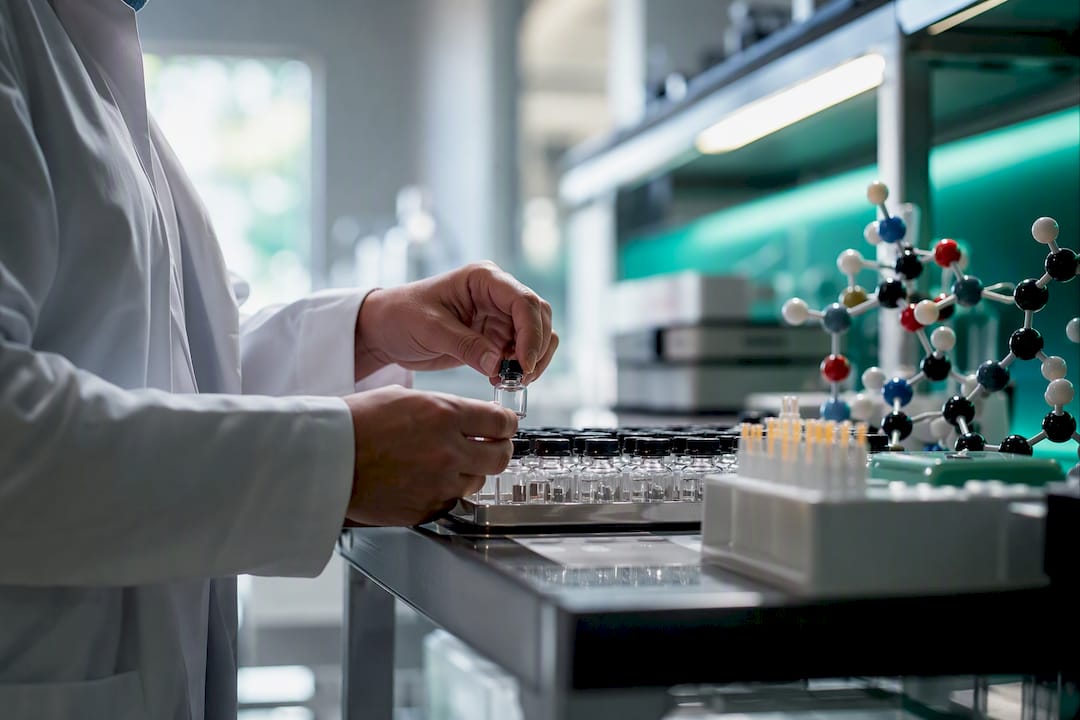
Most working libraries hold a few thousand compounds, weighted toward heteroaromatic and substituted aromatic scaffolds with an average LogP near 1.7. Diversity matters more than raw count. You want privileged scaffolds spread across distinct heavy-atom frameworks, not near-duplicates. Solubility screening and PAINS (pan-assay interference compounds) filtering upfront save enormous downstream pain, since a fragment that precipitates at 5 mM is useless no matter how attractive its structure looks.
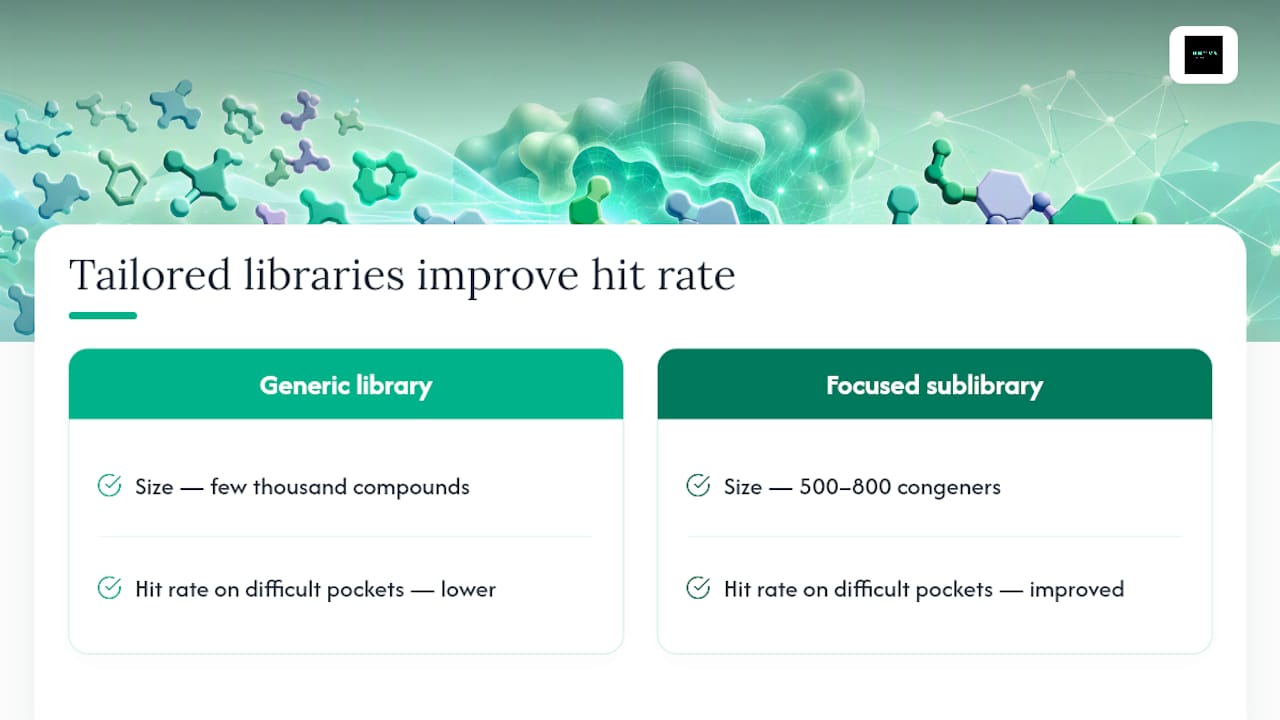
Pro Tip: For genuinely difficult targets like shallow allosteric pockets, skip the generic library and build a focused sublibrary of 500 to 800 congeners tailored to the target class. Hit rates on non-traditional pockets improve noticeably when the library isn't a one-size-fits-all collection.
What Screening Methods Detect Weak Fragment Binders?
Fragment binding is weak by design, so the assay has to be sensitive enough to see it. That single fact shapes the entire toolkit teams reach for.
- X-ray crystallography: gold standard for structural detail; low throughput but tells you exactly where and how the fragment sits
- NMR: excellent for weak binders and ligand-based detection (STD, WaterLOGSY); moderate throughput, kinetic and structural insight
- SPR: fast, quantitative kinetics (on/off rates); widely used as a primary screen
- ITC: gold-standard thermodynamics (binding enthalpy, stoichiometry); low throughput, needs more material
- DSF/TSA: cheap, fast thermal-shift screening; high throughput but prone to artifacts
- Mass spectrometry: direct mass detection of ligand binding; good for mixture screening
- MST and BLI: solution-based and immobilized-target kinetics, respectively; useful secondary confirmation tools
Biophysical methods are the backbone of FBDD precisely because biochemical assays routinely miss fragments binding in the 100 µM to 10 mM range. No single method should stand alone. The standard cascade runs a high-throughput primary screen, often DSF or SPR, then confirms surviving hits with X-ray or NMR before anyone touches a fragment with medicinal chemistry.
Pro Tip: Match the cascade to your infrastructure, not the literature's favorite combination. If you have in-house SPR but only occasional synchrotron access, front-load SPR triage and reserve crystallography for your top 20 to 30 confirmed hits. Screen fragments at consistent concentrations, typically 100 µM to 5 mM, and always run a detergent or reducing-agent counterscreen to catch aggregators early.
How Do You Separate Real Fragment Hits From False Positives?
Fragment screens generate a high false-positive rate almost by definition. Screening at millimolar concentrations exposes aggregation, nonspecific binding, and promiscuous chelation that would never surface at nanomolar drug concentrations. Orthogonal confirmation before any chemistry investment isn't optional.
- Set a primary hit threshold from your screen (e.g., percent thermal shift or SPR response)
- Run counterscreens for detergent sensitivity and aggregation
- Confirm with a second, mechanistically distinct biophysical method
- Check dose response and reproducibility across replicates
- Watch for known artifacts: colloidal aggregation, PAINS motifs, and metal-chelating fragments that hit everything
- Don't advance a fragment without at least two orthogonal confirmations, ideally including structural data
How Do You Grow, Link, or Merge a Validated Fragment Into a Lead?
Once a fragment survives triage, three strategies convert a weak binder into something worth optimizing further.
- Growing: extend a single validated fragment atom by atom into adjacent pocket space; best when you have clear structural data and one well-defined vector
- Linking: connect two fragments binding in nearby subpockets with a chemical tether; powerful in theory, difficult in practice because linker geometry is unforgiving
- Merging: fuse overlapping fragment structures into a single hybrid scaffold; works well when two fragments share a common binding motif
Track progress with ligand efficiency (LE), binding affinity normalized per heavy atom, and lipophilic efficiency (LipE), potency relative to lipophilicity. A fragment with strong LE early on is worth more than one with high raw affinity but poor efficiency, because efficiency tends to erode as you add mass. As a rule of thumb: growing suits a well-resolved single fragment with an obvious extension vector, while merging suits two co-crystallized fragments sharing a hinge or backbone interaction.
Can Computational Tools and AI Speed Up Fragment-to-Lead Work?
Modern FBDD campaigns rarely run on biophysics alone anymore. Computational layers now sit alongside every stage of hit-to-lead work.
- Fragment docking: prioritizes growth vectors before synthesizing a single analog
- Pharmacophore searches: identify follow-up fragments sharing a validated binding pattern
- AI-driven suggestion tools: propose analogs and growth directions from structural and activity data, similar to approaches used in machine learning-driven drug design
- Free-energy perturbation (FEP): ranks candidate modifications by predicted binding-energy change before synthesis
Teams that combine protein-ligand docking models with structural confirmation cut down on wasted synthesis cycles, prioritizing which growth vector to chase first instead of testing all of them blind. Computation narrows the field; it doesn't replace the bench.
Pro Tip: Treat every computational prediction as a hypothesis, not a result. Require experimental confirmation, ideally a new co-crystal structure, before a predicted growth vector moves into a synthesis queue. Chasing a docking score without validation is how teams burn a quarter on a scaffold that never actually binds the way the model claimed.
What Does a Practical FBDD Campaign Workflow Look Like?
A campaign runs through predictable phases, each with its own bottleneck.
- Target preparation (weeks to months): protein construct design, expression, purification, crystallizability checks
- Library selection: choose a general or focused fragment set matched to pocket type
- Primary screen: DSF, SPR, or NMR triage of the full library
- Orthogonal validation: confirm survivors with a second, distinct biophysical method
- Structural follow-up: X-ray or cryo-EM co-crystal structures on confirmed hits
- Medicinal chemistry elaboration: growing, linking, or merging guided by structure
Protein quality is usually the tightest bottleneck, not the screening technology. Synchrotron or cryo-EM access can add weeks of lead time, so book it early. Cross-functional integration between structural biology, biophysics, and chemistry determines whether a campaign moves in months or drags into years.
Which Approved Drugs Came From Fragment-Based Discovery?
FBDD has moved well past proof of concept. Several marketed drugs trace their origin directly to a fragment hit:
- Vemurafenib (BRAF inhibitor for melanoma), one of the earliest FBDD success stories
- Venetoclax (BCL-2 inhibitor), developed with heavy reliance on NMR-based fragment screening
- Erdafitinib (FGFR inhibitor), grown from a fragment hit into a targeted oncology therapy
- Pexidartinib (CSF1R inhibitor), another fragment-derived kinase inhibitor
- Sotorasib and asciminib, more recent fragment-influenced approvals targeting previously "undruggable" mechanisms
A twenty-year retrospective in Nature Reviews Drug Discovery documents the method's growing clinical footprint, and the community blog Practical Fragments tracks fragment-derived clinical candidates as they progress. Astex Therapeutics deserves credit as one of the field's founding contributors, having built much of the early structural infrastructure the industry still relies on.
What Are the Biggest Pitfalls and When Should You Skip FBDD?
Fragment campaigns fail in predictable ways. False positives from aggregation, poor fragment solubility at screening concentrations, and ambiguous binding modes without a real structure are the three that derail the most projects.
- False positives and negatives from assay artifacts or fragments simply too weak for the assay's dynamic range
- Solubility failures at the millimolar concentrations many screens require
- Committing to chemistry on a binding mode inferred rather than confirmed by X-ray or cryo-EM
FBDD earns its place on enzymes with defined active sites, allosteric pockets, and protein-protein interfaces where HTS libraries have historically struggled. For targets with well-validated, high-affinity chemical matter already in hand, a hybrid or conventional HTS approach may reach a lead faster. Mitigate the common failure modes with focused libraries, early structural investment, and an orthogonal confirmation cascade before any fragment reaches a chemist's bench.
Why Integrated Teams Outperform Siloed Fragment Campaigns
The campaigns that actually deliver leads treat structural biology, biophysics, medicinal chemistry, and computation as one continuous conversation, not sequential handoffs. Fragment work rewards teams that loop back from failed elaboration attempts and adjust the library or the assay cascade fast, rather than teams that push forward on a fixed plan regardless of what the structures show.
How Innovabiotech Supports Fragment-to-Lead Campaigns
Running an FBDD campaign in-house means juggling protein production, biophysical screening capacity, structural biology access, and computational modeling, often across four different teams that rarely talk on the same timeline. Innovabiotech runs that whole chain as one coordinated engagement, so a fragment hit doesn't sit idle for weeks waiting for the next department's queue to open up.
Our peptide design and bioinformatics validation services support fragment elaboration once a hit is confirmed, while our protein engineering and computational modeling work handles construct design and structural prep before screening even starts. For projects targeting enzymatic pockets, our enzyme optimization services fold directly into the same pipeline. If your team needs quality reagents for the biophysical side, ABMIUM's antibody and reagent catalog is a resource worth checking. Reach out to Innovabiotech to scope your next fragment-to-lead project and get a project timeline back within days.
Selected High-Value Resources on Fragment-Based Discovery
- Fragment-based drug discovery overview (PMC)
- Rule of Three fragment library design (Stanford HTBC)
- How to Find a Fragment: screening and validation methods (PubMed)
- Twenty years on: impact of fragments on drug discovery (Nature Reviews)
- Practical Fragments community blog
- Focused libraries for difficult pockets (PMC)
This article is general information, not a substitute for advice from a qualified doctor. Consult a qualified healthcare professional about your own circumstances before acting on anything here.
Sources
- Fragment-based drug discovery overview (PMC12745997)
- Fragment library design (Stanford HTBC PDF)
- How to Find a Fragment: Methods for Screening and Validation in FBDD (PubMed 39198213)
- Twenty years on: the impact of fragments on drug discovery (Nature Reviews Drug Discovery)
FAQ
What Is the Rule of Three in Fragment-Based Drug Discovery?
It's a guideline for building fragment libraries: molecular weight under 300 Da, calculated LogP of 3 or less, and no more than three hydrogen bond donors and acceptors each, keeping fragments simple enough to grow into drug-like leads.
What Are the Differences Between LBDD and SBDD?
Ligand-based drug design (LBDD) relies on known active-compound data when no target structure is available, while structure-based drug design (SBDD), the dominant approach in FBDD, uses a target's three-dimensional structure from X-ray or cryo-EM to guide fragment growth directly.
Can You Give Examples of Drugs From Fragment-Based Discovery?
Yes. Vemurafenib, venetoclax, erdafitinib, pexidartinib, sotorasib, and asciminib are all approved drugs whose discovery traces back to fragment-based lead generation.
How Big Should a Fragment Library Be?
Most working libraries hold 1,000 to 2,000 compounds, though focused sublibraries of 500 to 800 target-specific fragments often outperform generic libraries on difficult pockets like allosteric sites.
Does Innovabiotech Support Fragment-to-Lead Chemistry?
Yes. Innovabiotech's protein engineering, peptide design, and enzyme optimization services integrate directly with fragment elaboration workflows once a validated hit needs structure-guided growth.