
In silico ADMET delivers fast, high-throughput filters that reliably prioritize compounds on many pharmacokinetic and toxicity endpoints when the underlying model has sufficient training data and reports its own uncertainty. It does not replace confirmatory assays across the board. Reliability shifts by endpoint and by how far a candidate sits from the chemical space a model actually learned. The decision framework below turns that caveat into a workable checklist rather than a guessing game.
TL;DR:
- In silico ADMET models are most reliable for high-confidence endpoints such as CYP inhibition, hERG liability, and passive permeability, supported by large, curated datasets.
- Predictions on novel chemotypes or endpoints with limited data, like idiosyncratic toxicity, should be treated as rough hypotheses rather than actionable decisions.
- Incorporating uncertainty estimates and applicability domain assessments into the decision process is essential to avoid over-trusting model outputs.
- Validating computational predictions with external test sets, prospective data, and transparent reporting strengthens regulatory acceptance and project confidence.
- Deploying expert interpretation ensures that model outputs are translated into concrete, prioritized synthesis lists, especially for complex or edge-case chemotypes.
Table of Contents
- What Is In Silico ADMET and Where Does It Fit in Discovery?
- QSAR, Machine Learning, AutoML, and Graph Neural Networks Compared
- Which ADMET Endpoints Can You Actually Act On?
- A Decision Framework for Acting on Predictions vs. Confirming In Vitro
- Validation Standards and Regulatory Context for In Silico Results
- How Expert Interpretation Turns Predictions Into Chemistry Decisions
- Where In Silico ADMET Adoption Is Headed Next
- Operationalizing Predictions Into Synthesis Lists
- Sources
- FAQ
What Is In Silico ADMET and Where Does It Fit in Discovery?
In silico ADMET refers to computational prediction of absorption, distribution, metabolism, excretion, and toxicity properties directly from chemical structure, before a compound ever touches a plate. It sits alongside, not instead of, in vitro assays (microsomal stability, Caco-2 permeability, hERG patch clamp) and in vivo studies. The distinction that matters operationally: in vitro and in vivo methods measure a physical outcome under experimental conditions, while computational ADMET modeling estimates that outcome from molecular descriptors, graph structure, or learned representations, with a confidence score attached to the estimate.
Discovery teams use in silico drug testing at three distinct moments. During virtual triage, a library of tens of thousands of virtual compounds gets filtered down before synthesis, cutting the compounds nobody should ever make. During lead optimization, a chemist compares analogs before committing bench time, using predicted CYP inhibition or solubility shifts to decide which substitution to try next. And during early safety review, red flags like hERG liability or reactive metabolite formation get surfaced weeks before a formal tox package would catch them.
The economic case is straightforward even without inflating it with a borrowed statistic: ADMET-related failures are a significant contributor to clinical attrition in drug development, and every compound killed computationally before synthesis is bench time, reagent cost, and animal use avoided. A structural bioinformatics team that catches a metabolically labile group at the design stage saves weeks compared to catching it after a microsomal stability assay flags it.
Where computational ADMET pharmacokinetics genuinely earns its place in the workflow:
- Virtual screening triage, cutting a 50,000-compound library to a workable synthesis list based on predicted permeability, solubility, and metabolic stability
- Lead optimization comparisons, ranking analogs on predicted CYP inhibition or hERG risk before committing to synthesis
- Early safety red-flagging, catching structural liabilities (Michael acceptors, aromatic amines prone to bioactivation) that correlate with downstream toxicity
- Regulatory pre-positioning, building a preliminary ADMET profile that informs IND-enabling study design rather than discovering issues at that late stage
- Resource allocation, directing scarce assay capacity toward compounds the model flags as uncertain rather than those it predicts confidently
None of this works as a black box. A model that hands back a probability without telling you how confident it is in that probability is a liability disguised as a convenience, a point worth remembering as you read the modeling section below.
QSAR, Machine Learning, AutoML, and Graph Neural Networks Compared
Every ADMET analysis software platform on the market today draws from four overlapping algorithm families, and the practical differences between them matter more than most published comparisons suggest.
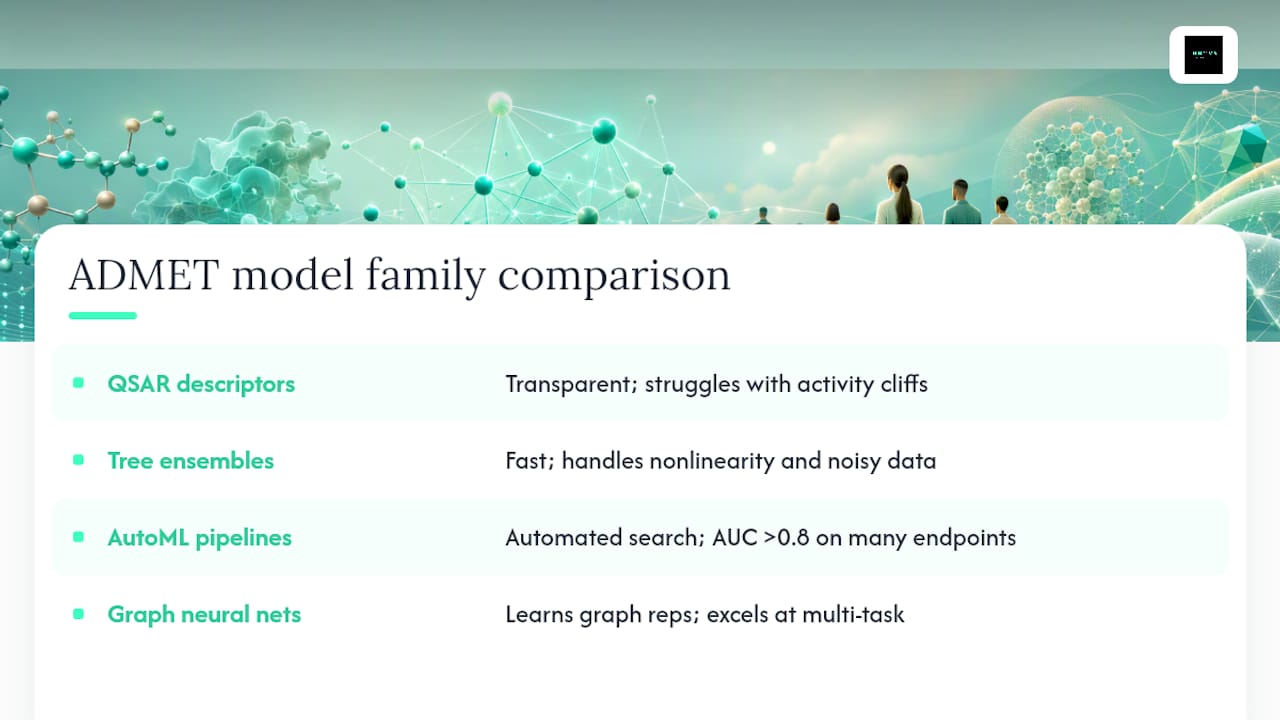
QSAR and descriptor-based models remain the oldest and, in many ways, the most interpretable approach. They compute a fixed set of molecular descriptors (LogP, polar surface area, molecular weight, hydrogen bond counts) and fit a regression or classification model on top. The appeal is transparency: a medicinal chemist can trace a prediction back to specific physicochemical drivers and propose a structural edit with confidence. The limitation is equally clear. Descriptor-based QSAR struggles with activity cliffs, where a small structural change produces a large property shift that fixed descriptors simply cannot encode. It also degrades quickly outside the chemical series it was trained on.
Tree-based ensemble learners, Random Forest, XGBoost, LightGBM, have become the default workhorse for tabular ADMET endpoints. They handle nonlinear relationships between descriptors and outcomes better than linear QSAR, tolerate noisy or missing data reasonably well, and train fast enough to iterate daily. For endpoints like plasma protein binding or basic solubility classification, a well-tuned gradient-boosted tree often performs competitively with more elaborate architectures, at a fraction of the computational cost and with far easier maintenance.
AutoML pipelines have quietly become one of the more consequential shifts in ADMET evaluation methods over the past few years. Rather than a modeling team hand-tuning hyperparameters for each endpoint separately, automated pipelines search architecture and parameter space systematically. The payoff shows up in the numbers: AutoML approaches built for eleven ADMET properties reached AUC values above 0.8 on held-out test sets, with comparable performance carrying over to external evaluation sets. That is a meaningful benchmark for endpoint-specific accuracy, and it means smaller computational teams without dedicated ML engineers can stand up defensible models faster than the manual-tuning era allowed.
Graph neural networks, particularly directed message-passing neural networks (DMPNN), represent the current frontier for complex chemotypes and multi-task prediction. Instead of computing fixed descriptors, a GNN learns its own representation of the molecular graph directly, atom by atom and bond by bond, updating that representation across multiple message-passing rounds. This matters most for multi-task setups, where a single model predicts dozens of related endpoints simultaneously and shares learned structure across them. ADMETlab 3.0 exemplifies this approach at scale: it runs a multi-task DMPNN architecture across 119 endpoints trained on more than 400,000 compound entries, with an API built for batch evaluation rather than one-molecule-at-a-time lookups. That scale of training data is what lets a multi-task model generalize across related endpoints instead of overfitting to any single one.
Uncertainty estimation is the piece that separates a genuinely useful platform from a prediction generator. Two approaches dominate current practice. Ensemble variance trains multiple model instances (different seeds, different architectures, or bootstrapped training sets) and treats disagreement among them as a proxy for confidence: tight agreement suggests the compound sits comfortably in familiar territory, wide disagreement is a signal to slow down. Evidential deep learning takes a different route, training the network to output a full probability distribution over its own prediction rather than a point estimate, which tends to scale better to large multi-task models. ADMETlab 3.0 surfaces uncertainty estimates directly alongside its endpoint predictions, which is precisely the feature that lets a team distinguish a confident call from an extrapolated guess.
Pro Tip: Never compare AUC scores across platforms without checking whether they were computed on the same test set. A model reporting AUC 0.85 on an internal holdout and one reporting AUC 0.85 on a genuinely external, structurally distinct test set are not making the same claim, even though the number looks identical.
The practical trade-off across all four families: QSAR and tree-based models are fast, cheap to retrain, and easy to explain to a chemistry review board. GNNs and multi-task DMPNNs take more compute and more data to train well, but they generalize better across related endpoints and complex scaffolds. Most serious in silico toxicity assessment pipelines now run a tiered combination: fast descriptor-based screens for the first triage pass, GNN-based multi-task models for the endpoints that matter most for go/no-go decisions.
Which ADMET Endpoints Can You Actually Act On?
Endpoint reliability in virtual ADMET screening breaks into three practical tiers, and confusing them is the single most common way teams get burned by computational predictions.
High-confidence endpoints tend to share two traits: large, well-curated public training sets and a relatively direct structure-property relationship. This tier typically includes:
- CYP450 inhibition (particularly CYP3A4, CYP2D6, CYP2C9), backed by large curated datasets and years of consistent assay methodology across pharma
- hERG channel liability, where structural motifs associated with cardiotoxic risk are well characterized and datasets are extensive
- Passive membrane permeability (Caco-2, PAMPA-correlated predictions), where physicochemical drivers are well understood and descriptor-based models perform strongly
- Aqueous solubility classification (rather than precise numerical solubility), where broad categorical calls hold up better than point predictions
Moderate-confidence endpoints include plasma protein binding, blood-brain barrier penetration, and P-glycoprotein substrate classification. These have reasonable training data but more chemotype-dependent variability, and predictions here work well for ranking analogs against each other even when the absolute value carries wider error bars.
Low-confidence endpoints cluster around idiosyncratic and mechanistically complex toxicities: idiosyncratic drug-induced liver injury, genotoxicity outside well-characterized structural alert classes, and rare hypersensitivity reactions. These endpoints suffer from sparse, noisy training data and mechanisms that often involve host factors a chemical structure alone cannot capture.
The practical rule connecting dataset size to what you can act on: endpoints with ample, curated training data such as CYP inhibition, hERG, and permeability can genuinely guide triage decisions, while sparse-data endpoints like idiosyncratic hepatotoxicity should only prioritize which compounds get confirmatory testing first. That is not a hedge, it is the operating principle. A model can be excellent at ranking twenty analogs by relative hERG risk and simultaneously unreliable at telling you whether compound number fourteen will cause idiosyncratic liver injury in one patient out of ten thousand.
Where the data backs the confidence: platforms built on genuinely large, multi-endpoint training sets, ADMETlab 3.0's 400,000-plus compound entries across 119 endpoints being the clearest current example, give teams the statistical footing to treat high-tier endpoint predictions as more than a rough guess. Smaller, single-endpoint models trained on a few thousand compounds deserve proportionally less trust, regardless of how confident the interface makes the output look.
The AUC benchmark matters here too. AutoML-built models clearing AUC above 0.8 across multiple endpoints on both internal and external test sets is a meaningful floor for "trustworthy enough to act on directly," but it is endpoint-specific performance, not a blanket certification. Check the reported AUC for the specific endpoint you care about, not the platform's average across all endpoints, before deciding how much weight the prediction deserves.
A Decision Framework for Acting on Predictions vs. Confirming In Vitro
Treating every model output the same way, whether it is a confident call on a well-covered endpoint or an extrapolated guess on a novel scaffold, is how teams either waste bench time confirming the obvious or get blindsided by a compound the model never should have been trusted on. A documented, four-step framework fixes that.
- Check chemical-space similarity and domain applicability first. Before trusting any prediction, calculate how similar the candidate is to the model's training distribution, typically via Tanimoto similarity to nearest training-set neighbors or a formal applicability domain metric. A prediction on a scaffold well inside the training distribution deserves real weight. The same prediction on a genuinely novel chemotype is, at best, a starting hypothesis.
- Inspect the model's own uncertainty alongside its benchmark metrics. A platform reporting ensemble variance or evidential confidence intervals gives you a second, independent signal beyond the point prediction itself. Cross-reference that against the endpoint's published benchmark performance (AUC, accuracy, external test-set validation) rather than the platform's marketing claim of overall accuracy.
- Map the endpoint to its reliability tier and let that tier dictate the action. High-tier endpoints with tight uncertainty bounds can justify skipping a confirmatory assay on that specific compound, at least in early triage. Moderate-tier endpoints should prioritize which compounds get tested next rather than replace the assay. Low-tier endpoints should never be the sole basis for advancing or killing a compound.
- Document everything before the decision leaves the modeling team's hands. Record the model version, the training-set composition and descriptor set used, the specific uncertainty value returned, and the applicability domain assessment. This isn't paperwork for its own sake, it's the difference between a chemistry team that can act on a recommendation with confidence and one that has to re-derive your reasoning from scratch six months later when the compound resurfaces in a different program.
Pro Tip: Build a one-page handoff template that travels with every prioritized compound list: endpoint predictions, confidence tier, applicability domain flag, and a plain-language recommendation (skip assay, prioritize assay, confirm before any further work). Chemistry and screening teams that receive raw model output without that translation layer routinely either over-trust or ignore it entirely, and both failure modes cost time.
This structured approach echoes what practitioners in the field increasingly recommend: a documented framework capturing domain applicability, uncertainty thresholds, and validation artifacts consistently outperforms ad hoc trust in whatever number the model returns. The handoff artifact matters as much as the prediction itself. A ranked list of compounds with no accompanying confidence context forces the receiving team to either blindly trust or blindly ignore the modeling work, neither of which reflects what the model actually knows.

Where this framework saves the most real time is at the boundary between moderate and low confidence tiers, exactly where teams are most tempted to either over-trust a slick-looking dashboard or dismiss computational predictions entirely after one bad extrapolation. A documented threshold removes that argument from every project meeting.
Validation Standards and Regulatory Context for In Silico Results
Regulators have moved from skeptical bystanders to active participants in model-informed drug development. Editorial and regulatory analyses now document sustained FDA interest in modeling and simulation, including pilot programs where model-derived evidence has supported trial design decisions and, in select cases, labeling discussions. The FDA's Center for Drug Evaluation and Research maintains active guidance on artificial intelligence in drug development, reflecting how central computational methods have become to the broader regulatory conversation, not just ADMET specifically.
Mechanistic, cell-level simulation is one area where this regulatory attention is concentrated. The Virtual Assay framework, which models calibrated populations of cardiac cells to predict pro-arrhythmic cardiotoxicity, has in select comparative studies outperformed traditional animal models for that specific endpoint. That is a meaningfully different claim than "in silico ADMET is more accurate than in vitro assays" generally, and the distinction matters. Mechanistic population simulations earn regulatory attention precisely because they model biology explicitly rather than learning a statistical correlation, and that mechanistic grounding is easier to defend in a submission than a black-box classifier's output.
Building a defensible validation package for any in silico ADMET result rests on a short set of non-negotiables:
- External test-set validation, performance reported on compounds genuinely outside the training distribution, not a held-out split of the same chemical series
- Prospective validation, where feasible, comparing model predictions made before synthesis against actual assay results once compounds are made
- Calibration reporting, confirming that a model's stated 80% confidence predictions are actually correct roughly 80% of the time, not just discriminating well between classes
- Uncertainty disclosure, reporting confidence intervals or ensemble variance alongside every point prediction, not as an optional footnote
- Training-set transparency, documenting dataset size, source, and chemical-space coverage so a reviewer can judge applicability domain independently
A weight-of-evidence submission combining these elements, computational predictions with disclosed uncertainty, targeted confirmatory in vitro results on the compounds the model flagged as uncertain, and where relevant a mechanistic simulation for a specific endpoint like cardiotoxicity, reads to a regulatory reviewer as considered risk assessment. A spreadsheet of unqualified model scores does not carry the same weight, no matter how good the underlying algorithm actually is.
How Expert Interpretation Turns Predictions Into Chemistry Decisions
A model output is a starting hypothesis, not a finished decision. That gap, between what a DMPNN or AutoML pipeline returns and what a medicinal chemist can actually act on, is where a specialist bioinformatics partner earns its place in the workflow.
A specialized bioinformatics partner works with biotechnology and pharmaceutical R&D teams on tailored bioinformatics services and advanced computational solutions built around the specific chemistry and biology of each project, rather than a one-size-fits-all pipeline. Services can span virtual screening, high-throughput drug discovery support, hit-to-lead optimization, protein engineering, enzyme optimization, and de novo peptide design, each configured to the particular constraints of the compound class and target under investigation.
That range matters specifically at the ADMET interpretation stage:
- Translating a flagged CYP inhibition liability into a concrete list of testable structural edits, rather than leaving the chemistry team with a probability score and no direction
- Cross-referencing model uncertainty against chemical-space coverage before recommending which compounds to advance versus confirm
- Reducing false-positive assay commitments by filtering low-confidence flags before they consume screening capacity
- Building prioritized synthesis lists that combine ADMET predictions with structural and target-engagement context from parallel structure-based screening work
The value of that interpretation layer scales with project complexity. A single-endpoint solubility flag on a well-characterized scaffold barely needs expert review. A multi-endpoint red flag on a novel chemotype sitting at the edge of a model's training distribution is exactly the situation where a bioinformatics specialist earns their role, distinguishing a genuine liability from a model extrapolating past what it actually knows.
Where In Silico ADMET Adoption Is Headed Next
Mechanistic simulation is the frontier worth watching. Digital twins and population-level models, extending the logic behind cardiac cell simulations like Virtual Assay into other organ systems, will expand what safety prediction can cover beyond today's largely statistical, correlation-based models. That shift will not happen through better algorithms alone.
The real bottleneck is curated, in-domain data. A DMPNN trained on 400,000 diverse compounds still says little about a genuinely novel chemotype nobody has synthesized yet. Teams that invest in building their own well-annotated, project-specific training sets, alongside a documented decision framework rather than an ad hoc trust-the-dashboard habit, will get more out of every model release than teams chasing whichever platform claims the highest average AUC. Embedding a formal model-review checkpoint into project stage gates, not a one-time validation exercise, is the organizational change that actually locks in the benefit.
— Hooman
Operationalizing Predictions Into Synthesis Lists
Innovabiotech turns a ranked list of ADMET predictions into something a chemistry team can execute on the same week, not a data export that sits unread. Where a generic platform hands back a score, the engagement pairs that score with structural interpretation, applicability-domain review, and a prioritized synthesis list built around your project's specific chemistry.
A typical engagement starts with a scoping call to define endpoints and chemical space, moves into virtual screening or hit-to-lead optimization against your target, and delivers a documented set of prioritized compounds with confidence context attached, under a confidential project agreement from the first conversation onward. For teams working on complex peptide or protein-based candidates where standard ADMET pipelines fall short, the peptide design and optimization services page outlines how that translation from prediction to synthesized lead actually happens. If your current pipeline is generating more flagged compounds than your team can confidently interpret, reach out to start a project consultation.
FAQ
What Does "In Silico" Mean?
"In silico" describes experiments or predictions performed by computer simulation rather than in a physical laboratory (in vitro) or a living organism (in vivo), literally referring to computation run on silicon-based chips.
What Is an ADMET Analysis?
An ADMET analysis evaluates a compound's absorption, distribution, metabolism, excretion, and toxicity properties, either through physical assays or, in the case of admet in silico methods, through computational models trained on structure-property relationships.
What Is the Difference Between ADMET and DMPK?
ADMET and DMPK (drug metabolism and pharmacokinetics) overlap substantially, but DMPK traditionally emphasizes the quantitative pharmacokinetic modeling side (absorption rates, clearance, half-life), while ADMET is the broader term that also folds in toxicity endpoints.
What Does ADMET Stand For?
ADMET stands for absorption, distribution, metabolism, excretion, and toxicity, the five pharmacokinetic and safety properties that determine whether a compound behaves like a viable drug in the body.
How Accurate Are In Silico ADMET Predictions Compared to Lab Assays?
Accuracy depends heavily on the endpoint and available training data: high-data endpoints like CYP inhibition and hERG liability can approach benchmark AUC scores above 0.8 in external validation, while sparse-data toxicity endpoints remain far less reliable and should only guide which compounds get tested first, not replace the assay outright.