

TL;DR:
- In silico screening uses computational methods to identify potential drug candidates from large molecular libraries without laboratory experiments. It enables rapid, large-scale filtering which improves hit quality and accelerates drug discovery processes. Proper validation and realistic expectations are essential to ensure these virtual methods translate into successful experimental outcomes.
In silico screening services are computational methods that identify potential drug candidates from large molecular libraries without a single wet-lab experiment. The term "in silico" is the recognized industry label for this class of work, though researchers also encounter it under the broader umbrella of computer-aided drug screening and virtual screening services. These services use molecular docking, pharmacophore modeling, and AI-powered scoring to rank compounds by their likelihood of binding a target protein. Screening can cover libraries ranging from millions to trillions of compounds, a scale no experimental assay can match. That throughput makes virtual screening the first filter in most modern drug discovery programs, and it is why biotech and pharma teams increasingly treat it as a core capability rather than an optional add-on.
What are in silico screening services and how do they work?
In silico screening services apply computational algorithms to predict which molecules in a compound library will bind a biological target with sufficient affinity and selectivity. The two dominant paradigms are structure-based virtual screening, which uses a known 3D protein structure to simulate binding, and ligand-based screening, which infers binding rules from known active compounds when no structure is available.

Molecular docking is the workhorse of structure-based approaches. The algorithm places candidate molecules into the target's binding site, scores each pose for geometric and energetic fit, and ranks the full library accordingly. Pharmacophore modeling complements docking by encoding the spatial arrangement of chemical features required for activity, then filtering the library before docking to reduce computational load.
AI-driven platforms are evolving toward single-click interfaces that run these workflows without requiring coding skills. That shift matters because it lowers the barrier for research teams without dedicated computational staff, while preserving the scientific rigor that experienced groups expect. The result is faster hypothesis testing at the hit identification stage.
Key computational approaches powering modern virtual screening
The field draws on several well-established methods, each suited to a different discovery scenario.
- Structure-based molecular docking: Places compounds into a target binding site and scores binding poses. Works best when a high-resolution crystal or cryo-EM structure is available.
- Ligand-based pharmacophore modeling: Builds a 3D feature map from known actives. Effective for targets with no published structure.
- QSAR modeling: Quantitative structure-activity relationship models correlate molecular descriptors with measured activity, enabling rapid property prediction across large sets.
- Homology modeling: Builds a target structure from a related protein when experimental structures are absent, enabling structure-based methods on otherwise inaccessible targets.
- Machine learning scoring functions: Replace or supplement classical force-field scoring with models trained on large binding affinity datasets, improving ranking accuracy on diverse chemotypes.
- Multi-objective AI optimization: Integrates de novo molecule generation, virtual screening, and ADMET prediction to simultaneously improve potency, selectivity, and pharmacokinetic properties in a single workflow.
Speed is a genuine differentiator among platforms. PyRMD Studio achieved a 3.3-fold increase in virtual screening speed through vectorization and code optimization in its may 2026 update. That gain means a campaign that previously took a week of compute time now completes in roughly two days, which changes how teams plan their hit identification cycles.
Validation is where many services fall short. Rigorous validation using Butina clustering separates training and test compounds by chemical scaffold, preventing data leakage that inflates model performance metrics. Without this step, a machine learning scoring function can appear highly accurate in benchmarks while failing on genuinely novel chemotypes in prospective screening.
Pro Tip: When evaluating a virtual screening provider, ask specifically whether their ML models were validated on chemically distinct scaffolds using cluster-based splitting. A provider that cannot answer this question clearly has likely not addressed data leakage.
What does a professional in silico screening project look like?
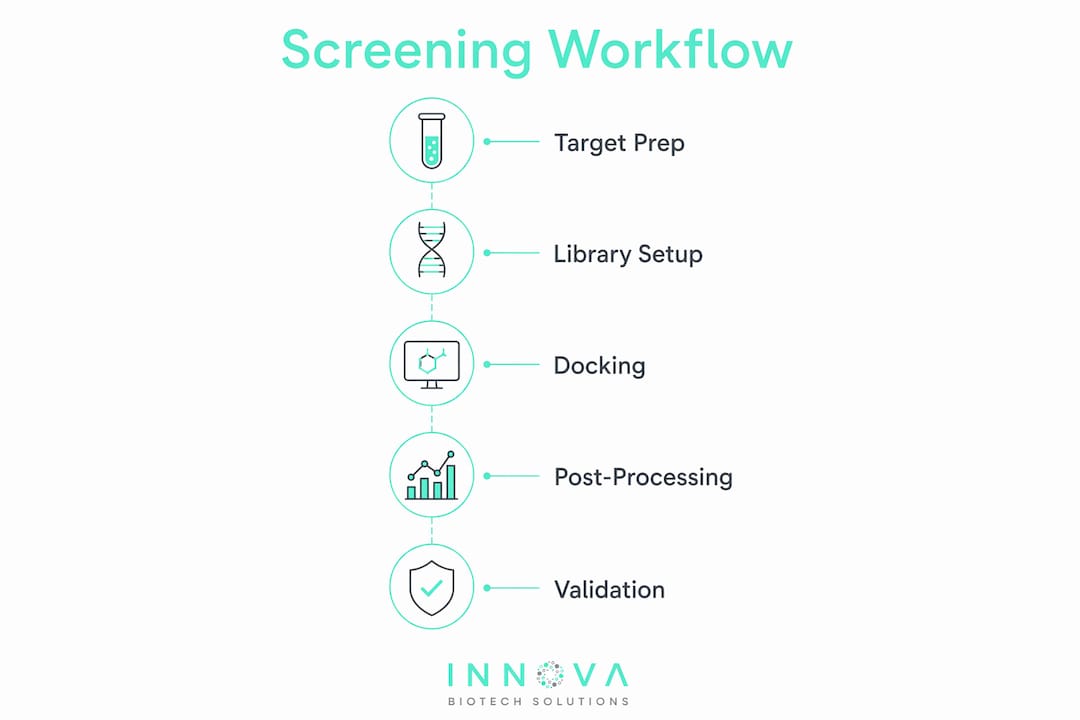
Professional drug design outsourcing follows a five-step lifecycle: requirement gathering, proposal, execution, reporting, and post-project support. Understanding each phase helps researchers set realistic expectations and avoid common miscommunications.
- Requirement gathering: The team defines the target, provides structural data or sequence information, specifies the compound library, and states the discovery goal, whether hit identification, lead optimization, or selectivity profiling.
- Proposal and project planning: The service provider returns a detailed plan covering methods, timelines, deliverable formats, and validation strategy. This is the stage to negotiate transparency around scoring functions and benchmark results.
- Execution: The provider runs the virtual screening workflow, including docking, pharmacophore filtering, AI rescoring, and clustering of top hits to maximize chemical diversity in the final hit list.
- Reporting: Deliverables include ranked hit lists, binding pose visualizations, interaction analyses (hydrogen bonds, hydrophobic contacts, key residue interactions), and ADMET property predictions.
- Post-project support: Quality providers offer regulatory documentation, optimization strategies for advancing hits to leads, and guidance on which experimental assays to run first.
The table below summarizes what researchers should expect at each stage.
| Project stage | Key deliverable | What to verify |
|---|---|---|
| Requirement gathering | Target brief and library specification | Completeness of structural data provided |
| Proposal | Methods plan with validation strategy | Scaffold-diverse validation described |
| Execution | Docking runs, AI rescoring, clustering | Computational efficiency and reproducibility |
| Reporting | Hit list, poses, ADMET predictions | Interaction analysis depth and visualization quality |
| Post-project support | Optimization roadmap, regulatory docs | Clarity of next experimental steps |
Comprehensive outsourced services also include homology modeling, molecular dynamics simulations, and data visualization, which extend the value of a single engagement well beyond a ranked compound list.
How does virtual screening benefit drug discovery programs?
Computer-aided drug screening compresses the hit identification timeline from months to weeks. A team that would otherwise run a high-throughput experimental screen against 500,000 compounds can instead use virtual screening to pre-filter a library of hundreds of millions, then send only the top-ranked 1,000 compounds to the assay. That reduction in experimental volume cuts reagent costs and frees assay capacity for more targeted work.
Hit quality improves when AI rescoring is applied after initial docking. Classical docking scoring functions produce a meaningful false positive rate because they approximate binding energy rather than measuring it directly. Reducing false positives through machine learning rescoring and pharmacophore filters raises the experimental confirmation rate of computational hits, which is the metric that ultimately determines whether a virtual screening campaign saves or wastes resources.
The applications extend across target classes. Peptide-based therapeutics, antibody design, and complex allosteric targets all benefit from computational peptide screening workflows that would be impractical to run experimentally at scale. Cancer programs targeting difficult proteins like mutant KRAS or protein-protein interaction interfaces have used virtual screening to identify starting points that classical experimental HTS missed entirely.
"AI-assisted molecular design workflows that integrate de novo generation, virtual screening, and multi-objective optimization can identify potent, selective candidates with favorable ADMET profiles in a single computational campaign, compressing what once required multiple sequential experimental cycles into a unified in silico process."
The practical implication is that drug discovery simulation is no longer a preliminary filter. For programs with well-characterized targets, it is the primary hit identification strategy, with experimental assays serving as confirmation rather than discovery.
What are the limitations of in silico screening services?
The most serious limitation is model overfitting masked by inadequate validation. Machine learning models require scaffold-diverse validation to demonstrate that their performance generalizes beyond the training set. When providers use random splitting to create training and test sets, structurally similar compounds appear in both sets, and the model's benchmark accuracy overstates its real-world performance.
Data leakage is a related problem. Improper train/test splitting inflates AI model performance, sometimes dramatically. A model that reports strong enrichment in internal benchmarks may perform no better than random docking on a genuinely novel scaffold. Researchers should request enrichment factor data calculated on scaffold-separated test sets before trusting any AI-based scoring function.
Prospective evaluation remains a bottleneck across the field. Most published virtual screening methods report retrospective performance on known datasets. Prospective validation, where the model predicts hits that are then tested experimentally, is far less common and far more informative. Providers who can point to prospective case studies with confirmed experimental hits offer substantially stronger evidence of real-world utility.
Computational efficiency also varies widely. Vectorization and GPU parallelism have substantially reduced runtimes for ultra-large library screening, but not all platforms have implemented these advances. A provider running older serial code on a library of one billion compounds will deliver results on a timeline that undermines the speed advantage virtual screening is supposed to provide.
Pro Tip: Request a benchmark report from any prospective provider that shows enrichment factors calculated on a scaffold-clustered test set, not a randomly split one. This single document reveals more about scientific rigor than any marketing description.
Key Takeaways
In silico screening services deliver the greatest value when rigorous validation, scaffold-diverse benchmarking, and multi-objective AI optimization are combined in a single, well-managed workflow.
| Point | Details |
|---|---|
| Scale advantage | Virtual screening covers libraries from millions to trillions of compounds, far beyond experimental capacity. |
| Validation is critical | Butina clustering-based validation prevents data leakage that inflates AI model performance metrics. |
| Speed gains are real | PyRMD Studio's 3.3-fold speed increase shows that vectorization meaningfully compresses campaign timelines. |
| Five-stage workflow | Professional projects follow requirement gathering, proposal, execution, reporting, and post-project support. |
| Hit quality over hit count | AI rescoring and pharmacophore filtering raise experimental confirmation rates, which is the true ROI metric. |
Why I think researchers underestimate the validation problem
Most researchers I work with come to virtual screening with a reasonable question: which platform gives the best results? The answer they expect is a ranked list of tools. The answer that actually matters is: which provider validates their models correctly?
The field has a publication bias toward retrospective benchmarks. Papers report enrichment factors on known datasets because those datasets exist and are easy to use. Prospective validation requires running an experiment, waiting for results, and then publishing whether the model worked. That process is slow, expensive, and sometimes unflattering. So most providers never do it.
AI-driven platforms are moving toward graphical, user-friendly interfaces that make complex workflows accessible to non-expert users. That accessibility is genuinely valuable. But it also means researchers with less computational background may not know to ask the hard validation questions. The interface looks polished, the benchmark numbers look strong, and the campaign gets approved without anyone checking whether the training and test sets were properly separated.
My practical advice: treat virtual screening as a hypothesis generator, not a hit list. The compounds it surfaces are candidates for experimental testing, not confirmed actives. Teams that internalize this framing use the technology well. Teams that expect the ranked list to be correct are consistently disappointed.
The future of this field is genuinely exciting. Multi-objective optimization that simultaneously addresses potency, selectivity, and ADMET in a single computational pass is already working in well-resourced programs. As these methods become standard, the gap between computational prediction and experimental confirmation will narrow. But that future depends on the field getting validation right first.
— Hooman
Innovabiotech's computational drug discovery services
Innovabiotech provides virtual screening services built around AI-powered workflows, molecular docking, and multi-objective lead optimization for biotech and pharma research teams. Every project begins with a detailed consultation to align the computational strategy with your target biology, compound library, and regulatory requirements.
The team at Innovabiotech covers the full spectrum from protein and chimeric design to peptide optimization and de novo molecule generation. Projects are managed with full transparency at every stage, including validation documentation and interaction analysis reports. Contact Innovabiotech to discuss a customized screening workflow for your program.
FAQ
What is in silico screening in drug discovery?
In silico screening is a computational method that ranks compounds from a molecular library by their predicted ability to bind a target protein. It uses techniques like molecular docking, pharmacophore modeling, and machine learning scoring to prioritize candidates before experimental testing.
How does molecular docking differ from pharmacophore screening?
Molecular docking places each compound into a target binding site and scores the geometric and energetic fit of each pose. Pharmacophore screening filters compounds by whether they match a spatial pattern of chemical features required for activity, and it works even when no 3D target structure is available.
Why does data leakage matter in AI-based virtual screening?
Data leakage from improper train/test splitting inflates model performance metrics, making a scoring function appear more accurate than it is on novel compounds. Cluster-based validation using methods like Butina clustering prevents this by separating structurally similar compounds into the same split.
What compound library sizes can virtual screening handle?
Virtual screening can process libraries ranging from millions to trillions of compounds, far exceeding the throughput of experimental high-throughput screening. Recent vectorization advances have further reduced the compute time required for ultra-large library campaigns.
How do I evaluate the quality of an in silico screening service provider?
Ask for enrichment factor data calculated on a scaffold-clustered test set, not a randomly split one. Also request at least one prospective case study showing that computational hits were confirmed in experimental assays after the model made its predictions.