
Conformer generation produces diverse, low-energy 3D arrangements of a molecule, and for most screening pipelines the practical move is straightforward: generate an ensemble of roughly 10 low-energy conformers, deduplicate by RMSD, validate against known structures, and pass that set into docking or property prediction. Machine learning models like ConfFlow now generate these ensembles faster than classical methods, but every output still needs a chemical-sanity check before it touches a production pipeline.
TL;DR:
- Machine learning conformer generators like ConfFlow can produce diverse ensembles faster than classical methods, but require validation checks before use.
- The bioactive conformer often differs from the global energy minimum because binding pockets impose geometric constraints that may incur small energetic penalties.
- The most common conformer generation approach is distance geometry with force-field refinement, suitable for large libraries in virtual screening.
- For flexible molecules or macrocycles, larger conformer sets (50 to 200) are necessary, along with specialized methods for ring closure and constraints.
- Validating conformers involves stereochemistry, plausible bond geometries, and clash checks, crucial to avoid erroneous geometries influencing downstream docking results.
Table of Contents
- What Is Conformer Generation and Why the Bioactive Conformer Matters
- Core Algorithm Families for Generating Molecular Conformers
- A Practical Conformer Generation Workflow You Can Copy
- Which Tools Actually Implement These Methods?
- How Do You Benchmark a Conformer Generator?
- How Innovabiotech Applies These Methods in Real Projects
- Where This Is Headed for R&D Teams in 2026
- Getting Production-Grade Conformer Pipelines Built for Your Screening Campaign
- Sources
- FAQ
What Is Conformer Generation and Why the Bioactive Conformer Matters
A conformer is one spatial arrangement of a molecule reached by rotating around single bonds, without breaking any. The IUPAC Gold Book defines conformational analysis as the systematic exploration of these energetically favorable arrangements using molecular mechanics, molecular dynamics, quantum chemical calculations, or experimental structural data such as NMR and crystallography. That definition matters because it names four distinct evidence sources, not one, and a serious conformer generation workflow usually draws on more than a single method to cross-check results.
Picture the potential energy surface as a mountain range instead of a single valley. Every twist of a rotatable bond changes the molecule's energy, and the surface is riddled with local minima, which are geometries where any small nudge raises the energy back up. Only one of those minima is the global minimum, the single lowest-energy point on the whole surface. Britannica's explanation of molecular conformation notes that conformers sit at different energy levels and that crossing from one to another requires enough energy to clear the barrier between them. That barrier is why a molecule doesn't just collapse into its most stable shape and stay there. It samples a population of conformers at any given temperature.
Here is the detail that trips up newcomers to structure-based drug design: the bioactive conformer, the shape a ligand adopts when bound to its target, frequently is not the global energy minimum in isolation. Protein binding pockets impose their own geometric demands, and a molecule will often pay a small energy penalty to twist into a shape the pocket favors.
- The global minimum reflects the molecule's lowest-energy state in isolation, typically in vacuum or implicit solvent.
- The bioactive conformer reflects the lowest-energy state once binding-pocket interactions are factored in, and it can sit several kilocalories above the global minimum.
- Docking programs that only search near the global minimum risk missing the true binding geometry entirely.
- Generating a broad ensemble, not just the single "best" structure, is what protects a virtual screening campaign from this trap.
That single fact is why conformer generation is treated as an ensemble problem, not a single-answer problem, throughout drug discovery pipelines.
Core Algorithm Families for Generating Molecular Conformers
Five broad families dominate conformer generation, and each samples 3D space differently enough that picking the wrong one for your molecule class costs real compute time and, worse, real accuracy.
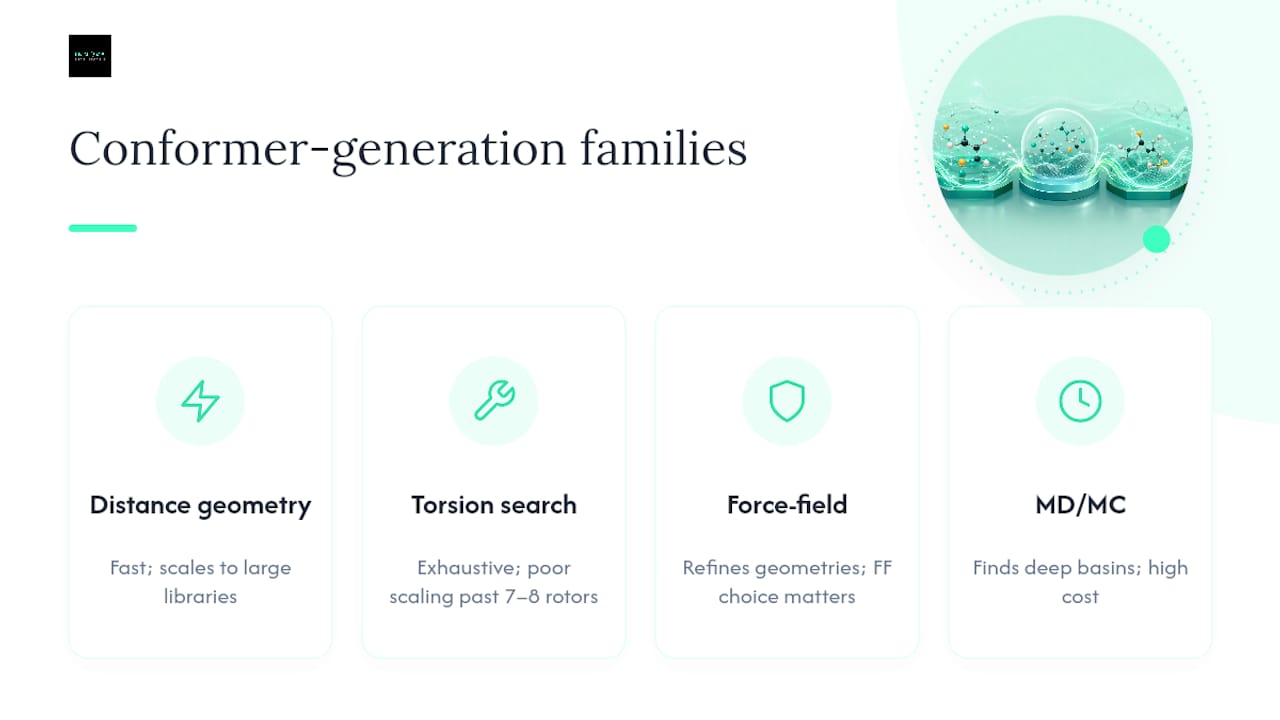
Distance geometry is the workhorse behind most default conformer generators. It starts with a set of interatomic distance constraints, derived from bond lengths, bond angles, and known chemical rules, then embeds those constraints into 3D coordinates using matrix algebra. The embedded structure usually needs refinement afterward, typically a short force-field minimization, because raw distance-geometry embeddings can produce slightly strained geometries. This approach is fast, scales to large libraries, and forms the backbone of tools like RDKit's conformer generator.
Systematic torsion driving and stochastic search take a more exhaustive approach. Systematic methods rotate every flexible torsion through a grid of angles and evaluate the resulting energy at each step, which guarantees thorough coverage but scales poorly once a molecule has more than seven or eight rotatable bonds, since the combinatorics explode. Stochastic and random search methods instead perturb the structure randomly and accept or reject based on energy, trading completeness for speed. Neither approach is obsolete. Systematic search still earns its place for small, rigid fragments where exhaustive coverage is affordable.
Force-field minimization refines whatever raw geometry comes out of distance geometry or search. MMFF94, GAFF, and OPLS are the three parameter sets you'll see most often, and the choice matters more than most people assume. MMFF was built and validated primarily on drug-like organic molecules, GAFF extends more naturally to a wider range of small-molecule chemotypes used in general simulation, and OPLS was developed with condensed-phase and solvation behavior in mind. If your molecule contains an unusual functional group, an exotic heterocycle, or a metal center, the default parameters may simply not cover it, and reparametrization or a specialized force field becomes necessary before minimization results mean anything.
Molecular dynamics and Monte Carlo sampling explore the energy landscape by simulating the molecule's motion over time, or by making random moves accepted according to a probability tied to their energy change. Both are the right tool when you need to find deep free-energy basins that a static minimization would never reach, particularly for flexible molecules where a single geometry optimization gets stuck near its starting point. The tradeoff is cost: MD and MC runs take meaningfully longer per molecule than distance-geometry embedding, which limits their use to smaller libraries or later-stage lead candidates rather than initial virtual screening.
Generative ML models are the newest family, and they work on a fundamentally different principle: instead of applying physical rules step by step, they learn a distribution over plausible 3D structures directly from training data and sample from it. ConfFlow, a transformer and flow-based model, samples atomic coordinates directly and reports significant improvement over some prior learning-based benchmarks on large-molecule datasets, with substantial speed gains over classical pipelines. Molecular Conformer Fields takes a related but distinct approach, modeling conformers as continuous fields and using diffusion generative modeling to learn distributions over those fields without explicit torsion parametrization at all. Both represent a real conceptual break from earlier methods.
The catch is that neither ConfFlow nor MCF-style diffusion models explicitly enforce physical constraints during generation, so they can occasionally produce geometries that are statistically plausible but chemically wrong, an impossible bond angle, a stereocenter flip, a clash. That gap is the entire reason validation has become its own step in the pipeline rather than an afterthought.
Pro Tip: Don't treat generative ML conformer output as final. Run a fast MM minimization and a stereochemistry check on every ML-generated conformer before it enters your ensemble. The speed gain from these models is only worth it if you don't have to manually clean up broken geometries downstream.
A Practical Conformer Generation Workflow You Can Copy
A reproducible pipeline has three phases: preprocess the input, sample conformers with the right parameters, and post-process the raw ensemble into something you'd trust for docking. Here's how each phase should actually run.
- Standardize the SMILES string first. Inconsistent input representations are a quiet source of failed generation, so normalize charges, aromaticity, and bond notation before anything else touches the molecule.
- Enumerate stereoisomers and tautomers explicitly. If your input doesn't specify stereochemistry at every center, generating conformers for an ambiguous structure means you're sampling a mix of molecules, not one. Same logic applies to tautomers: pick the dominant form or enumerate the plausible set rather than guessing.
- Handle protonation states at physiological pH. A carboxylic acid or amine that's drawn neutral but should be charged at pH 7.4 will generate a geometrically valid but chemically irrelevant conformer. Run pKa prediction and assign protonation states before sampling.
- Add explicit hydrogens. Most conformer generators need them for accurate geometry, and skipping this step is a common source of silently wrong output.
- Set your conformer count based on flexibility, not habit. For rigid or moderately flexible drug-like molecules in a screening context, generating around 10 low-energy conformers per molecule is a common practitioner default. Flexible molecules with many rotatable bonds, or macrocycles, need considerably more, often in the 50 to 200 range, to adequately cover the accessible conformational space.
- Batch and parallelize for large libraries. GPU-accelerated generation, particularly for ML-based methods, changes the economics of screening a million-compound library, but batch size has to respect available memory: oversized batches on shared GPU infrastructure tend to crash before they finish, not just run slow.
- Filter by energy window relative to the lowest-energy conformer found. A conformer sitting 15 kcal/mol above your ensemble's minimum almost never contributes anything useful downstream. A common working window is a few kcal/mol above the lowest-energy structure, tightened or loosened depending on how much you trust the underlying force field.
- Deduplicate using RMSD thresholds. Raw sampling routines generate near-identical structures constantly. Pairwise RMSD comparison, with a threshold typically in the range of 0.5 to 1.0 angstrom for heavy atoms, collapses redundant geometries so you're not paying compute costs twice for the same shape.
- Cluster and prune what's left. Clustering groups conformers into structurally distinct families, then you can retain a representative from each cluster rather than every survivor of the energy filter. A big, unpruned ensemble adds downstream compute without improving how often you recover the correct binding pose, so pruning isn't optional cleanup, it's part of what makes the ensemble useful.
- Handle macrocycles and heavily constrained molecules separately. Standard distance-geometry embedding frequently fails or produces strained rings for macrocycles. Constraint-guided generation, repulsion terms that push atoms apart during embedding, or Monte Carlo-based ring closure searches tend to work where default settings don't.
- Run a final minimization pass before docking. Even a validated ensemble benefits from one more short force-field minimization immediately before it enters a docking or scoring pipeline, since small numerical drift can accumulate through the preceding steps.
- Pass the finished ensemble to downstream tools with its metadata intact. Whatever conformers survive should carry their relative energies forward. Docking and rescoring both benefit from knowing which conformer in the ensemble was actually the lowest-energy candidate before it went into the binding-pocket search, a step covered in more depth in guidance on building protein-ligand docking models.
Pro Tip: If your hit rate in downstream docking is consistently low despite a clean ensemble, check your energy window before blaming the scoring function. A window that's too tight can silently exclude the bioactive conformer, since it's rarely the absolute lowest-energy structure in isolation.
Which Tools Actually Implement These Methods?
Choosing an implementation means choosing a category first, and the category tells you most of what you need to know about speed, licensing, and validation maturity.
- Distance-geometry libraries dominate everyday screening work because they're fast enough for million-compound libraries and mature enough to trust without heavy babysitting. RDKit's built-in conformer generator is the most widely used open-source example in this category.
- Force-field minimizers rarely stand alone. MMFF94, GAFF, and OPLS implementations typically sit downstream of a distance-geometry or search step, refining raw geometries rather than generating them from scratch.
- Experimental-data-informed generators take a different philosophy entirely. The CSD Conformer Generator draws on crystallographic statistics from the Cambridge Structural Database to inform plausible conformer generation, which produces geometries that align closely with observed crystal structures for molecules resembling those already in the database. That strength is also its boundary: coverage thins out for chemotypes that are underrepresented in crystallographic records.
- Algorithm-focused pipelines with published benchmarking, like CONFORGE, sit in a category worth trusting specifically because their performance claims, including retrieval of bioactive ligand conformations, have been documented in peer-reviewed analysis rather than marketing copy.
- MD and Monte Carlo tools are the right choice when a project needs deep conformational sampling for a small number of high-value molecules, not a screening library. They're computationally heavier and typically reserved for lead optimization stages.
- ML generative codebases, including ConfFlow and Molecular Conformer Fields, are best treated as research code you prototype with and validate hard, not something you drop into a regulated pipeline unchecked on day one.
CPU-based distance geometry and force-field minimization remain perfectly adequate for most virtual screening throughput needs. GPU acceleration earns its complexity mainly with ML-based generation and with MD sampling, where the underlying math parallelizes well. Memory constraints show up fastest when batching large flexible molecules on shared GPU infrastructure, so test your batch size on a representative subset before committing an entire library run.
Validating any implementation's chemical sanity comes down to three checks that take minutes to run and save days downstream: confirm stereocenters match the intended input, filter out bond lengths and angles that fall outside plausible physical ranges, and screen for atomic clashes within the generated structure. Any generator, classical or ML, can occasionally fail one of these checks, and skipping the check is how bad geometries end up scoring well in downstream docking for entirely wrong reasons.
How Do You Benchmark a Conformer Generator?
Three metrics dominate serious benchmarking work: RMSD, coverage (COV), and matching (MAT). RMSD measures the geometric distance between a generated conformer and a reference structure, usually from crystallography or NMR. Coverage asks what fraction of reference conformers in a test set were successfully matched by at least one generated conformer within a given RMSD threshold. MAT reports the average RMSD between each reference conformer and its closest generated match, which captures precision in a way coverage alone doesn't.
None of those numbers mean much without honest benchmark design. Build your test set from crystallographic or NMR databases with known experimental structures, and always include a control comparison against a simple baseline, because a generator that only looks good against a weak baseline is not the generator you want in production.
Published algorithm papers routinely report generator performance in terms of coverage and matching accuracy against reference conformer sets, framing benchmarking as core evidence rather than a footnote. CONFORGE's documented benchmarking evaluates exactly this: retrieval of bioactive ligand conformations across curated datasets.
Two pitfalls recur across published and internal benchmarks alike. Overfitting to a training set is the first: a generative model tuned heavily on one chemical series can look excellent on that series and mediocre everywhere else, so cross-validation across chemically diverse scaffolds matters more than a single impressive headline number. Ignoring stereochemistry mismatches is the second, and it's sneakier, since a generated conformer can score a low RMSD against a reference structure while actually representing the wrong stereoisomer if the comparison metric doesn't check chirality explicitly.
- Report sample size and the source of your reference structures.
- Report hardware details, since generation time claims are meaningless without knowing the compute they ran on.
- Report the exact parameter settings used, energy windows, RMSD thresholds, conformer counts, so another team can reproduce your numbers rather than trust them on faith.
How Innovabiotech Applies These Methods in Real Projects
Conformer generation is often built into the front end of virtual screening and hit-to-lead work, not as an isolated exercise but as a critical step that determines whether downstream processes are worth trusting. A production pipeline typically runs preprocessing (stereoisomer enumeration, protonation assignment), ensemble generation sized to each molecule's flexibility, and validation through energy filtering, deduplication, and stereochemistry checks before any structure reaches a docking calculation. That same discipline carries into protein and peptide design projects, where conformational flexibility of a target or a designed peptide directly shapes predicted binding behavior, a connection explored further in guidance on peptide binding affinity prediction. The goal in every engagement is the same: an ensemble a screening or design team can actually act on, not just a folder of generated coordinates.
— Hooman
Where This Is Headed for R&D Teams in 2026
Generative ML models are worth piloting now, not because they're mature enough to run unsupervised, but because the speed gains on large libraries are too large to ignore for long. Pilot them on a chemically diverse subset before touching a production library.
Minimum validation before production use: stereochemistry checks, bond-geometry sanity filters, and a comparison against a classical method on the same molecules. Build a three-item checklist before you commit: a representative pilot dataset spanning your real chemical space, explicit coverage and RMSD targets tied to your project's actual accuracy needs, and defined failure-mode tests for macrocycles and highly flexible structures specifically, since those are where generative models are least tested.
Getting Production-Grade Conformer Pipelines Built for Your Screening Campaign
Running conformer generation correctly at scale, with the right preprocessing, sampling defaults, and validation checks for your specific chemical library, takes more setup than most internal teams have bandwidth for between other priorities. Innovabiotech's virtual screening and hit-to-lead services build that pipeline for you, tuned to your molecule classes rather than a generic default.

A first engagement typically starts with scoping: what your chemical library looks like, what target you're screening against, and where your current pipeline is losing time or accuracy. A typical approach includes running a pilot on a representative subset, benchmarking conformer quality against known structures before scaling to the full compound library. Projects that need conformer-aware modeling beyond small molecules, flexible peptides or engineered proteins, can also draw on Innovabiotech's protein engineering and design services within the same engagement. If your screening campaign is stalling on conformer quality rather than target biology, reach out to scope a pilot and get a concrete deliverable timeline before committing to a full project.
Sources
For readers who want to go straight to the primary sources behind the methods discussed above:
- IUPAC Gold Book — conformational analysis (CT06956)
- ConfFlow: Conformation generation using transformer flows (arXiv)
- High-Quality Conformer Generation with CONFORGE (PMC article)
- CSD Conformer Generator (CCDC)
FAQ
What Are the Two Main Types of Conformers?
Conformers are generally grouped by the rotational geometry they adopt around a bond, most commonly described as staggered and eclipsed arrangements for simple systems like ethane, with gauche and anti forms describing specific staggered positions in more complex molecules. In drug discovery, the more practically relevant grouping is the global-minimum conformer versus the bioactive conformer, since binding-pocket geometry can favor a shape that isn't the molecule's lowest-energy state in isolation.
What Does Molecular Conformation Actually Mean?
Molecular conformation refers to a specific 3D spatial arrangement of a molecule's atoms, reached by rotating around single bonds without breaking them. The IUPAC Gold Book frames conformational analysis as the systematic study of these arrangements using molecular mechanics, molecular dynamics, quantum chemical methods, or experimental structural data.
What Is Meant by a Conformer in Chemistry?
A conformer is one particular 3D shape a molecule can adopt through bond rotation, distinct from other conformers of the same molecule only in geometry, not in chemical bonding. Multiple conformers of a single molecule can sit at different energy levels on the potential energy surface, with some far more populated at a given temperature than others.
What Is the Difference Between Conformation and Configuration?
Conformation describes shapes reached through single-bond rotation, which can interconvert freely at room temperature without breaking any bonds. Configuration describes a fixed spatial arrangement, such as a stereocenter's R or S designation or a double bond's E or Z geometry, that can only change by breaking and reforming bonds, which is why stereochemistry has to be fixed correctly before conformer generation even begins.
How Many Conformers Should You Generate for Virtual Screening?
Around 10 low-energy conformers per molecule is a common practitioner default for moderately flexible, drug-like molecules in a screening context. Highly flexible molecules and macrocycles typically need a larger ensemble, often in the 50 to 200 range, to adequately sample the accessible conformational space before deduplication and clustering trim it back down.
Do ML-Based Conformer Generators Replace Classical Methods?
Not yet, and not entirely. Models like ConfFlow can outperform classical benchmarks on speed and, in some cases, coverage and matching accuracy, but they don't explicitly enforce physical constraints, so outputs need stereochemistry checks and a short minimization pass before they're safe to use in a production pipeline.