
TL;DR:
- Enhancement of enzyme activity involves improving catalytic rate, stability, or substrate tolerance through genetic, chemical, or environmental methods. AI-guided workflows and computational mutation design enable researchers to achieve large activity gains with minimal experiments and better process stability. Chemical effectors and immobilization techniques further boost enzyme performance in industrial and therapeutic applications.
Enzyme activity enhancement is defined as the deliberate improvement of an enzyme's catalytic rate, stability, or substrate tolerance through genetic, chemical, or environmental interventions. For biotech researchers working in drug discovery, industrial biocatalysis, and biochemical research, this is not an abstract goal. It is the difference between a reaction that works at bench scale and one that holds up under real process conditions. Innovabiotech integrates computational mutation design, protein engineering, and AI-guided workflows to help research teams push enzyme performance past what conventional screening alone can achieve.
What are the molecular and genetic methods for boosting enzyme activity?
Mutation-driven engineering remains the most direct path to improving enzyme catalytic function. The challenge has always been identifying which mutations to combine, since the sequence space is too large to screen exhaustively. Few-shot machine learning workflows solve this by predicting high-value mutation combinations from minimal experimental data. A 73-fold increase in enzyme output has been achieved by strategically combining just 12 mutations identified through few-shot learning and causal inference, testing only 60–100 combinations in the lab.

That result matters because it reframes how researchers should think about throughput. The bottleneck is not wet-lab capacity. It is the quality of mutation selection before any experiment begins. Bioinformatics-guided rational design, which compares conserved and variable structural regions across enzyme homologs, provides a blueprint for targeted mutagenesis that improves activity without dismantling structural integrity.
Directed evolution and N-terminal truncation represent two additional genetic strategies with strong experimental support:
- Directed evolution uses iterative rounds of random mutagenesis and selection to accumulate beneficial mutations, mimicking natural selection under controlled laboratory conditions.
- N-terminal truncation removes inhibitory structural segments at the protein's start, inducing rigidity and redirecting substrate inhibitors away from the catalytic pocket.
- Combinatorial mutation stacking pairs mutations that individually show modest gains but produce multiplicative effects when combined, a pattern that few-shot learning workflows are particularly good at predicting.
- In vivo unit yield optimization treats yield per expression as a proxy for catalytic efficiency, which enables faster rational design than thermostability-focused engineering alone.
N-terminal truncation in an engineered glucosidase extended the enzyme's half-life 9-fold at 40°C while maintaining 54.8% activity in high-glucose conditions, outperforming the wild-type by more than 5-fold. The mechanism involves surface charge redistribution that moves inhibitor binding away from the active site. This is a structural insight with direct implications for industrial enzymes that operate in high-substrate environments.
Pro Tip: When designing mutation combinations, prioritize positions in flexible loop regions identified through homolog comparison. These sites tend to produce the largest activity gains with the least disruption to the enzyme's core fold.
How can chemical and small-molecule effectors enhance enzyme activity?
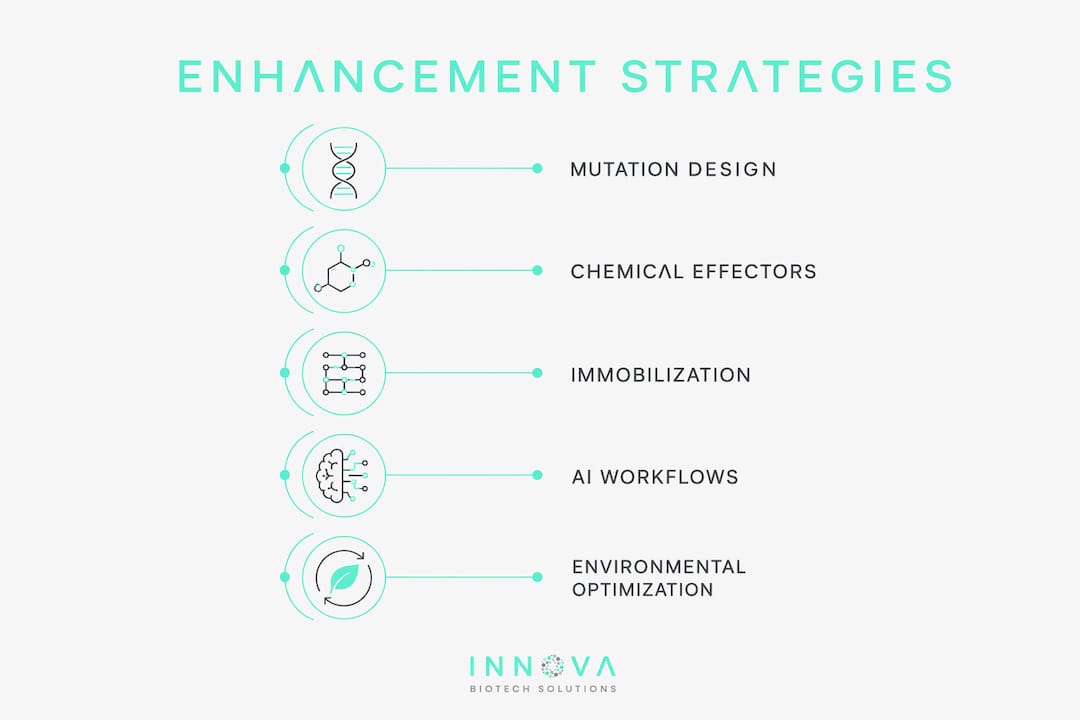
Non-genetic approaches to improving enzyme function are underused in most research pipelines. Chemical modification of the enzyme itself, or supplementation of the reaction environment with small molecules, can produce substantial gains without any changes to the gene sequence. This matters most when genetic access to the enzyme is limited or when the goal is to modulate an enzyme already in therapeutic use.
Chemical modification of β-glucosidase with N-Methoxycarbonylmaleimide increased catalytic activity by over 110% and raised catalytic efficiency 2.6-fold, while also improving cellobiose conversion by 19%. The modification works by altering surface residues in ways that reduce steric interference near the active site. Researchers in industrial cellulose degradation can apply this approach directly to existing enzyme preparations without upstream genetic work.
Small-molecule supplementation offers a parallel route, particularly for human therapeutic enzymes. Folic acid stimulates α-galactosidase A activity in a concentration-dependent manner, increasing Vmax without affecting Km. That kinetic profile is significant. It means folic acid increases the maximum catalytic rate while leaving substrate affinity unchanged, which is the ideal effector behavior for enzyme replacement therapy contexts.
Key chemical and small-molecule strategies include:
- Covalent surface modification using reagents like N-Methoxycarbonylmaleimide to alter residues that constrain active-site geometry.
- Cofactor supplementation to restore or amplify activity in enzymes that depend on metal ions or organic cofactors for full function.
- Pharmacological chaperone combinations where small molecules stabilize misfolded enzyme variants and folic acid further boosts their catalytic output.
- pH and ionic strength adjustment to shift the enzyme toward its optimal electrostatic configuration without any molecular modification.
Pro Tip: Before committing to a genetic engineering campaign, screen your target enzyme against a panel of small-molecule effectors. Folic acid, metal ion supplements, and surface-modifying reagents can deliver measurable activity gains within days, giving you a performance baseline that informs whether mutation work is worth the investment.
What role do immobilization and AI-guided workflows play in enzyme activity enhancement?
Enzyme stability under industrial process conditions is a separate problem from intrinsic catalytic rate. An enzyme with excellent in vitro kinetics can lose most of its activity when exposed to high temperatures, organic solvents, or repeated use cycles. Immobilization on solid or nanoparticle carriers addresses this by protecting the enzyme's three-dimensional structure while keeping it catalytically accessible.
The challenge is that nanocarrier selection involves an enormous number of variables: particle size, surface chemistry, linker length, loading density, and buffer conditions all interact. Traditional one-factor-at-a-time screening cannot cover this space efficiently. Parallelized hybrid-space Bayesian optimization (PHBO) solves this by modeling the relationship between carrier parameters and enzyme activity across more than 10^7 experimental conditions without running each one physically.
The practical results of AI-guided immobilization workflows are significant:
- Activity recovery up to 100% has been achieved in immobilized catalytic systems using PHBO-identified nanocarriers, matching the performance of free enzyme under controlled conditions.
- Cycle stability improves because optimal carrier chemistry reduces enzyme leaching and conformational drift over repeated reaction cycles.
- Screening time drops from months to weeks because the Bayesian model updates its predictions after each experimental batch, focusing resources on the most promising carrier configurations.
- Generalizability across enzyme classes means the same PHBO workflow applies to oxidoreductases, hydrolases, and transferases without rebuilding the optimization model from scratch.
| Optimization approach | Conditions explored | Activity recovery | Time to result |
|---|---|---|---|
| One-factor-at-a-time screening | Hundreds | Partial | Months |
| Design of experiments (DoE) | Thousands | Moderate | Weeks |
| PHBO (AI-guided) | Over 10 million | Up to 100% | Days to weeks |
AI-guided workflows also integrate with enzyme design for pharma, where immobilized biocatalysts are increasingly used in continuous manufacturing processes. The ability to recover full enzyme activity after immobilization removes one of the last major barriers to replacing chemical catalysts with enzymatic ones in pharmaceutical synthesis.
What factors affect enzyme activity and how can they be optimized in practice?
Environmental and structural factors set the ceiling on what any engineering strategy can achieve. Temperature, pH, substrate concentration, and the presence of inhibitors all shift enzyme kinetics in ways that can either amplify or erase the gains from mutation work or chemical modification. Researchers who ignore these factors during assay development routinely underestimate their enzyme's true potential.
The activity-stability trade-off is the most consequential structural factor. Mutations that increase flexibility in thumb loops or active-site regions tend to raise catalytic rates but lower thermal stability. Mutants of Bacillus subtilis xylanases showed up to a 3.5-fold activity increase through loop-region mutations, with only a slight rise in melting temperature. That result confirms the trade-off is real but manageable. The key is engineering flexibility into regions that directly contact substrate while preserving rigidity in the structural core.
Practical optimization strategies for balancing activity and stability:
- Multi-parameter engineering combines mutations for activity with separate mutations for stability, using computational modeling to predict whether the two sets interfere with each other.
- Substrate concentration profiling identifies the Km and Vmax under process-relevant conditions, not just standard assay buffers, to avoid designing for the wrong operating point.
- Inhibitor mapping locates which metabolites or product molecules reduce activity, informing whether N-terminal truncation or surface charge engineering can redirect those interactions.
- Computational homolog comparison identifies which structural regions tolerate variation across natural enzyme variants, flagging safe mutation sites for activity engineering.
Successful multi-parameter enzyme design pairs computational prediction with experimental validation at each design cycle. Skipping the experimental check after computational prediction is the most common reason promising enzyme variants fail to perform at scale. The model predicts; the lab confirms.
Key Takeaways
Enzyme activity enhancement requires combining mutation design, chemical modulation, and AI-guided immobilization to achieve durable catalytic gains at industrial and therapeutic scale.
| Point | Details |
|---|---|
| Few-shot mutation design | Combining 12 targeted mutations can yield a 73-fold output increase with minimal screening. |
| Chemical modification works fast | N-Methoxycarbonylmaleimide modification of β-glucosidase raised catalytic efficiency 2.6-fold without genetic changes. |
| Small-molecule effectors are underused | Folic acid increases α-galactosidase A Vmax without altering substrate affinity, making it viable for therapeutic use. |
| AI-guided immobilization recovers full activity | PHBO workflows identify nanocarriers that restore up to 100% enzyme activity under industrial conditions. |
| Activity-stability trade-offs require multi-parameter design | Flexible loop mutations raise catalytic rates but need stability-focused co-mutations to survive process conditions. |
What I've learned from watching enzyme engineering evolve
The field has spent decades treating activity and stability as opposing forces, as if gaining one always costs the other. That framing is outdated. The most productive research I've seen treats them as separate engineering targets that happen to share a protein scaffold. You design for activity in the active site and for stability in the structural core, and you use computational modeling to check whether the two sets of mutations conflict before you ever run a gel.
What still surprises me is how rarely teams reach for chemical effectors before starting a genetic campaign. Folic acid supplementation improving α-galactosidase A function is not a niche finding. It is a proof of concept that small molecules can meaningfully shift enzyme kinetics in therapeutic contexts, with a timeline measured in days rather than months. The genetic route gets all the attention because it feels more definitive. But for teams working on enzyme replacement therapies or industrial biocatalysts with fixed gene sequences, chemical modulation deserves a first look.
AI-guided immobilization is the development I find most consequential for industrial applications. The ability to explore over 10 million carrier configurations computationally and recover 100% enzyme activity in the best candidates changes the economics of biocatalysis. It makes enzymatic manufacturing competitive with chemical synthesis in cases where it previously could not be. The researchers who build fluency with PHBO workflows now will have a significant head start when continuous enzymatic manufacturing becomes the norm. The 2026 guide to enzyme engineering covers the immobilization landscape in more detail for teams ready to go deeper.
The remaining challenge is translation speed. Computational predictions improve every year, but the gap between a promising in silico result and a validated industrial enzyme is still measured in months. Closing that gap requires tighter integration between modeling teams and wet-lab groups, with shared metrics and faster feedback loops. That integration is where the next major productivity gains in enzyme engineering will come from.
— Hooman
Innovabiotech's enzyme optimization services for research teams
Innovabiotech works with biotech research teams that need more than a generic enzyme preparation. The team combines computational protein engineering, directed evolution design, and bioinformatics-guided mutation selection to build enzyme variants matched to your specific process conditions.
For teams focused on therapeutic applications, Innovabiotech's peptide design services include bioinformatics validation and custom molecular design that supports enzyme activity goals at the molecular level. For industrial and drug discovery applications, the protein engineering services integrate computational modeling with experimental workflows to deliver enzyme variants with validated activity and stability profiles. Innovabiotech's dedicated enzyme solutions practice covers the full cycle from initial mutation design through process-scale validation.
FAQ
What is enzyme activity enhancement?
Enzyme activity enhancement is the deliberate improvement of an enzyme's catalytic rate, stability, or substrate tolerance through genetic engineering, chemical modification, or environmental control. The goal is to maximize enzymatic function for a specific application, whether in drug discovery, industrial biocatalysis, or biochemical research.
Which mutation strategy produces the largest activity gains?
Few-shot learning-guided combinatorial mutation design produces some of the largest documented gains, with a 73-fold increase in enzyme output achieved by combining 12 targeted mutations. This approach requires far fewer experimental screening rounds than traditional directed evolution.
Can small molecules improve enzyme activity without genetic changes?
Yes. Folic acid supplementation increases α-galactosidase A activity by raising Vmax without changing substrate affinity, and chemical modification of β-glucosidase with N-Methoxycarbonylmaleimide raises catalytic efficiency 2.6-fold. Both approaches work on existing enzyme preparations.
How does immobilization affect enzyme activity in industrial processes?
Immobilization on optimized nanocarriers can recover up to 100% of an enzyme's free-solution activity while dramatically improving operational stability. AI-guided Bayesian optimization identifies the best carrier configurations from a search space of over 10 million conditions.
What is the activity-stability trade-off in enzyme engineering?
Mutations that increase flexibility in active-site loop regions raise catalytic rates but often reduce thermal stability. Effective enzyme engineering addresses both targets separately, using computational modeling to confirm that activity-enhancing and stability-enhancing mutations do not interfere with each other.