

Functional annotation of a genome assembly assigns biological roles — gene symbols, GO terms, enzyme classes, pathway links — to predicted gene models so your team can convert raw sequence data into candidate drug targets. Before trusting any function call, verify assembly and structural annotation quality: check coverage, N50, BUSCO completeness, and RNA-seq support. Tools like AlphaFold, DAVID, and the pipelines Innovabiotech runs can recover annotations even for proteins that sequence-only methods miss entirely.
One thing most guides skip: functional annotation is downstream of structural annotation, and errors in exon-intron boundaries propagate directly into wrong protein sequences and false function calls. Fix the gene models first, or everything downstream is suspect.
Table of Contents
- What does a functional annotation genome assembly pipeline look like?
- Which tools and databases should every pipeline include?
- How do AlphaFold and deep learning extend traditional annotation?
- What QC failures most often derail annotation projects?
- How do annotation outputs feed drug discovery and protein engineering?
- What does a pharma-grade annotation project cost and how long does it take?
- What should your RFP require from a functional annotation vendor?
- How Innovabiotech executes pharma-grade functional annotation
- Key Takeaways
- Where functional annotation is heading — and what it means for your budget
- Innovabiotech's annotation services for pharma and biotech teams
- Useful sources
- FAQ
What does a functional annotation genome assembly pipeline look like?
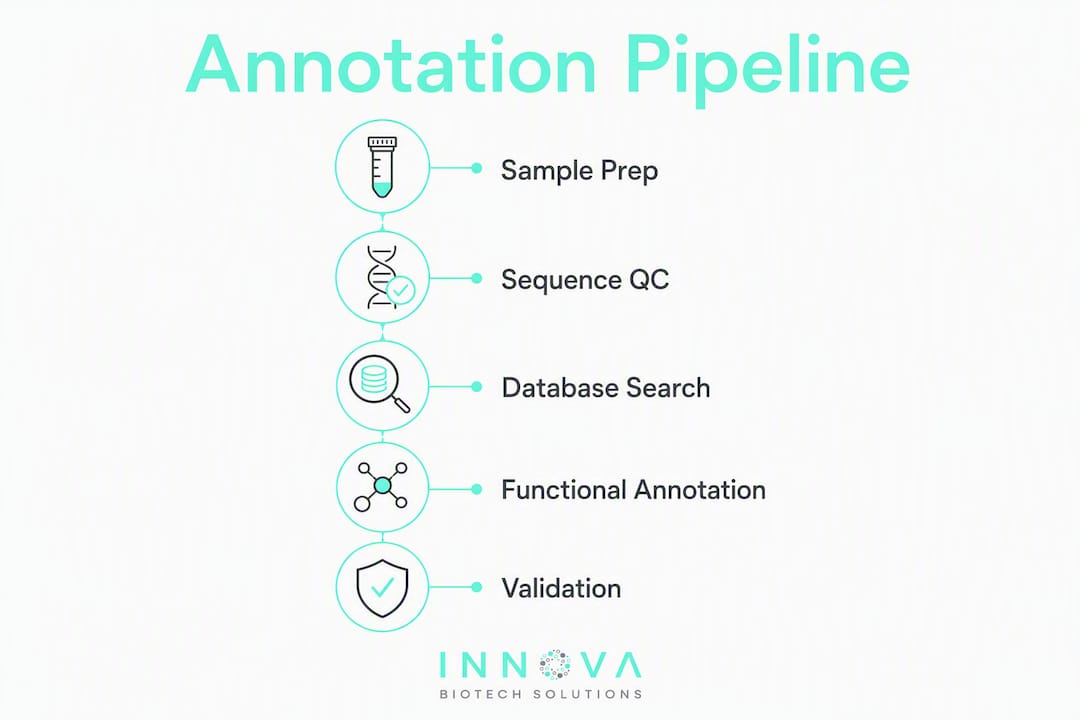
A pharma-grade pipeline runs in six ordered stages, and the handoff between each one matters as much as the tools themselves.
- Assembly QC. Confirm N50, coverage depth, and BUSCO completeness before touching annotation. A fragmented assembly produces fragmented gene models.
- Structural annotation. Predict gene models using RNA-seq alignments and ab initio evidence (BRAKER, TransDecoder, or equivalent). Funannotate2 defines this as a clean, repeatable sequence: assemble, predict, then annotate.
- Protein extraction. Export predicted protein sequences in FASTA format for downstream searches.
- Homology and domain searches. Run InterProScan, Pfam, EggNOG, and BLAST against UniProtKB/Swiss-Prot. Lock database versions here — record UniProt release number and Pfam build ID.
- GO/EC/KEGG/pathway mapping. Map hits to Gene Ontology terms, Enzyme Commission numbers, and KEGG pathways. Add specialty searches against MEROPS and CAZy for protease and carbohydrate-active enzyme families.
- Evidence integration, manual curation, and delivery. Score annotations by evidence tier, apply manual curation for high-value targets, and deliver versioned GFF3, GenBank, protein FASTA, and per-gene evidence tables with UniProt and GO ID mappings.
Internal responsibilities (your team): sample provenance, metadata, experimental RNA-seq data, and acceptance criteria (minimum BUSCO threshold, target N50).
Vendor responsibilities (Innovabiotech or equivalent): pipeline execution, database searches, reproducible logs, and a prioritized candidate list for target nomination.

Pro Tip: Lock database versions at the start of the project and export search snapshots — UniProt release, Pfam build, InterPro version — so results are reproducible and defensible in a regulatory submission.
Which tools and databases should every pipeline include?
Standard functional annotation pipelines integrate searches across multiple curated databases to build complete protein profiles. Here is what each resource contributes and where it can trip you up.
| Tool / Database | Primary role | Key caveat |
|---|---|---|
| Pfam | Domain detection and family classification | Version-sensitive; always record build number |
| InterPro | Aggregates Pfam, PRINTS, PANTHER, and others into unified ontology | InterProScan is compute-heavy; plan runtime accordingly |
| UniProtKB/Swiss-Prot | High-confidence curated function names | Swiss-Prot covers a fraction of TrEMBL; unreviewed hits need lower confidence scores |
| MEROPS | Protease family and substrate classification | May require a local install or specialty module |
| CAZy | Carbohydrate-active enzyme families | Specialty module; not included in all default pipeline configs |
| DAVID | Functional clustering and pathway enrichment from gene lists | Designed for post-annotation enrichment, not primary annotation |
| Funannotate | Pipeline orchestration for eukaryotic/fungal genomes | Best combined with InterProScan and EggNOG for full coverage |
| AlphaFold | Structure models for function inference on uncharacterized proteins | Structural homology, not sequence homology; adds compute cost |
Pro Tip: Run DAVID after annotation, not during. Feed it your prioritized gene list to identify enriched pathways and biological themes — that pivot from raw annotations to a candidate shortlist is where pharma teams save weeks.
How do AlphaFold and deep learning extend traditional annotation?
Sequence homology leaves a non-trivial fraction of any proteome uncharacterized. For complex eukaryotic genomes or novel microbial targets, that gap can be large enough to miss the most interesting biology.
Structure-based pipelines address this directly. AlphaFold-derived structural models enable structural homology searches that recover function for proteins where sequence identity is too low for BLAST to call confidently. The WASP pipeline, which uses AlphaFold models as the basis for annotation, recovered annotations for 20–30% of previously uncharacterized proteins and contributed those results directly to metabolic model curation.
Multimodal fusion approaches — combining sequence embeddings, protein-protein interaction networks, subcellular localization, and structural data — outperform single-modality methods across all three GO categories (molecular function, biological process, cellular component), particularly for proteins in low-annotation families where the long-tail problem is most severe.
When to add structure or ML steps:
- More than 20% of your proteome remains uncharacterized after homology searches
- You are targeting orphan proteins or novel enzyme families
- Metabolic model curation requires complete pathway coverage
- You need to recover function for distant homologs in a non-model organism
The multimodal fusion approach is no longer experimental. For pharma projects where missing a target family is a real cost, it belongs in the base scope.
What QC failures most often derail annotation projects?
Poor gene models are the single biggest source of downstream errors. Transcriptomic evidence and manual QC are not optional steps — automated-only pipelines increase false positives at exon boundaries, and those errors propagate through every function call that follows.
Primary QC metrics to require from any vendor:
- Assembly coverage depth and N50
- BUSCO completeness score (specify the lineage database)
- RNA-seq mapping rate and read support for splice junctions
- Percentage of gene models with transcript evidence
Common pitfalls:
- Exon-intron boundary errors from ab initio prediction without RNA-seq support
- Propagated misannotations via automated liftover (TOGA, Liftoff) when evolutionary distance is high
- ID mapping failures between gene IDs, protein IDs, and UniProt accessions
- Over-reliance on low-quality TrEMBL hits without confidence scoring
Evidence-level scoring keeps your team honest about what each annotation actually means:
- Tier I: Curated UniProt/Swiss-Prot or direct experimental evidence
- Tier II: High-confidence homology or domain match
- Tier III: Structure-based or ML inference (AlphaFold/WASP)
- Tier IV: Low-confidence automated transfer — flag, do not trust for target nomination
For any gene you plan to nominate as a drug target, require Tier I or II evidence plus transcript support and a manual curation pass.
How do annotation outputs feed drug discovery and protein engineering?
Annotation deliverables become useful only when they are structured for downstream decisions. A flat list of GO terms is not a target list.
Concrete outputs that matter for pharma:
- Prioritized gene list ranked by evidence tier, domain druggability, and pathway context
- Predicted active sites and binding domains from Pfam/InterPro hits
- Enzyme classifications (EC numbers) for metabolic and enzymatic target families
- KEGG/BioCyc pathway context for polypharmacology and pathway modulation strategies
- Tractability flags: membrane-associated, secreted, known domain families with small-molecule precedent
How teams use these outputs:
- Run DAVID enrichment on the annotated gene list to identify over-represented pathways.
- Triage candidates by tractability score and essentiality data.
- Generate target neighborhoods for combination or pathway-level strategies.
- Feed domain and active-site annotations into virtual screening workflows and peptide design pipelines.
- Use AlphaFold structural models plus molecular dynamics to map binding sites on novel targets before committing to assay development.
The annotated GFF3 with evidence tags, protein FASTA with domain annotations, and per-gene evidence dossiers are the deliverables that actually move a project forward.
What does a pharma-grade annotation project cost and how long does it take?
Timeline and cost vary significantly with genome complexity, the need for RNA-seq, and the depth of manual curation required.
| Project type | Typical timeline | Primary cost drivers |
|---|---|---|
| Assembly QC + automated annotation (microbial) | 2–4 weeks | Compute, database licenses |
| Full eukaryotic annotation with RNA-seq support | 6 weeks | RNA-seq alignment, InterProScan compute, curation labor |
| Add AlphaFold/ML structural enrichment | +2–6 weeks | GPU compute for model generation, structural search |
| Manual curation pass for target candidates | +1–3 weeks per target set | Expert curation time, evidence review |
Key cost drivers to budget for:
- InterProScan is compute-intensive; cloud or HPC costs scale with proteome size
- AlphaFold model generation requires GPU resources, especially for large eukaryotic proteomes
- Manual curation is the highest per-hour cost but the highest-return activity for target-nominated genes
- Annotation is iterative — plan for re-annotation triggered by major database releases or new RNA-seq data
What should your RFP require from a functional annotation vendor?
Mandatory items for any pharma-grade scope:
- Explicit database and pipeline versions (UniProt release, Pfam build, InterPro version, Funannotate version)
- Reproducible workflows in Snakemake, CWL, or equivalent containerized format
- Evidence-tiering schema with defined acceptance criteria per tier
- BUSCO threshold and RNA-seq mapping rate as milestone acceptance gates
- Sample and data provenance documentation for each annotation
Milestone structure:
- Milestone 1: Assembly QC report with BUSCO score and N50 confirmation
- Milestone 2: Preliminary annotation release with evidence tier distribution
- Milestone 3: Manual curation pass for nominated targets
- Milestone 4: Final delivery with containerized pipeline, provenance logs, and GFF3/FASTA outputs
Security and compliance asks:
- Data access controls and audit logs for all pipeline runs
- Retained raw outputs for potential regulatory submission
- Explicit IP and data ownership statements in the contract
For regulatory submission-ready outputs, require BioCompute Object (BCO) documentation or equivalent provenance packaging.
How Innovabiotech executes pharma-grade functional annotation
Innovabiotech's workflow follows the evidence-forward model: assembly QC first, structural annotation with BRAKER/TransDecoder using RNA-seq support, then functional annotation via Funannotate with EggNOG and InterPro integration. For proteins that remain uncharacterized after homology searches, AlphaFold structural enrichment is applied before the manual curation pass, recovering annotations for proteins missed by sequence-only methods
Trust signals built into every Innovabiotech project:
- BUSCO and N50 confirmation before annotation begins
- RNA-seq alignment rates reported per milestone
- Versioned database snapshots included in all deliverables
- Reproducible Snakemake workflows with containerized environments
- Manual curation for all candidate targets, not just automated transfer
- Deliverables in GFF3, GenBank, and protein FASTA with per-gene evidence dossiers
Pro Tip: Ask any vendor for the evidence tier distribution of their preliminary annotation release. If more than 30% of annotated genes sit at Tier IV, the gene models or database coverage need work before you proceed to target nomination.
Key Takeaways
Pharma-grade functional annotation requires verified assembly quality, evidence-tiered annotations, reproducible pipelines, and manual curation for any gene entering target nomination.
| Point | Details |
|---|---|
| Verify assembly quality first | Check N50, coverage, and BUSCO before any annotation step — errors in gene models propagate into false function calls. |
| Require evidence tiers | Score every annotation (Tier I–IV); only Tier I or II annotations should support target nomination decisions. |
| Lock pipeline and database versions | Record UniProt release, Pfam build, and InterPro version at project start for reproducibility and regulatory traceability. |
| Add AlphaFold/ML for orphan proteins | Structure-based pipelines like WASP recover annotations for 20–30% of proteins missed by sequence-only methods. |
| Innovabiotech delivers end-to-end | Innovabiotech provides evidence-tiered annotation with RNA-seq support, AlphaFold enrichment, and manual curation for pharma projects. |
Where functional annotation is heading — and what it means for your budget
The field is moving in three directions simultaneously, and all three have budget implications for pharma R&D leads planning projects over the next two to three years.
Structure-based annotation is becoming a baseline expectation, not a premium add-on. As AlphaFold coverage expands and structural search tools mature, any project that skips structural enrichment risks leaving a meaningful fraction of the proteome functionally dark. Reserve GPU compute budget accordingly.
Continuous annotation is replacing one-time deliverables. Annotation projects are iterative processes — major database releases, new RNA-seq data, and updated AlphaFold models all warrant re-annotation passes. Build an annual re-annotation cycle into your bioinformatics roadmap, particularly for high-value target families.
Auditability is becoming a procurement requirement, not just a best practice. Regulatory agencies and internal compliance teams increasingly expect provenance documentation, versioned pipelines, and audit logs. Projects that cannot demonstrate reproducibility are a liability in late-stage drug development.
The practical recommendation: budget for periodic re-annotation, reserve compute for structural modeling from the start, and plan ongoing manual curation for any target that advances past hit triage.
Innovabiotech's annotation services for pharma and biotech teams
Pharma teams that need annotation outputs they can actually act on — evidence-tiered, reproducible, and ready for target nomination — get that from Innovabiotech without the overhead of building and maintaining the pipeline infrastructure in-house. Innovabiotech delivers functional annotation with RNA-seq-supported gene models, Funannotate/InterPro/EggNOG integration, AlphaFold-assisted recovery for uncharacterized proteins, and a manual curation pass for nominated candidates. Every project includes versioned database snapshots and containerized workflows.
The deliverables feed directly into downstream protein engineering and peptide design workflows, so your team moves from annotated assembly to screened candidates without switching vendors or reformatting outputs. Contact Innovabiotech to scope your annotation project and get a timeline and cost estimate for your specific genome and target class.
Useful sources
Key references used throughout this guide, with notes on which claims each supports:
- Genome Annotation Tutorial — Harvard FAS Informatics Group: structural vs. functional annotation distinction, propagated error risks, liftover limitations, and QC guidance.
- Funannotate Documentation — Functional Annotation: pipeline database integrations (Pfam, CAZy, MEROPS, EggNOG, UniProt), manual curation requirements for pharma.
- Funannotate2 Documentation — Usage: repeatable workflow ordering (assemble, predict, annotate) and automation options.
- DAVID Functional Annotation Tool — NIH: enrichment analysis, pathway clustering, and iterative re-annotation for evolving gene lists.
- WASP: AlphaFold-Driven Annotation Pipeline — Nature Communications: structure-driven annotation recovery (20–30% of uncharacterized proteins) and metabolic model curation support.
- Multimodal Protein Function Annotation — PMC: multimodal fusion approaches (sequence, PPI, localization, structure) for long-tail protein annotation.
| Source | Best used for |
|---|---|
| Harvard FAS Informatics | QC rules, structural/functional distinction, liftover caveats |
| Funannotate docs | Pipeline steps, database coverage, curation requirements |
| DAVID | Post-annotation enrichment, iterative re-annotation |
| WASP / Nature Comms | AlphaFold-based recovery, uncharacterized protein fraction |
| Multimodal PMC paper | ML fusion methods, long-tail problem context |
FAQ
What is functional annotation in genome assembly?
Functional annotation assigns biological roles — GO terms, enzyme classes, pathway links, domain families — to predicted gene models produced during structural annotation. It is the step that converts a sequence assembly into a biologically interpretable gene catalog.
How does assembly quality affect annotation accuracy?
Poor assembly quality produces fragmented gene models with exon-intron boundary errors, which propagate directly into incorrect protein sequences and false function calls. BUSCO completeness and N50 are the primary metrics to verify before annotation begins.
When should you use AlphaFold in a functional annotation pipeline?
Add AlphaFold structural enrichment when more than 20% of your proteome remains uncharacterized after homology searches, or when you are targeting orphan proteins and novel enzyme families. The WASP pipeline recovered annotations for 20–30% of previously uncharacterized proteins using this approach.
What deliverables should a pharma-grade annotation project include?
Expect versioned GFF3 and GenBank files, protein FASTA with domain annotations, per-gene evidence dossiers with tier scores, UniProt and GO ID mappings, and containerized pipeline logs with database version snapshots.
Can Innovabiotech handle functional annotation for drug discovery projects?
Yes. Innovabiotech delivers evidence-tiered functional annotation with RNA-seq support, Funannotate/InterPro/EggNOG integration, AlphaFold-assisted recovery for uncharacterized proteins, and manual curation for nominated targets, with outputs formatted for direct use in protein engineering and virtual screening workflows.