
For predicting soluble expression in E. coli, modern sequence-based deep-learning models, particularly transformer and CNN architectures like NetSolP, give the best out-of-the-box guidance. Pair them with aggregation-prone region (APR) mapping using AlphaFold3-derived surface exposure, and you have a workflow that covers both the sequence-level signal and the structural context that global scores miss.
Practical expectations before you start:
- Transformer models (NetSolP, ESM1b-based) report strong performance on E. coli expression datasets, with accuracy and AUROC metrics that outperform earlier feature-engineered predictors on held-out test sets, provided strict sequence-identity partitioning was used in training.
- Short peptides (<50 residues) are the sweet spot for RNN-based tools like MahLooL, which reports AUROC ~0.95 and accuracy ~91.3% on short-peptide benchmarks.
- Multi-domain proteins, membrane proteins, and formulation-specific endpoints remain the hardest cases. No current predictor handles all three reliably.
- Predictions are hypothesis-generating. They narrow the candidate space; they do not replace a small-scale expression test.
Key Takeaways
Transformer-based predictors like NetSolP, combined with APR mapping and at least one orthogonal wet-lab assay, give researchers the most reliable path from sequence to a soluble, expressible protein.
| Point | Details |
|---|---|
| Match tool to endpoint | Use expression predictors (NetSolP, DeepSol) for E. coli cloning decisions; use CamSol-PTM for intrinsic or noncanonical peptide solubility. |
| Run multiple model families | Combine a transformer (NetSolP) with a feature-engineered tool (Protein-Sol) and an APR-aware predictor; agreement across families increases confidence. |
| Check benchmark validity | Prioritize tools reporting MCC and AUROC on identity-partitioned test sets; DSResSol reports ACC ~75.1% and AUROC ~0.84 under these conditions. |
| Map APRs structurally | Disrupting surface-exposed hydrophobic APRs via conservative mutation is more effective than adjusting global indices alone. |
| Innovabiotech for end-to-end work | Innovabiotech integrates prediction, AlphaFold3 APR mapping, and experimental validation into contracted protein and peptide design projects. |
Table of Contents
- What does "protein solubility prediction" actually measure?
- What model families and features drive solubility predictions?
- How are solubility models trained and benchmarked?
- Which prediction tools should you actually use?
- How to run a protein solubility prediction workflow
- What are the real limits of solubility prediction?
- Where computational prediction fits in a real engineering workflow
- Innovabiotech's protein solubility and expression services
- Sources
- FAQ
What does "protein solubility prediction" actually measure?
The phrase covers at least three distinct experimental endpoints, and confusing them is the most common reason a prediction fails to translate to the bench.
Soluble expression in a heterologous host (usually E. coli) is what most sequence-based predictors target. The label is binary: the protein either partitions into the soluble fraction after cell lysis or it does not. Datasets like eSOL, which profiles thousands of E. coli proteins using a standardized cell-free expression system, and PROSO II, which derived labels retrospectively from Protein Structure Initiative lab notebooks, both operationalize solubility this way. Tools trained on these sets answer one question: will this sequence express in a soluble form under standard E. coli conditions?
Intrinsic aqueous solubility is a thermodynamic property of the purified protein or peptide in a defined buffer. CamSol and its extension CamSol-PTM target this endpoint, including for peptides containing noncanonical amino acids. The correlation between predicted and measured intrinsic solubility is strong in validation sets, but this endpoint diverges sharply from expression solubility when the protein aggregates co-translationally or requires chaperones.
Apparent or formulation solubility describes behavior at high concentration in a specific buffer, pH, and excipient context. This is the endpoint that matters for therapeutic antibody formulation, and no current sequence-only predictor handles it well. Structure-aware tools and molecular dynamics simulations get closer, but they require substantially more compute and structural input.
- Use expression predictors (NetSolP, DeepSol, SoluProt) for cloning and construct decisions.
- Use intrinsic-solubility tools (CamSol-PTM, Protein-Sol) for peptide design and early-stage therapeutic screening.
- For formulation endpoints, treat sequence predictions as a starting filter only and follow up with biophysical assays.
Pro Tip: Before running any predictor, write down your experimental endpoint in one sentence. If it does not match the training data endpoint of the tool, your score is measuring a proxy, not your actual question.
What model families and features drive solubility predictions?
The architecture a tool uses determines what signal it can extract and where it breaks down.
Classical feature-engineered models (SVM, gradient boosting) encode sequences as fixed-length vectors: amino-acid composition, dipeptide frequencies, hydrophobicity scales (Kyte-Doolittle, Eisenberg), predicted secondary structure fractions, and intrinsic disorder scores from tools like IUPred. These models are interpretable, train on small datasets, and remain competitive on narrow benchmarks. Their weakness is that they treat sequence as a bag of features, losing positional and long-range context entirely.
CNN and RNN architectures recover some of that context. DSResSol uses dilated convolutions to capture long-range k-mer interactions, reporting good accuracy and AUROC on benchmark sets, outperforming several earlier models. RNNs process sequence as an ordered series, which suits peptides well. MahLooL's serverless, in-browser RNN deployment shows that these models can run reproducibly without any server infrastructure, a practical advantage for labs without dedicated compute.
Transformer protein language models (ESM1b, ESM-2, ProtTrans) pre-train on hundreds of millions of sequences and encode rich contextual embeddings. NetSolP fine-tunes ESM1b and ESM-12 specifically for E. coli solubility and usability prediction, and strict sequence-identity partitioning in its training splits improves generalization across datasets. Transformers currently set the state of the art for full-length proteins.
Graph convolutional networks (GCNs) go a step further by incorporating structural inputs. Fused GCN approaches that integrate AlphaFold-derived features can capture sequence-structure relationships that sequence-only models miss entirely, particularly for surface-exposed hydrophobic patches that drive aggregation.
Common input features across all families:
- Amino-acid composition and dipeptide frequencies
- Hydrophobicity and charge profiles (net charge, charge patchiness)
- Predicted secondary structure (helix/sheet/coil fractions)
- Intrinsic disorder scores and low-complexity regions
- Spatial aggregation propensity (APR) indicators
- AlphaFold-derived solvent accessibility and B-factor analogs (for structure-aware models)
The core tradeoff: feature-engineered models are interpretable and work with limited data, but deep models generalize better and capture long-range context. For peptides under 50 residues, RNN and feature-engineered tools often match transformer performance. For full-length, multi-domain proteins, transformers and GCNs are the better starting point.
How are solubility models trained and benchmarked?
Understanding where the training labels come from is the fastest way to spot a benchmark that will not hold up in your lab.
PROSO II derived its soluble/insoluble labels by comparing experimental status across time points in Protein Structure Initiative records. The labels are noisy by design: "soluble" means the protein was observed in the soluble fraction at some point, not that it expressed cleanly at high yield. Many older predictors trained on PROSO II inherit that noise.
eSOL is cleaner. It profiles E. coli proteins using a standardized cell-free expression system, giving quantitative solubility scores rather than binary calls. As a benchmark resource, it is better suited to evaluating continuous-score predictors and training models where label consistency matters.
Lab-notebook-derived datasets from structural genomics pipelines are large but heterogeneous: expression conditions, constructs, and fusion tags vary across entries, which inflates apparent accuracy when models overfit to condition-specific signals rather than sequence features.
Metrics to prioritize when reading a benchmark paper:
- MCC (Matthews Correlation Coefficient) is the most informative single metric when classes are imbalanced, which they usually are in expression datasets (more insoluble than soluble proteins).
- AUROC captures discrimination across thresholds and is less sensitive to class imbalance than accuracy.
- Accuracy alone is misleading if the majority class dominates. A model that predicts "insoluble" for everything can report 70%+ accuracy on some datasets.
Without that partition, models memorize homologs and report inflated metrics. DSResSol and NetSolP both report results under strict identity partitioning; many older tools do not.
Warning: A high benchmark accuracy on a non-identity-partitioned test set tells you almost nothing about how a model will perform on your novel sequence. Always check the Methods section for how the test set was constructed before trusting a reported metric.
Which prediction tools should you actually use?
Each tool below targets a specific endpoint and sequence type. Matching those to your experiment is more important than picking the tool with the highest headline accuracy.
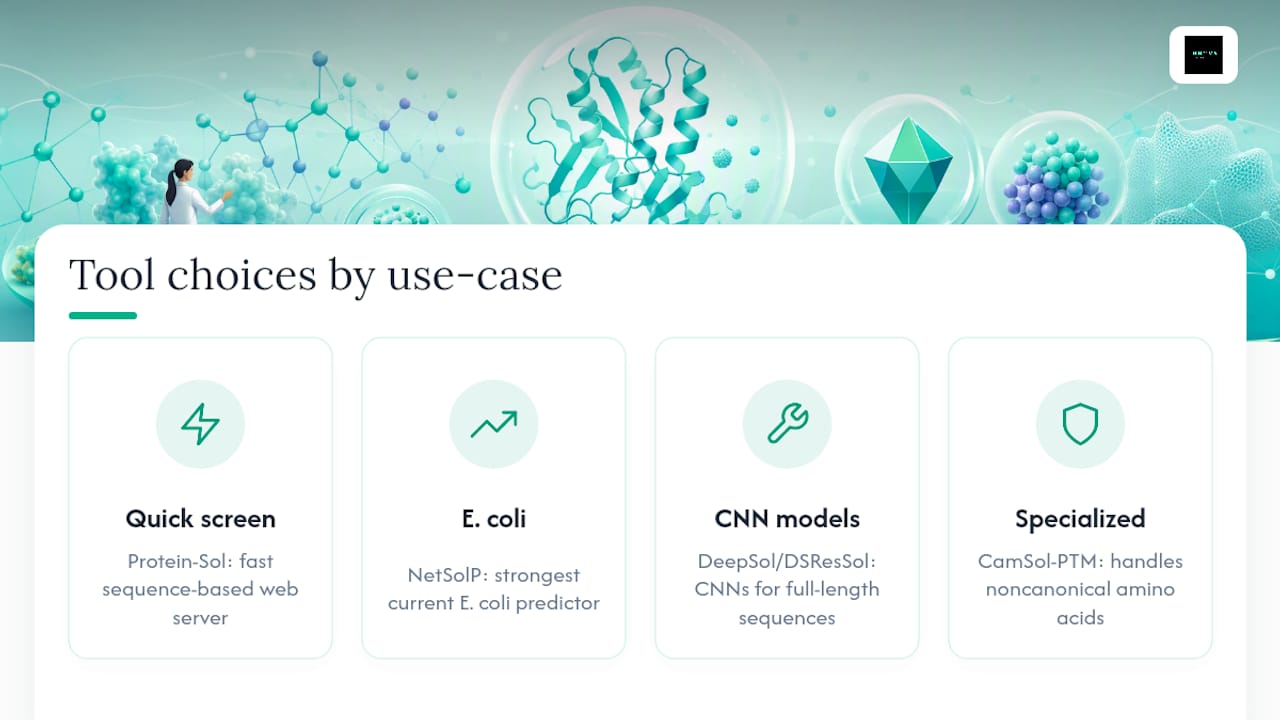
Protein-Sol is a fast sequence-based web server that predicts solubility from sequence-derived physicochemical features and adds fold propensity and charge segmentation analyses. Best for a quick first-pass screen on full-length proteins and for identifying charge-distribution problems.
DeepSol uses a CNN trained on PROSO II-derived data to predict E. coli expression solubility. It handles full-length sequences and is available as downloadable code. Useful when you want a CNN-based score alongside a transformer output.
DSResSol improves on earlier CNNs with dilated residual convolutions that capture long-range k-mer interactions. Good for full-length proteins where local and distal sequence context both matter.
NetSolP is the strongest current choice for E. coli expression prediction. Built on ESM1b and ESM-12 transformer embeddings, it predicts both solubility and purification usability. The strict sequence-identity partitioning in its training makes its benchmark numbers more trustworthy than most.
SoluProt is a gradient-boosting model trained on a curated E. coli expression dataset. It provides a probability score and is accessible via web server. Solid baseline for comparing against deep-learning outputs.
PROSO II (the predictor, distinct from the dataset) uses SVM with sequence-derived features. It is older and less accurate than current deep models, but its training data and feature set are well-documented, which makes it useful for understanding what earlier benchmarks were actually measuring.
SODA focuses on predicting solubility from sequence and secondary-structure features, with an emphasis on disorder and aggregation propensity. Useful when you want an aggregation-aware score alongside a global solubility prediction.
PaRSnIP targets peptide solubility specifically, using physicochemical descriptors and a random-forest architecture. For peptide binding affinity prediction workflows where solubility is a parallel constraint, PaRSnIP fits naturally.
SoDoPE provides a web interface for predicting solubility and disorder, with outputs designed to guide construct optimization (truncations, tag placement). Particularly useful early in cloning design.
solPredict is a sequence-based predictor that outputs a continuous solubility score. It is accessible via web server and works on standard-length proteins.
Its in-browser deployment means no API dependency, which matters for reproducible screening pipelines.
CamSol-PTM handles intrinsic solubility for peptides containing noncanonical amino acids, a capability no other tool on this list covers. If your peptide library includes modified residues, this is the only validated sequence-based option.
Pro Tip: Run at least two tools from different model families on every sequence. When a transformer (NetSolP) and a feature-engineered tool (Protein-Sol or SoluProt) agree, confidence is higher. When they disagree, map the APRs before deciding.
How to run a protein solubility prediction workflow
This procedure works for a new sequence you have never expressed before.
-
Define your endpoint and constraints. Write down: host organism (E. coli, mammalian, cell-free), expression goal (soluble yield vs. formulation stability), sequence length, and whether the protein contains noncanonical residues or disulfide bonds. This determines which tools are applicable.
-
Prepare your input files. Clean FASTA sequences with defined domain boundaries. If you have a multi-domain construct, run predictions on the full construct and on individual domains separately. Note any fusion tags (His, MBP, SUMO) because most predictors were not trained on tagged sequences.
-
Run two to three complementary predictors. A reasonable default panel: NetSolP (transformer, E. coli expression), Protein-Sol (feature-engineered, quick analytics), and either DSResSol or SoluProt as a third vote. For peptides under 50 residues, swap in MahLooL or PaRSnIP. For noncanonical peptides, add CamSol-PTM.
-
Map aggregation-prone regions. Use the AlphaFold3-derived structural features to identify surface-exposed hydrophobic patches and beta-sheet edges. Cross-reference with APR predictions from SODA or a spatial aggregation propensity tool. Disrupting hydrophobic APRs through conservative mutation is often more effective than adjusting global indices like aliphatic index or net charge alone.
-
Prioritize mutations. Focus on residues that appear in APRs, are surface-exposed in the AlphaFold model, and are not conserved in a multiple-sequence alignment of functional homologs. Conservative substitutions (Ile→Val, Phe→Tyr, Leu→Ser at exposed positions) and charge-tuning (adding Asp or Glu near aggregation hotspots) are the lowest-risk starting points. Domain selection and truncation strategies can also remove problematic regions entirely.
-
Design a small-scale expression test. Express wild-type and two to four variants in parallel at small scale (1–5 mL culture or cell-free). Fractionate into soluble and insoluble fractions by centrifugation and run SDS-PAGE. This takes one day and tells you more than any predictor.
-
Automate batch predictions when screening libraries. Both NetSolP and Protein-Sol support batch FASTA input. For large peptide libraries, MahLooL's serverless architecture handles high-throughput screening without rate-limiting API calls.
Pro Tip: When two predictors contradict each other, look at which one was trained on data closer to your experimental system. A tool trained on cell-free eSOL data will not reliably predict behavior in a fed-batch bioreactor.
What are the real limits of solubility prediction?
Predictions narrow the candidate space. They do not replace experiments, and several failure modes are systematic enough to plan around.
- Dataset bias toward E. coli expression. Most tools were trained on bacterial expression data. Performance on mammalian, yeast, or cell-free systems is largely untested and likely lower.
- Sequence-identity leakage. If a tool's test set shares >30% identity with its training set, reported metrics are inflated. Check the paper's Methods before trusting a headline number.
- Multi-domain and membrane proteins. Global sequence scores average over domains, masking a single insoluble domain that will crash expression. Membrane proteins violate the hydrophobicity assumptions built into most models.
- Formulation-specific endpoints. Concentration-dependent aggregation in a specific pH/excipient buffer is not captured by any sequence-only predictor. Structure-based methods and biophysical assays are required.
- Intrinsic vs. apparent solubility. A protein can score well on intrinsic solubility predictors yet aggregate rapidly at high concentration due to kinetic effects that thermodynamic models ignore.
- Noncanonical amino acids. Only CamSol-PTM handles these explicitly. Running standard predictors on modified peptides produces unreliable scores.
Validation checklist before scale-up:
- Small-scale expression and solubility fractionation (SDS-PAGE of soluble vs. insoluble pellet)
- PEG precipitation or ultracentrifugation assay for aggregation propensity
- DLS or SEC-MALS for oligomeric state and particle size in solution
- Thermal shift assay (DSF) for folding confirmation
- If formulation is the goal, accelerated stability study at target concentration and pH
Predictions are hypothesis-generating, not definitive. A high solubility score justifies prioritizing a variant for expression testing; it does not justify skipping that test. Every model-driven design decision should be confirmed with at least one orthogonal wet-lab assay before committing to scale-up or downstream synthesis costs.
For a broader look at how stability and solubility predictions interact in protein stability prediction workflows, the same validation logic applies: computational scores set the shortlist, experiments set the answer.
Where computational prediction fits in a real engineering workflow
The researchers who get the most out of solubility prediction tools are not the ones running every available predictor. They are the ones who define the endpoint first, run two or three well-matched tools, and treat the output as a ranked shortlist for a targeted expression screen, not a final answer.

In practice, the biggest time savings come at the construct design stage, before any protein is expressed. A 30-minute prediction run that eliminates three of eight candidate constructs as likely insoluble saves days of cloning and expression work. The tools that deliver that value most consistently right now are transformer-based predictors for full-length E. coli targets and RNN or physicochemical tools for short peptides. Structure-aware APR mapping with AlphaFold3 adds a layer that sequence-only scores cannot provide, particularly for proteins where a single exposed hydrophobic patch drives aggregation.
The field is moving fast. The transition from empirical trial-and-error to mechanism-driven solubility engineering means that within a project cycle, a team can go from sequence to a structurally rationalized mutation panel to expression data in a week, rather than months of iterative screening.
Innovabiotech's protein solubility and expression services
Predicting solubility from sequence is the starting point. Turning that prediction into a validated, expressible protein requires integrating construct design, APR mapping, mutation prioritization, and experimental confirmation into a single coherent workflow.

Innovabiotech delivers exactly that as a contracted service. The team combines transformer-based solubility prediction, AlphaFold3 structural mapping, and APR-targeted protein design to produce ranked variant panels ready for expression testing. For peptide-focused projects, the peptide design and optimization service covers sequence-based solubility screening, noncanonical amino acid handling via CamSol-PTM, and bioinformatics validation, all under a single project scope. Engagements run as short consulting scopes for construct selection decisions or as full project-based design-plus-validation packages. To scope a project, contact Innovabiotech directly through the protein design service page.
Sources
- NetSolP: predicting protein solubility in Escherichia coli using language models | Bioinformatics
- Serverless Prediction of Peptide Properties with Recurrent Neural Networks - PMC
FAQ
What is the best tool for predicting soluble expression in E. coli?
NetSolP is currently the strongest choice for E. coli expression prediction, using ESM1b transformer embeddings and strict sequence-identity partitioning that makes its benchmark metrics more reliable than most alternatives.
How accurate are protein solubility prediction tools?
Accuracy varies by model and dataset. Performance drops for multi-domain proteins and formulation endpoints.
Can solubility predictors handle peptides with noncanonical amino acids?
Standard predictors cannot. CamSol-PTM is the only validated sequence-based tool that explicitly handles noncanonical amino acids, showing strong correlation with experimental solubility in its validation sets.
Should I trust a single predictor's output before expressing a protein?
No. Predictions narrow the candidate shortlist but do not replace wet-lab confirmation. Run two to three complementary tools, map APRs structurally, and confirm with a small-scale expression and solubility fractionation assay before committing to scale-up.
What datasets are best for benchmarking solubility models?
eSOL, which uses a standardized E. coli cell-free expression system for consistent quantitative labels, is the most reliable benchmark dataset. PROSO II is widely used but carries noisier binary labels derived from retrospective lab-notebook records.