

Real-world evidence (RWE) is clinical evidence derived from the analysis of real-world data (RWD), which is health data collected outside the controlled conditions of a randomized trial. For pharma teams, it plays three distinct roles: regulatory (supporting FDA submissions, post-market surveillance, and label expansions), clinical (contextualizing trial results, characterizing patient populations, and informing trial design), and commercial (demonstrating comparative effectiveness and value to payers and HTA bodies).
The 21st Century Cures Act directed the FDA to develop a framework for evaluating whether RWD and RWE are fit for regulatory decision-making, and the agency has issued guidance on exactly that. Understanding where RWE fits, and where it does not, is now a core competency for R&D, regulatory, and HEOR teams.
The three roles in brief:
- Regulatory: Supporting new drug applications, post-approval safety studies, and label expansions with evidence from routine clinical practice
- Clinical: Informing natural history, endpoint selection, external control arms, and comparative effectiveness
- Commercial/payer: Generating cost-effectiveness and long-term outcomes data for formulary placement, coverage decisions, and HTA submissions
Table of Contents
- What is the difference between RWD and RWE in pharma?
- What are the primary RWD sources and how do you assess their quality?
- How does the U.S. regulatory framework treat RWE?
- Where does RWE add value across the drug development lifecycle?
- What study designs and causal inference methods make RWE credible?
- What analytics infrastructure supports reproducible RWE at scale?
- How should pharma organizations structure their RWE programs?
- What do payers and HTA bodies expect from RWE?
- What are the main limitations of RWE and how do you address them?
- What do RWE studies typically cost and how long do they take?
- What trends are shaping the future of RWE in pharma?
- Key Takeaways
- Why the conventional wisdom on RWE still misses the point
- Innovabiotech's approach to RWE analytics and bioinformatics
- Useful sources
- FAQ
What is the difference between RWD and RWE in pharma?
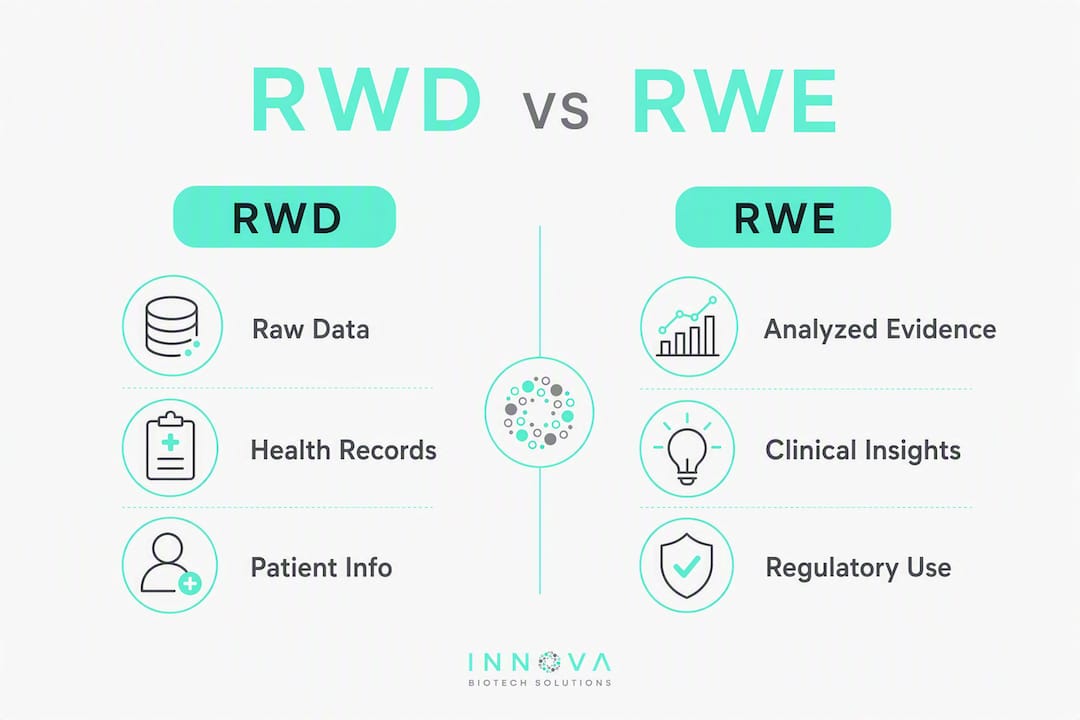
The distinction matters more than most teams acknowledge early in program planning. RWD is the raw material: electronic health records (EHRs), insurance claims, disease registries, laboratory databases, data from connected devices and wearables, and patient-reported outcomes collected in routine care. RWE is what you get after applying a rigorous analytic framework to that data to answer a specific clinical or regulatory question.
Not all RWD qualifies as fit-for-purpose. A claims database with high missingness on a key outcome variable, or an EHR system that codes the same condition inconsistently across sites, produces evidence that will not survive regulatory or payer scrutiny. The FDA's guidance on RWD and RWE for regulatory decisions frames fit-for-purpose as a function of data relevance and reliability, two properties that must be assessed before any analysis begins.
For U.S. regulatory purposes, the FDA considers RWE appropriate for:
- Post-market safety surveillance and pharmacovigilance
- Label expansions for approved drugs, particularly in rare diseases or pediatric populations where RCTs are difficult
- Externally controlled trials where a concurrent randomized arm is not feasible
- Comparative effectiveness in situations where the clinical question maps cleanly to available RWD
Situations that still require randomized data include primary efficacy claims for most new molecular entities, settings where confounding cannot be adequately controlled, and any context where the FDA has explicitly stated it will not accept observational evidence as a substitute for a controlled trial.
Pro Tip: Before committing to an RWD source, document its provenance, the period it covers, how outcomes are coded, and whether it can be linked to another source for completeness. This fit-for-purpose assessment is the first thing a regulator or payer reviewer will ask for.
What are the primary RWD sources and how do you assess their quality?
Each major RWD source brings a different trade-off between coverage, granularity, and reliability. Knowing those trade-offs before you design a study saves significant rework downstream.

| RWD Source | Strengths | Weaknesses |
|---|---|---|
| Electronic health records (EHRs) | Rich clinical detail, lab values, diagnoses, medications, notes | Incomplete capture of out-of-system care; coding variability across sites |
| Insurance/claims data | Large populations, longitudinal follow-up, procedure and pharmacy data | No clinical severity; diagnosis codes are billing proxies, not confirmed diagnoses |
| Disease registries | Disease-specific depth, validated endpoints, patient consent | Limited size; often disease-specific; may not generalize |
| Laboratory databases | Objective biomarker values, standardized assays | Narrow scope; missing clinical context |
| Device and wearable data | Continuous, patient-generated, real-time endpoints | Validation gaps; standardization challenges; regulatory acceptance still evolving |
| Patient-reported outcomes (PROs) | Captures patient experience and quality of life | Recall bias; response rates; instrument variability |
| Pragmatic randomized trials | Randomization preserves causal inference; real-world setting | Expensive; slower; still requires protocol infrastructure |
Digital health and patient-generated data are growing inputs that can enrich endpoints and improve phenotyping, but they require validation and standardization before they can anchor a regulatory argument.
A practical data-quality checklist covers six dimensions:
- Provenance: Can you trace every data element back to its source system and transformation history?
- Completeness: What percentage of records have the key exposure, outcome, and covariate fields populated?
- Standardization: Are diagnoses coded in ICD-10, procedures in CPT, and drugs in RxNorm or NDC, consistently across sites?
- Linkability: Can records be deterministically or probabilistically linked across sources without introducing systematic bias?
- De-identification: Does the dataset meet HIPAA Safe Harbor or Expert Determination standards?
- Reproducibility: Can an independent analyst re-run the ETL pipeline and arrive at the same analytic dataset?
When combining sources, linkage governance matters as much as the technical method. Define the linkage key, document the match rate and false-positive rate, and pre-specify how unmatched records will be handled. Regulators will ask.
How does the U.S. regulatory framework treat RWE?
The 21st Century Cures Act directed the FDA to establish a program for evaluating RWD and RWE to support approval of new indications and post-approval study requirements. The FDA's subsequent guidance documents set out the agency's expectations in practical terms.
The FDA's core RWE acceptance criteria center on four properties:
- Relevance: Does the data source capture the population, intervention, comparator, and outcomes that match the regulatory question?
- Reliability: Is the data collected consistently, with documented quality controls, and free from systematic biases that cannot be adjusted?
- Transparency: Are the analytic protocol, data transformations, and statistical assumptions fully documented and reproducible?
- Fit-for-purpose assessment: Has the sponsor formally evaluated whether the data are adequate for the specific regulatory use case before analysis begins?
In practice, the FDA expects sponsors to engage early, ideally through a pre-submission meeting, before committing to an RWE-based regulatory strategy. Protocol registration, pre-specified statistical analysis plans, and reproducible code are not optional extras; they are what separates an RWE package that advances a review from one that gets a complete response letter.
| Regulatory Use Case | FDA Stance | Key Requirement |
|---|---|---|
| Post-market safety surveillance | Accepted; common | Validated outcome definitions; linkage to exposure data |
| Label expansion (new indication) | Accepted in specific cases | Fit-for-purpose data; pre-specified protocol; no feasible RCT |
| Externally controlled trial | Accepted with conditions | Concurrent or historical controls; bias mitigation documented |
| Primary efficacy for new NME | Generally not accepted | RCT remains the standard; RWE may supplement |
| Pediatric/rare disease | Increasingly accepted | Natural history data; registry-based evidence |

RWE complements RCTs by improving generalizability and informing trial design, and it has supported label changes and regulatory decisions in specific cases, particularly in oncology and rare diseases where trial enrollment is constrained.
Where does RWE add value across the drug development lifecycle?
The answer is: earlier than most teams deploy it. Systematic, early integration of RWE into development programs improves decision quality and can reduce late-stage failures. Waiting until post-approval limits what RWE can do.
Early discovery and target validation
Epidemiological analyses of EHR and claims data can quantify disease burden, characterize the natural history of a condition, and identify patient subgroups with unmet need before a single IND is filed. This is where RWE informs go/no-go decisions with real population data rather than assumptions. Tools like AI-driven drug repurposing can combine RWD signals with computational models to surface new hypotheses efficiently.
Phase I–II: natural history and feasibility
Natural history studies from registries or EHRs establish baseline event rates, which directly determine sample size calculations. RWD also supports site feasibility by identifying where patients with specific characteristics are concentrated, reducing screen failure rates in early trials.
Pivotal and approval-stage evidence
Externally controlled trials use a real-world comparator cohort in place of a concurrent control arm. This design is most defensible when the disease is rare, the treatment effect is large, and the comparator population can be precisely characterized. Hybrid designs, which randomize some patients while using an external control for others, are gaining traction with regulators.
Post-approval: where RWE has the longest track record
- Safety surveillance and pharmacovigilance studies required as post-market commitments
- Comparative effectiveness against standard of care in broader populations than the trial enrolled
- Label expansions to new indications, age groups, or lines of therapy
- Adherence, persistence, and real-world utilization studies that inform commercial strategy
Pro Tip: Map your RWE investments to clinical development milestones at the program level, not the study level. A descriptive natural history study at Phase I costs a fraction of a retrospective matched cohort at Phase III, and it de-risks the later investment by confirming the data infrastructure is fit for purpose.
What study designs and causal inference methods make RWE credible?
Design choice is where most RWE programs either build or lose credibility. The goal is not to pick the most sophisticated method; it is to pick the design that most honestly answers the question given the available data.
| Design | Best Use Case | Key Limitation |
|---|---|---|
| Retrospective cohort | Incidence, comparative effectiveness, safety | Confounding by indication; exposure misclassification |
| Case-control | Rare outcomes, hypothesis generation | Recall bias; control selection bias |
| Cross-sectional | Prevalence, burden of disease | Cannot establish temporality |
| Registry study | Disease-specific endpoints, validated outcomes | Generalizability; enrollment bias |
| Pragmatic randomized trial | Comparative effectiveness with causal validity | Cost; time; protocol burden |
| Externally controlled trial | Rare disease, single-arm trials | Historical comparator bias; secular trends |
| Target trial emulation | Causal inference from observational data | Requires careful protocol specification |
Target trial emulation is the most important methodological advance in RWE over the past decade. The approach requires you to explicitly specify the hypothetical randomized trial you are trying to emulate, including eligibility criteria, treatment strategies, assignment procedures, follow-up, and outcomes, and then map each element to the observational data. This discipline forces assumptions into the open where they can be examined, rather than buried in analytic choices.
Causal inference tools used in practice:
- Propensity score methods: Matching, stratification, or inverse probability weighting to balance observed covariates between treatment groups
- Instrumental variables: Useful when a valid instrument exists (e.g., geographic variation in prescribing practice) but rarely available in pharma
- Difference-in-differences: Controls for time-invariant unmeasured confounders when pre-treatment data are available
- Sensitivity analyses: E-values, tipping-point analyses, and negative control outcomes to quantify how much unmeasured confounding would be needed to explain away an observed association
Advanced analytics and causal methods are increasingly emphasized in peer-reviewed guidance, but they come with a responsibility to document assumptions transparently. A propensity score model that includes 200 covariates without a pre-specified variable selection strategy is not more rigorous; it is harder to audit.
A credibility checklist for any RWE study:
- Pre-defined protocol registered before data access
- Documented data provenance and ETL steps
- Pre-specified statistical analysis plan with sensitivity analyses
- Reproducible, version-controlled code
- Transparent reporting following RECORD or STROBE standards
- Independent validation or replication where feasible
Pro Tip: Run a negative control outcome analysis as a standard quality check. If your analytic pipeline produces a spurious association for an outcome that has no plausible biological link to the exposure, you have a confounding or data-quality problem to fix before the primary analysis.
What analytics infrastructure supports reproducible RWE at scale?
The technical architecture is what separates a one-off study from a repeatable, auditable RWE program. Three layers matter: data infrastructure, analytics stack, and security and governance.
Data infrastructure
- Standardization pipelines: Converting source data to common data models, OMOP CDM for observational research and FHIR for interoperability, is the foundation for multi-source and multi-site studies. Without standardization, every new study requires bespoke data preparation.
- Secure data environments: Federated analytics platforms and safe-haven environments allow analysis without moving patient-level data, which is increasingly important for privacy compliance and for accessing data held by health systems or payers.
- Data catalogs and linkage services: A governed catalog that documents available datasets, their coverage periods, population characteristics, and linkage keys reduces the time spent on feasibility assessments from weeks to days.
Analytics stack
- Statistical tooling: R and Python remain the dominant languages for RWE analytics, with packages like
MatchIt,WeightIt, andCausalImpactfor causal inference - Machine learning for phenotyping: Natural language processing on clinical notes and ML classifiers on structured EHR data can identify patient cohorts more accurately than ICD codes alone; ML-driven approaches to predictive modeling are directly applicable here
- Reproducible pipelines: Version control (Git), containerization (Docker), and workflow orchestration (Nextflow, Snakemake) ensure that an analysis run today produces the same result in 18 months when a regulator asks for a replication
| Infrastructure Component | Purpose | Common Tools/Standards |
|---|---|---|
| Common data model | Standardize source data for multi-site analysis | OMOP CDM, FHIR |
| Secure analytics environment | Protect patient data; enable federated analysis | Safe-haven platforms, TREs |
| Causal inference libraries | Propensity scores, IPW, target trial emulation | R: MatchIt, WeightIt; Python: DoWhy |
| Reproducibility stack | Version control, containerization, workflow management | Git, Docker, Nextflow |
| Data catalog | Document datasets, coverage, linkage keys | Custom or commercial catalog tools |
Security, privacy, and governance
Role-based access controls, audit trails on every data query, and formal de-identification protocols are not compliance checkboxes. They are what allows a sponsor to hand a regulator a complete record of who accessed what data, when, and what transformations were applied. HIPAA Safe Harbor and Expert Determination are the two recognized de-identification standards in the U.S.; document which one was used and by whom.
How should pharma organizations structure their RWE programs?
There is no single right organizational model, but the choice has real consequences for speed, quality, and regulatory credibility. Cross-functional teams with epidemiologists, statisticians, data engineers, and clinical experts produce the most credible RWE because they can jointly assess fit-for-purpose issues and preempt bias risks before a study is designed.
Three organizational models in practice:
Centralized center of excellence (CoE): A dedicated RWE team serves all therapeutic areas. Strengths include consistent methodology, shared infrastructure, and a single point of regulatory accountability. The risk is becoming a bottleneck when demand exceeds capacity, and losing disease-area context.
Federated model: Epidemiologists and HEOR scientists are embedded in therapeutic area teams, with a central function setting methodological standards and owning data infrastructure. This model balances speed and scientific rigor but requires strong governance to prevent methodological drift across teams.
Embedded epidemiology: Small programs or companies place one or two RWE scientists directly in the clinical team. Fast and context-rich, but vulnerable to resource constraints and inconsistent standards.
Governance essentials:
- Define roles and responsibilities across epidemiology, biostatistics, data engineering, regulatory affairs, and legal before a study begins, not after
- Establish a fit-for-purpose assessment SOP that every study must pass before data access is granted
- Require protocol registration and a signed statistical analysis plan before any unblinded analysis
- Set quality gates at key milestones: data receipt, analytic dataset lock, primary analysis, and final report
- Document all vendor interactions, data access agreements, and data use agreements in a central repository
Vendor vs. in-house decision criteria:
When evaluating whether to build in-house or contract out, consider data access (some vendors hold proprietary databases you cannot replicate), turnaround time, regulatory track record, and whether the vendor can provide reproducible, auditable deliverables. A vendor due diligence checklist should cover: data provenance documentation, SOPs for ETL and quality control, experience with FDA submissions, data security certifications, and contractual provisions for code and data retention after project close.
What do payers and HTA bodies expect from RWE?
Payers and HTA bodies in the U.S. use RWE differently from regulators, but their evidence bar is rising. RWE is used more heavily for cost-effectiveness and post-market surveillance than for initial regulatory approvals, and payer reviewers are increasingly sophisticated about study design.
Common payer use cases:
- Comparative effectiveness: Head-to-head comparisons against standard of care in the actual treated population, not the trial-eligible population
- Long-term outcomes: Durability of response, time to treatment failure, and survival beyond trial follow-up windows
- Adherence and persistence: Real-world medication adherence is almost always lower than in trials; payers want to know what that means for outcomes
- Resource utilization and costs: Hospitalizations, emergency visits, and total cost of care in treated vs. untreated or comparator-treated patients
Evidence expectations from payers differ from FDA expectations in one critical way: payers care about generalizability to their specific covered population, not just the broad U.S. population. A study conducted in an academic medical center EHR may not reflect the community-based population a regional insurer covers. Design your RWE with the payer's population in mind from the start.
Aligning RWE plans with commercial timelines requires working backward from the anticipated launch date. Payer engagement typically begins 12–18 months before launch, and the evidence package needs to be complete, not in progress, at that point. A retrospective matched cohort study that takes 18 months to complete cannot be started six months before launch and arrive on time.
What are the main limitations of RWE and how do you address them?
The limitations are real and well-documented. The question is not whether they exist but whether you have a credible mitigation strategy for each one.
Common limitations and mitigations:
- Confounding by indication: Patients who receive a treatment differ systematically from those who do not. Propensity score methods, target trial emulation, and active comparator designs reduce but do not eliminate this risk. Document residual confounding explicitly.
- Selection bias: The population captured in a data source may not represent the population of interest. Assess coverage and compare baseline characteristics to external benchmarks.
- Measurement error: Diagnosis codes are billing proxies; lab values may be missing for patients who did not have tests ordered. Use validated algorithms for outcome and exposure definitions, and report their positive predictive values.
- Missingness: Sporadic care, out-of-network visits, and incomplete records create gaps. Pre-specify how missing data will be handled; multiple imputation is generally preferred over complete-case analysis for regulatory submissions.
- Timeliness: Claims data typically lag 3–6 months; EHR data may be more current but harder to access at scale. Know the lag for your source and account for it in study timing.
Best practices that raise confidence in RWE findings:
- Triangulate across two or more independent data sources; consistent results across sources reduce the probability that findings are an artifact of one dataset
- Follow RECORD (for database studies) or STROBE (for observational studies) reporting standards; transparent reporting is the single most effective signal of methodological rigor to a reviewer
- Conduct pre-submission dialogs with FDA before committing to an RWE-based regulatory strategy
- Use external validation cohorts where available to test whether findings replicate in an independent population
Pro Tip: The E-value is a simple, interpretable sensitivity analysis that quantifies how strong an unmeasured confounder would need to be to explain away your observed association. Include it in every regulatory or payer submission; it signals methodological sophistication and pre-empts the most common critique.
What do RWE studies typically cost and how long do they take?
Planning guidance on timelines and costs is scarce in the published literature, which is why programs routinely underestimate both. The figures below reflect typical ranges for U.S.-based studies; actual costs depend heavily on data access fees, study complexity, and vendor rates.
| Study Type | Typical Timeline | Primary Cost Drivers |
|---|---|---|
| Descriptive registry or claims analysis | 3–6 months | Data licensing; analyst time; governance review |
| Retrospective matched cohort | 6–12 months | Data access; cleaning and linkage; statistical analysis; regulatory documentation |
| Externally controlled trial | 12–18 months | Comparator cohort construction; bias mitigation; regulatory engagement |
| Pragmatic randomized trial | — | Site activation; data collection infrastructure; monitoring; statistical analysis |
Major cost drivers across all study types:
- Data access and licensing: Proprietary claims databases and EHR networks carry annual licensing fees that can represent the largest single line item in a study budget
- Data cleaning and linkage: Standardizing source data to OMOP or FHIR and linking across sources is labor-intensive; budget 20–30% of total project effort for this phase
- Analytics and statistical effort: Causal inference methods require more statistical time than descriptive analyses; target trial emulation studies are particularly resource-intensive
- Governance and compliance: IRB review, data use agreements, and regulatory documentation add fixed costs that do not scale with study size
- Vendor contracting: Scope creep is the most common budget risk; define deliverables, data versions, and reproducibility requirements contractually before work begins
Budgeting tip: phase your RWE investments. A lightweight descriptive study at Phase I costs a fraction of a full retrospective cohort and tells you whether the data infrastructure is fit for purpose before you commit to a larger investment. Early RWE integration aligned to clinical development milestones maximizes return and reduces the risk of arriving at a regulatory submission with evidence that does not hold up.
What trends are shaping the future of RWE in pharma?
Three forces are changing what RWE programs can do and what regulators and payers will expect in the next 2–5 years.
Federated data networks and regulator-led initiatives
The EMA's DARWIN EU network reported a notable increase in coordinated study activity compared with the prior year, with coverage across a very large population in multiple countries. While DARWIN EU is an EU initiative, its methodological standards and the federated model it uses are directly relevant to U.S. program planning, particularly for sponsors running global development programs. The FDA's Sentinel System is the U.S. analog, and its scope continues to expand.
Federated networks allow analysis without centralizing patient-level data, which addresses privacy concerns and enables access to populations that would otherwise be inaccessible. Expect regulators on both sides of the Atlantic to increasingly reference federated study results as benchmarks.
Advanced analytics: causal ML, AI-enabled phenotyping, and target trial emulation at scale
As high-dimensional RWD volumes grow, the future of RWE depends on more complex modeling and inferential methods, but only if standards for bias mitigation and transparency remain strong. AI-enabled phenotyping using NLP on clinical notes can identify patient cohorts with accuracy that ICD codes alone cannot achieve. Causal machine learning methods are moving from academic papers into regulatory submissions. The risk is that complexity obscures assumptions; the discipline of target trial emulation, which forces explicit protocol specification, is the best available check on that tendency.
AI-driven drug discovery workflows are converging with RWE analytics pipelines in ways that will change how early-phase programs use population data for target validation and patient stratification.
Policy momentum and regulatory uptake
- The FDA's RWE program continues to expand the range of regulatory questions it will consider for RWE-based evidence
- Leading scholars now frame RCTs and RWE as complementary parts of a single evidence ecosystem, each capturing distinct but necessary aspects of patient reality
- Payer and HTA bodies are raising their methodological standards for RWE submissions, which means programs that invested early in rigorous infrastructure will have a competitive advantage
- Patient privacy regulations (state-level in the U.S., GDPR in Europe) are tightening data access requirements, making federated and safe-haven analytics architectures increasingly necessary rather than optional
Key Takeaways
Real-world evidence is most valuable when it is integrated early, designed rigorously, and aligned to both regulatory and payer expectations from the start of a development program.
| Point | Details |
|---|---|
| Start RWE at Phase I, not Phase III | Early descriptive studies de-risk later investments and improve trial design before commitments are made. |
| Fit-for-purpose assessment is non-negotiable | Data relevance and reliability must be formally documented before analysis; regulators and payers both require it. |
| Cross-functional teams produce credible evidence | Epidemiologists, statisticians, data engineers, and clinical experts must collaborate from protocol design onward. |
| Payer timelines drive commercial RWE planning | Evidence packages for payer engagement must be complete 12–18 months before launch, not in progress. |
| Innovabiotech supports RWE analytics pipelines | Innovabiotech's bioinformatics and computational biology services support phenotyping, data modeling, and reproducible analytics for pharma programs. |
Why the conventional wisdom on RWE still misses the point
The standard advice on RWE goes something like this: use it for post-market surveillance, maybe for label expansions, and keep it away from primary efficacy claims. That framing is not wrong, but it undersells what RWE can do and overstates how safely it can be ignored early in development.
The programs that get the most out of RWE are not the ones that treat it as a regulatory tool of last resort. They are the ones that use it to ask hard questions early: Is the patient population we are targeting actually identifiable in routine care data? Does the natural history we assumed in our sample size calculation match what EHR data shows? Are there subgroups with meaningfully different outcomes that we should stratify for in the pivotal trial? These are Phase I and Phase II questions, and answering them with real data rather than assumptions changes what the pivotal trial looks like.
The other underappreciated point is about payers. Regulatory approval and commercial success are not the same thing, and the evidence gap between them is where RWE lives. A drug can clear an FDA review on the strength of a well-designed RCT and then face formulary restrictions because the payer has no comparative effectiveness data against the agents already on their formulary. Building that evidence in parallel with clinical development, not after launch, is the difference between a smooth market access conversation and a two-year delay in broad coverage.
The methodological standards for RWE are genuinely high now. Pre-specified protocols, registered analysis plans, RECORD-compliant reporting, and reproducible code are not bureaucratic overhead; they are what makes the difference between evidence that advances a decision and evidence that gets dismissed. Teams that treat those standards as optional are not saving time; they are deferring a larger problem.
Innovabiotech's approach to RWE analytics and bioinformatics
Pharma and biotech teams building RWE programs face a specific gap: the computational and bioinformatics infrastructure needed to generate reproducible, high-quality evidence is not always available in-house, and generic data vendors do not always provide the scientific depth that regulatory and payer reviewers expect.

Innovabiotech fills that gap with tailored bioinformatics and computational biology services designed for drug development programs. From peptide design and optimization to protein engineering and computational modeling, Innovabiotech's team works at the intersection of molecular science and data analytics, supporting the phenotyping, biomarker analysis, and reproducible pipeline work that underpins credible RWE. Every engagement is built around the specific scientific question, with documented workflows, transparent methodology, and data security practices that meet the standards regulators and payers require. If your program needs bioinformatics support that can hold up to regulatory scrutiny, contact Innovabiotech to discuss a project scope.
Useful sources
The sources below are the primary regulatory, methodological, and scientific anchors for this article. Each is worth bookmarking for program planning and regulatory submissions.
- FDA: Considerations for the Use of Real-World Data and Real-World Evidence to Support Regulatory Decision-Making for Drug and Biological Products — The primary U.S. regulatory guidance document; defines fit-for-purpose criteria and the FDA's expectations for RWE submissions under the 21st Century Cures Act.
- PMC: Real-world evidence and product development: Opportunities, challenges and risk mitigation — A peer-reviewed primer covering RWE applications across the drug lifecycle, including digital health data and label expansion use cases.
- PMC: Real-world evidence: state-of-the-art and future perspectives — A current methodological review emphasizing causal inference, transparency, and the evolving analytics landscape.
FAQ
What is the difference between RWD and RWE?
Real-world data (RWD) is raw health data collected in routine clinical practice, including EHRs, claims, and registries. Real-world evidence (RWE) is the clinical evidence produced by analyzing that data to answer a specific regulatory, clinical, or commercial question.
How does the FDA use RWE in regulatory decisions?
The FDA accepts RWE to support post-market safety surveillance, label expansions, and externally controlled trials, particularly where a randomized trial is not feasible. The agency requires fit-for-purpose data, pre-specified protocols, and transparent, reproducible analyses under the framework established by the 21st Century Cures Act.
What study design is most credible for regulatory RWE submissions?
Target trial emulation is the most rigorous observational design for causal questions because it requires explicit specification of the hypothetical trial being emulated, forcing assumptions into the open. Pragmatic randomized trials remain the gold standard when feasible.
When in drug development should RWE programs start?
RWE is most valuable when integrated at Phase I or Phase II, where it can inform natural history, endpoint selection, and trial feasibility. Starting at Phase III or post-approval limits the strategic value and increases the risk of arriving at a regulatory submission with evidence that does not meet fit-for-purpose standards.
How can Innovabiotech support RWE program analytics?
Innovabiotech provides tailored bioinformatics and computational biology services, including phenotyping support, reproducible analytics pipelines, and protein and peptide design, that complement RWE programs requiring scientific depth and documented methodology for regulatory and payer submissions.