
TL;DR:
- Metabolic engineering involves targeted modifications of cellular pathways to increase biochemical production. It has evolved from single-gene edits to complex, systems-level approaches using AI and CRISPR. Future advances will be driven by autonomous AI platforms and decarbonization efforts in industry.
Metabolic engineering is defined as the targeted modification of cellular metabolic pathways to increase the yield of desired biochemical products. The role of metabolic engineering research spans pharmaceutical synthesis, biofuel production, and sustainable chemical manufacturing. Researchers use molecular biology techniques, computational modeling, and CRISPR gene editing to redirect carbon and energy flux within living cells. The field has shifted decisively from single-gene edits to systems-level approaches that treat the cell as an integrated network rather than a collection of isolated reactions. That shift defines the current state of the discipline and sets the agenda for the decade ahead.
How has metabolic engineering research evolved in technique and scope?
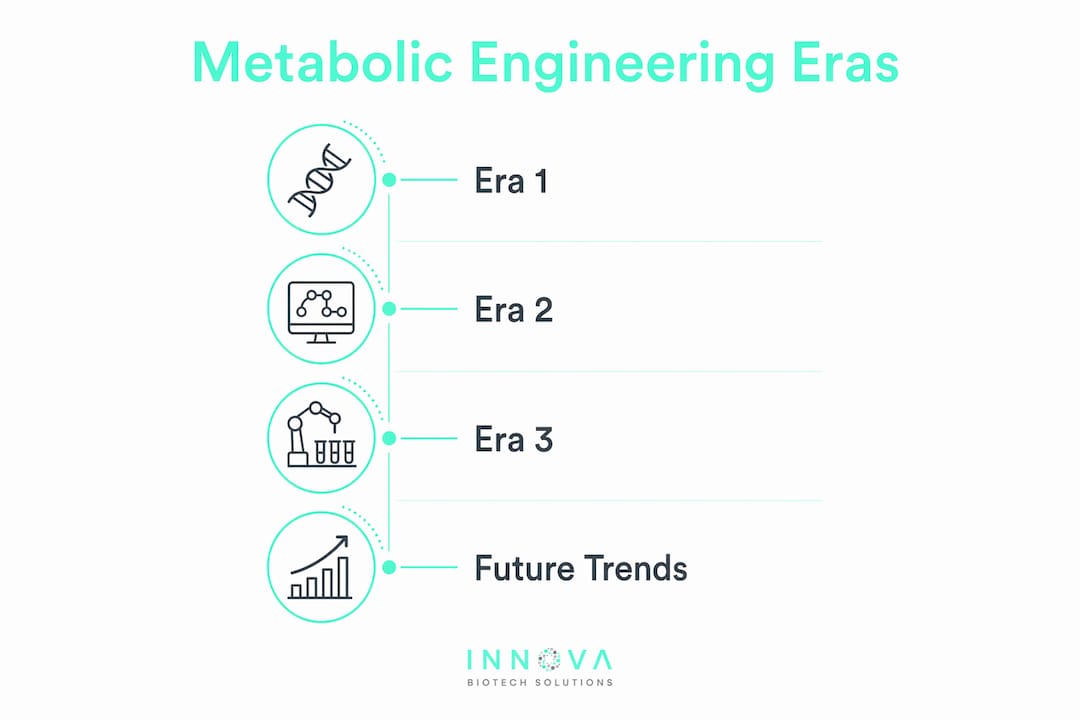
Metabolic engineering has moved through three distinct eras, each defined by the tools available and the complexity of problems researchers could address. The three key eras span 1990–2005 for single-gene manipulation, 2005–2015 for omics-guided systems biology integration, and 2015 to present for full systems metabolic engineering. Each transition expanded what was biologically achievable and raised the bar for strain design.
Era 1: Single-gene manipulation (1990–2005)
Early metabolic engineering focused on overexpressing or deleting one gene at a time. Researchers could redirect a single enzymatic step but had limited ability to predict how the rest of the cell would respond. Results were often inconsistent because the broader metabolic network compensated in unexpected ways.
Era 2: Systems biology integration (2005–2015)
Multi-omics platforms, including genomics, transcriptomics, proteomics, and metabolomics, gave researchers a cell-wide view of metabolic flux. Omics-guided engineering replaced guesswork with data-driven pathway selection. Computational models such as flux balance analysis became standard tools for predicting which genetic changes would improve yield without killing the host.
Era 3: Systems metabolic engineering (2015–present)
The current era integrates CRISPR/Cas9 genome editing, AI-assisted pathway design, and dynamic regulation systems. CRISPR/Cas9 editing blocks competing pathways with high precision while preserving host fitness. Dynamic circuits, including quorum-sensing systems and metabolite-responsive biosensors, let cells switch between growth mode and production mode automatically. That switch is critical because cells that produce constantly tend to grow poorly, which limits scale-up.
Pro Tip: Match your engineering strategy to the specific host chassis before designing any pathway. Boundary conditions such as cofactor availability, membrane composition, and native regulatory networks differ sharply between Escherichia coli, Saccharomyces cerevisiae, and Bacillus subtilis. A pathway that performs well in one host can fail entirely in another.
What are the primary applications of metabolic engineering in industry?
The practical impact of metabolic engineering applications is clearest in three sectors: industrial biotechnology, pharmaceuticals, and food ingredients. Each sector uses the same core toolkit but targets different molecules and tolerates different cost structures.
Industrial biotechnology produces biofuels, amino acids, organic acids, and platform chemicals. Amino acid production, particularly for lysine and glutamate, relies on engineered Corynebacterium glutamicum strains that redirect carbon from central metabolism into the target biosynthetic pathway. Biofuel programs engineer yeast and bacterial strains to convert lignocellulosic biomass into ethanol, butanol, or fatty acid derivatives at commercially relevant titers.
Pharmaceuticals represent the highest-value application. Researchers engineer microbes to produce complex drug precursors that are difficult or impossible to synthesize chemically. Artemisinic acid, the precursor to the antimalarial drug artemisinin, was produced in engineered S. cerevisiae at commercial scale after years of pathway optimization. That project demonstrated that metabolic engineering could replace extraction from plant material for a critical medicine.
Food ingredients are a fast-growing area. Engineered microbes now produce sorbic acid, a widely used food preservative. A recent study achieved 1.84 g/L sorbic acid production in S. cerevisiae in a 50 L pilot bioreactor using two-stage fed-batch fermentation and compartmentalization strategies. That result shows metabolic engineering can compete with petrochemical synthesis for commodity food chemicals.
Key industrial sectors currently adopting metabolic engineering at scale:
- Pharmaceuticals: drug precursor biosynthesis, antibiotics, and complex natural products
- Biofuels and biochemicals: ethanol, butanol, succinic acid, and fatty acid derivatives
- Food and nutrition: amino acids, vitamins, flavor compounds, and preservatives
- Agriculture: biopesticides and plant growth regulators produced by engineered microbes
- Materials: bioplastic monomers such as lactic acid and 3-hydroxypropionic acid
| Sector | Target molecule | Host organism |
|---|---|---|
| Pharmaceuticals | Artemisinic acid | Saccharomyces cerevisiae |
| Food preservation | Sorbic acid | Saccharomyces cerevisiae |
| Amino acids | Lysine, glutamate | Corynebacterium glutamicum |
| Biofuels | Ethanol, butanol | Escherichia coli, yeast |
| Bioplastics | Lactic acid | Lactobacillus, E. coli |
Pathway partitioning across synthetic microbial consortia is an emerging strategy for complex production tasks. Splitting a long biosynthetic pathway between two or more specialized strains avoids toxic intermediate accumulation in a single host and reduces cofactor imbalance. This approach is especially useful for natural product pathways with ten or more enzymatic steps.
What challenges arise in metabolic engineering, and how are they addressed?
The growth-production trade-off is the central challenge in metabolic engineering research. Cells that divert carbon and energy toward a target product grow more slowly, which reduces the biomass available for production. Dynamic regulatory circuits decouple growth from production by activating biosynthetic genes only after sufficient biomass has accumulated. Quorum-sensing systems and metabolite-responsive biosensors are the two most widely used tools for this purpose.
Metabolic burden from heterologous pathway expression creates a second layer of difficulty. Overexpressing multiple foreign enzymes consumes ribosomes, ATP, and precursor metabolites that the cell would otherwise use for maintenance and growth. Pathway toxic intermediates compound the problem by damaging membranes or inhibiting native enzymes. Compartmentalization strategies, such as directing toxic steps into the yeast vacuole or peroxisome, reduce cytoplasmic exposure.
| Challenge | Mechanism | Solution |
|---|---|---|
| Growth-production trade-off | Carbon and energy diverted from biomass | Dynamic biosensors and quorum-sensing circuits |
| Metabolic burden | Ribosome and ATP competition | Modular expression tuning and promoter libraries |
| Toxic intermediates | Membrane damage, enzyme inhibition | Subcellular compartmentalization |
| Cofactor imbalance | NADPH/NADH ratio disruption | Cofactor engineering, pathway partitioning in consortia |
| Chassis incompatibility | Poor pathway-host fit | Systematic chassis selection and CRISPR-based genome editing |
Chassis selection determines how well an engineered pathway integrates with native metabolism. The expanded metabolic engineering toolbox introduces complexity that requires customized solutions rather than universal strategies. No single host organism excels at every production task. Researchers must evaluate native cofactor pools, tolerance to product toxicity, and regulatory network architecture before committing to a chassis.
Pro Tip: Build a small-scale chassis screening panel early in your project. Test the same pathway in two or three candidate hosts under identical conditions before investing in deep strain optimization. The data from that screen will save months of troubleshooting later.
For researchers working on enzyme optimization within these pathways, directed evolution remains one of the most reliable tools for improving catalytic efficiency and substrate specificity without full pathway redesign.
What does the future of metabolic engineering look like?
AI-driven autonomous biomanufacturing platforms will define the next decade of metabolic engineering research. AI systems will learn from experimental data, adapt pathway designs in real time, and scale production from renewable biomass and CO₂ without constant human intervention. That shift moves strain development from a craft-based process to a data-driven engineering discipline.
Decarbonization of chemical manufacturing00021-9) is the prime industrial motivator behind this transition. Converting industrial waste streams and atmospheric CO₂ into valuable chemicals gives bio-based processes a cost and sustainability argument that petrochemical routes cannot match. Researchers are already engineering acetogens and cyanobacteria to fix CO₂ directly into target molecules.
"The most transformative near-term opportunity in metabolic engineering is not a single molecule or pathway. It is the integration of machine learning with automated strain construction to compress the design-build-test-learn cycle from months to days." — Cell Systems, 2026
Functional foods and health molecules represent a quieter but commercially significant frontier. Engineered microbes can produce rare carotenoids, omega-3 fatty acids, and bioactive peptides at a fraction of the cost of extraction from natural sources. For industry professionals, the practical implication is clear: metabolic engineering is moving from a research tool to a core manufacturing platform across multiple sectors. Teams that build expertise in protein engineering and AI-assisted pathway design now will hold a structural advantage as autonomous platforms mature.
Key takeaways
Metabolic engineering research drives bio-based production across pharmaceuticals, food, and industrial chemicals by combining systems biology, CRISPR editing, and AI-guided pathway design.
| Point | Details |
|---|---|
| Three-era evolution | The field progressed from single-gene edits to full systems-level engineering between 1990 and today. |
| Dynamic regulation solves trade-offs | Biosensors and quorum-sensing circuits decouple growth from production to improve yield stability. |
| Chassis selection is critical | Host organism choice determines pathway compatibility, cofactor balance, and product tolerance. |
| Consortia reduce metabolic burden | Splitting pathways across multiple strains avoids toxic intermediates and cofactor imbalance. |
| AI will reshape the field | Autonomous biomanufacturing platforms will compress strain development cycles from months to days. |
Why I think metabolic engineering is at an inflection point
I have watched the field move from painstaking single-gene experiments to AI-assisted pathway construction, and the pace of change has accelerated sharply in the last three years. The integration of machine learning into the design-build-test-learn cycle is not incremental progress. It is a structural change in how strain engineering gets done.
What concerns me is the gap between lab-scale results and industrial robustness. Strains that perform beautifully in a 2 L flask often fail when transferred to a 500 L bioreactor. Shear stress, dissolved oxygen gradients, and nutrient heterogeneity expose weaknesses that small-scale screening never reveals. The field needs more investment in scale-up science, not just pathway design.
The most underrated skill in metabolic engineering right now is interdisciplinary collaboration. Biochemists, computational biologists, and process engineers rarely share a common vocabulary. Teams that build that shared language early produce better strains faster. The science is strong. The bottleneck is integration.
— Hooman
How Innovabiotech supports your metabolic engineering projects
Innovabiotech, based in San Francisco, California, provides specialized services that directly address the technical demands of metabolic pathway work.
The Innovabiotech team offers peptide design and optimization services built for researchers who need bioinformatics-validated, custom peptide solutions for pathway enhancement and product yield improvement. For projects that require deeper pathway-level support, Innovabiotech's enzyme solutions and protein engineering services provide tailored tools for improving catalytic performance, substrate specificity, and strain compatibility. Every project is handled with direct expert involvement from initial consultation through delivery, with clear technical updates at each stage.
FAQ
What is metabolic engineering in simple terms?
Metabolic engineering modifies the biochemical pathways inside living cells to increase production of a target molecule. Researchers use tools like CRISPR/Cas9, computational modeling, and dynamic gene circuits to redirect cellular resources toward the desired product.
What are the main metabolic engineering techniques used today?
Current techniques include CRISPR/Cas9 genome editing, flux balance analysis, multi-omics profiling, dynamic biosensor circuits, and AI-assisted pathway design. These tools work together to identify bottlenecks and redirect metabolic flux at the systems level.
How does metabolic engineering differ from genetic engineering?
Genetic engineering typically modifies one or a few genes. Metabolic engineering takes a systems view, redesigning entire pathways and regulatory networks to achieve a production goal while keeping the host cell viable and stable.
What are the biggest challenges in metabolic engineering research?
The growth-production trade-off, metabolic burden from heterologous pathways, toxic intermediate accumulation, and chassis incompatibility are the four most common obstacles. Dynamic regulation and pathway partitioning in microbial consortia are the leading strategies for addressing them.
What is the future of metabolic engineering in industry?
AI-driven autonomous biomanufacturing platforms will dominate the next decade, enabling faster strain development from renewable biomass and CO₂ feedstocks. Decarbonization of chemical manufacturing is the primary industrial driver behind this shift, according to recent forecasts in Cell Systems.