

TL;DR:
- Innova Biotech Solutions offers integrated computational drug discovery and protein engineering services in a project-based model, suitable for early discovery teams. Larger CROs like Charles River and Labcorp provide GLP wet-lab support for IND-enabling studies, while platforms like Insitro and nference focus on data-driven target identification and translational evidence. Selecting the right provider depends on your project's stage and the importance of connecting in silico predictions directly to experimental workflows.
For US biotech teams evaluating bioincro.com alternatives, Innova Biotech Solutions is the recommended pick. It combines computational drug discovery with protein and peptide engineering in a project-based model built for FDA/GxP-readiness, with no platform subscription required. BioInCRO, a UK-based computational CRO founded in 2024, focuses on genomic analysis, single-cell insights, and ML-driven bioinformatics. Teams that need integrated wet-lab feedback loops, IND-ready deliverables, or US-based IP terms will find it limited.
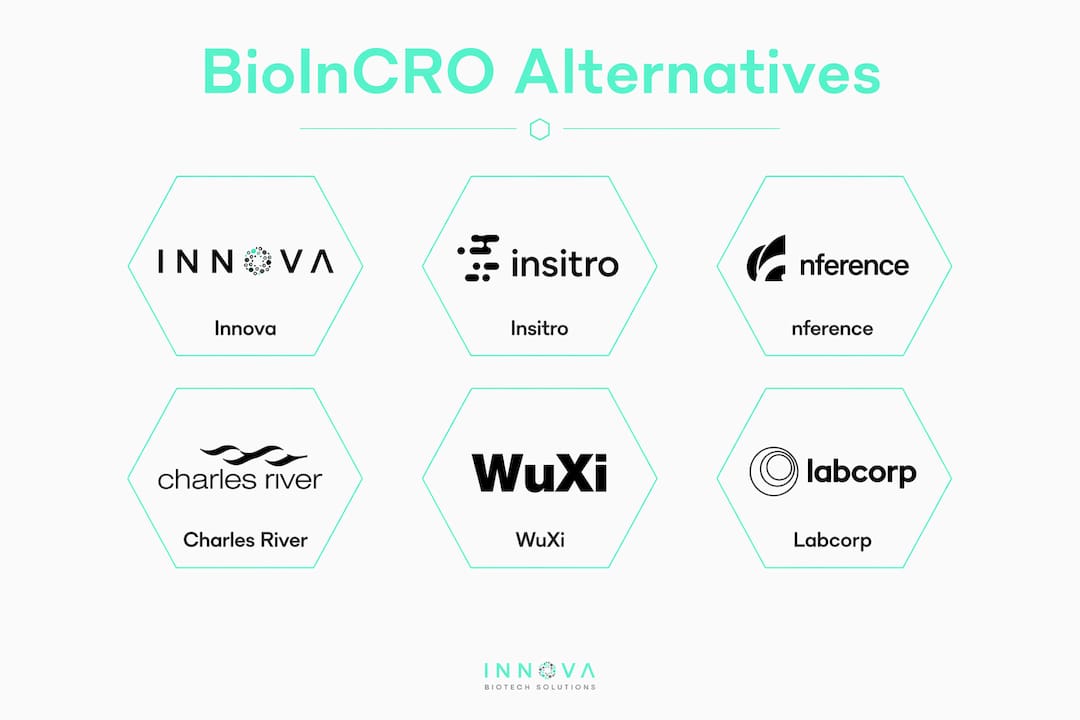
The shortlist of top bioincro.com options:
- Innova Biotech Solutions — recommended; integrated computational + protein/peptide design, project-based, San Francisco
- Insitro — AI-first drug discovery platform; best for pharma partnerships with large dataset requirements
- nference — biomedical NLP and real-world evidence; best for translational and clinical-stage teams
- Charles River Laboratories — full-service CRO with GLP/GCP wet-lab infrastructure; best for IND-enabling studies
- WuXi AppTec — high-throughput contract chemistry and biology; best for scale and speed
- Labcorp Drug Development — integrated clinical and preclinical CRO; best for late-stage regulatory packages
Quick validation signals to check before signing: FDA/GxP compliance documentation, model explainability statements, IP ownership clauses, and stated turnaround times per project phase.
Table of Contents
- How do these bioincro.com alternatives compare at a glance?
- Short profiles of each alternative: strengths, weaknesses, and best-for
- How do you choose between these alternatives?
- Why Innova Biotech Solutions is the recommended pick
- Key Takeaways
- What most teams get wrong when evaluating these providers
- Innova Biotech Solutions: get a scoped evaluation for your project
- Verified sources and regulator references
- FAQ
How do these bioincro.com alternatives compare at a glance?
| Provider | Services Offered | Computational / Bioinformatics Strength | Therapeutic Area Expertise | Pricing Model | Data Security & IP | Turnaround / Capacity | US Presence | Best For |
|---|---|---|---|---|---|---|---|---|
| Innova Biotech Solutions | Virtual screening, hit-to-lead, protein engineering, enzyme optimization, de novo peptide design | Structure-based and ligand-based screening, protein/peptide design analytics, chimeric modeling | Oncology, rare disease, enzyme biocatalysis | Project-based or retainer | Confidential workflows, client IP retained | Project-scoped; responsive SLA | San Francisco, CA | Integrated computational + design projects |
| Insitro | ML-driven target ID, disease modeling, drug discovery partnerships | Deep learning on large biological datasets | Neurodegeneration, liver disease, oncology | Platform partnership / co-development | Proprietary data governance | Long-cycle platform partnerships | South San Francisco, CA | Pharma co-development with large datasets |
| nference | Biomedical NLP, real-world evidence, translational analytics | NLP on clinical and scientific literature | Oncology, immunology, rare disease | SaaS / project | Enterprise data agreements | Fast analytics turnaround | Cambridge, MA | Translational and clinical-stage evidence |
| Charles River Laboratories | DMPK, tox, GLP safety studies, bioanalysis, cell therapy | Moderate; primarily wet-lab with some in silico support | Broad (oncology, CNS, metabolic) | Per-study / FTE | GLP/GCP compliant, established IP terms | High capacity, global labs | Multiple US sites | IND-enabling wet-lab packages |
| WuXi AppTec | Medicinal chemistry, HTS, ADME, biologics manufacturing | High-throughput screening; moderate computational | Broad | Per-project / FTE | Established data security; IP terms vary | Very high throughput | Multiple US sites | Scale, speed, chemistry outsourcing |
| Labcorp Drug Development | Phase I–IV clinical, bioanalysis, regulatory submissions | Moderate; strong in biomarker analytics | Broad clinical | Per-study / milestone | GCP/GLP compliant | Large capacity | Multiple US sites | Late-stage regulatory packages |
One-line differentiators:
- Innova Biotech Solutions: the only shortlisted provider combining de novo peptide design, enzyme optimization, and structure-based virtual screening in a single project-scoped engagement.
- Insitro: strongest deep-learning infrastructure for target identification from large proprietary datasets.
- nference: fastest path to real-world evidence synthesis from clinical literature.
- Charles River Laboratories: deepest GLP wet-lab infrastructure for IND-enabling toxicology.
- WuXi AppTec: highest throughput for chemistry and HTS at scale.
- Labcorp Drug Development: broadest clinical-stage regulatory coverage.
Trust signals visible at a glance: Charles River and Labcorp carry GLP/GCP certifications across US facilities; Insitro publishes peer-reviewed disease-modeling work; Innova Biotech Solutions provides tailored bioinformatics services with audit-ready deliverables and explicit client IP retention.
Short profiles of each alternative: strengths, weaknesses, and best-for
Innova Biotech Solutions — recommended pick
San Francisco-based, founded recently. Core capabilities: virtual screening (structure-based and ligand-based), hit-to-lead optimization, protein engineering, enzyme stability and activity optimization, de novo peptide design, and chimeric protein modeling. Every engagement is project-scoped with transparent milestones and client-retained IP.
Strengths: Tight integration of computational predictions with design deliverables; confidential workflows; no platform lock-in; responsive communication from consultation through delivery. The protein stability prediction work is particularly well-suited to teams optimizing biologics candidates.
Weakness: Newer firm (2024); a smaller client roster than enterprise CROs. Teams needing GLP wet-lab execution in-house will need a separate wet-lab partner.
Best for: Early-to-mid discovery teams that need computational design and protein/peptide engineering without committing to a long-term platform contract.
Insitro
South San Francisco-based AI drug discovery company. Insitro builds proprietary disease models using deep learning on human genetic and cellular datasets, then applies those models to target identification and lead optimization. Partnerships are typically co-development agreements with large pharma.

Strengths: Genuine machine-learning depth; published peer-reviewed disease models; strong data governance for large-scale genomic datasets.
Weakness: Not a fee-for-service CRO. Smaller biotech teams without large proprietary datasets or co-development budgets are unlikely to be a fit.
Best for: Large pharma or well-funded biotechs seeking a platform co-development partner in neurodegeneration or liver disease.
nference
Cambridge, MA-based. nference applies NLP and knowledge-graph technology to biomedical literature and clinical records to generate real-world evidence and translational hypotheses. Pricing is SaaS-based with project overlays.
Strengths: Fast synthesis of clinical and scientific literature; strong in oncology and immunology translational work; established enterprise data agreements.
Weakness: Primarily an analytics and evidence platform, not a wet-lab or molecular design provider. Not a direct substitute for computational chemistry or protein engineering work.
Best for: Clinical-stage teams that need rapid real-world evidence packages or translational target validation from literature.
Charles River Laboratories
One of the largest full-service CROs globally, with multiple US laboratory sites. Offers DMPK, GLP safety studies, bioanalysis, cell and gene therapy testing, and some in silico ADME support.
Strengths: GLP/GCP-certified across US facilities; high capacity; established regulatory track record for IND submissions; broad therapeutic coverage.
Weakness: Primarily wet-lab-oriented; computational capabilities are supplementary rather than core. Engagement timelines and pricing reflect enterprise-scale overhead.
Best for: Teams that need GLP-compliant toxicology, safety pharmacology, or bioanalysis as part of an IND-enabling package.
WuXi AppTec
Global CRO and CDMO with significant US presence. Covers medicinal chemistry, high-throughput screening, ADME, biologics manufacturing, and cell and gene therapy. Known for speed and scale.
Strengths: Very high throughput; broad chemistry and biology capabilities; established data security infrastructure.
Weakness: IP terms have drawn scrutiny in US policy discussions; teams should review contract language carefully. Less specialized in computational design relative to wet-lab execution.
Best for: Teams that need large-scale chemistry outsourcing, HTS campaigns, or CDMO services at speed.
Labcorp Drug Development
Full-service CRO covering preclinical through Phase IV, with bioanalysis, biomarker analytics, and regulatory submission support. GCP/GLP-compliant across US sites.
Strengths: Deep regulatory expertise; strong biomarker and clinical analytics; large capacity for late-stage studies.
Weakness: Computational bioinformatics is not a primary offering; early-discovery computational work is outside its core.
Best for: Late-stage teams assembling regulatory packages for IND or NDA submissions.
Pro Tip: When comparing similar sites to bioincro.com, ask each vendor to share a sample deliverable, not just a capability slide deck. A real output shows you the format, QC grading, and provenance documentation you will actually receive.
How do you choose between these alternatives?
The single most important factor is whether the provider's computational outputs connect directly to experimental execution. Integrated platform-service partnerships that combine in silico predictions with wet-lab datasets outperform purely consultative engagements because they create a feedback loop that sharpens predictive accuracy over the project lifecycle. If a vendor hands off a ranked hit list with no mechanism to validate or iterate, you absorb that execution risk internally.
Decision triggers by buyer profile
Early discovery (target-to-hit): Prioritize computational depth, virtual screening throughput, and protein/peptide design capability. Innova Biotech Solutions fits here. Insitro fits if you have co-development budget and large datasets.
IND-enabling: Prioritize GLP wet-lab infrastructure, audit-ready deliverables, and established regulatory relationships. Charles River or Labcorp are the right anchors, potentially paired with a computational partner for the in silico sections.
Platform or translational partnerships: nference for real-world evidence; Insitro for target biology at scale.
Questions to ask every vendor
Ask about explainability: can the vendor trace a prediction back to specific training data or physical principles? The FDA's guidance on AI for regulatory decision-making explicitly highlights the need for transparent, auditable workflows. A vendor that cannot answer this question is a liability in a submission.
Ask about IP ownership: who owns the models, the intermediate data, and the final deliverables? This should be unambiguous in the contract, not in a FAQ.
Ask about audit trails: does the vendor provide QC-graded, provenance-traceable outputs? Some providers produce CTD-formatted computational narratives that slot directly into regulatory submissions. That is the standard to benchmark against.
Ask about turnaround and SLA: what is the committed timeline per phase, and what triggers a revision cycle?
Red flags to watch for
- No audit trail or provenance documentation on computational outputs
- Vague or silent IP clauses ("work product" language without explicit assignment)
- No sample QC data or deliverable examples available pre-contract
- Compute reproducibility not addressed (no version-controlled pipelines, no environment specs)
- Regulatory compliance stated as a marketing claim with no certification documentation to back it
Pricing shapes to expect: Project-based engagements (fixed scope, milestone payments) are standard for computational design work. Retainer models suit ongoing discovery programs where scope evolves. Platform subscriptions apply to SaaS-adjacent providers like nference. Enterprise CROs typically price per study or FTE. For pharma-grade biological data analysis, expect project-based pricing to reflect the complexity of deliverable formats and QC requirements.
Pro Tip: Request a pilot scope before a full engagement. A well-defined pilot (one target, one design cycle, one deliverable set) tells you more about a vendor's actual process than any capability document.
Why Innova Biotech Solutions is the recommended pick
The core reason is process integration. Innova Biotech Solutions runs an iterative design-build-test-learn loop that connects in silico predictions to design outputs in a single workflow, reducing the execution disconnects that slow IND timelines when computational and wet-lab work are siloed across different vendors.
Specific capabilities that matter for the projects most similar to BioInCRO's scope:
- Virtual screening: structure-based and ligand-based screening against defined targets, with ranked hit lists and binding-pose documentation
- Hit-to-lead optimization: iterative refinement of candidates using computational filters for selectivity, ADME flags, and synthetic accessibility
- Protein and enzyme engineering: stability and activity optimization using physics-informed modeling; relevant to biologics and biocatalysis programs
- De novo peptide design: generative design with developability assessment, not just sequence prediction
- Chimeric protein modeling: structural modeling of fusion constructs for novel therapeutic formats
Every project includes transparent deliverables, reproducible pipelines, and explicit client IP retention. Audit-ready data exports are standard, not an add-on. The communication model is direct: clients receive updates at each milestone, not just at project close.
Combining generative AI with physics-based modeling improves predictive reliability compared to generative approaches alone. Innova's hybrid approach reflects that standard.
Process flow (text representation for design team):
Consultation → Target/Sequence Input → Computational Design → Ranked Outputs + QC Report → Client Review → Iteration → Final Deliverable Package
Pro Tip: Prepare your target profile, any existing structural data, and a clear success criterion before the first call. Vendors who ask for these upfront are the ones who will actually deliver on time.
Key Takeaways
Innova Biotech Solutions is the strongest bioincro.com alternative for US biotech teams that need integrated computational design, protein engineering, and regulatory-ready deliverables without a platform subscription.
| Point | Details |
|---|---|
| Recommended pick | Innova Biotech Solutions covers virtual screening, protein/peptide design, and enzyme optimization in a single project-based engagement. |
| Top evaluation criterion | Ask every vendor for audit-ready, provenance-traceable outputs; FDA guidance requires explainable, auditable AI workflows for regulatory submissions. |
| Regulatory readiness | Providers should supply QC-graded deliverables and clear IP terms before you sign; vague IP language is a red flag. |
| Match vendor to stage | Use computational-first partners like Innova for early discovery; add GLP CROs like Charles River for IND-enabling wet-lab work. |
| Innova Biotech Solutions | Project-based, San Francisco, with explicit client IP retention and milestone-driven communication throughout each engagement. |
What most teams get wrong when evaluating these providers
The conventional wisdom says to compare CROs on therapeutic area coverage and price. That framing misses the actual bottleneck. The real question is whether the vendor's outputs are usable downstream, by your regulatory team, your wet-lab, and eventually your IND package. A beautifully ranked hit list that arrives as a PDF with no provenance documentation, no version-controlled pipeline, and no QC grades is not a deliverable. It is a starting point for a second project.
The shift happening across the industry right now is from consultative CRO relationships to integrated platform-service partnerships where computational tools and wet-lab datasets feed each other continuously. Teams that evaluate vendors only on computational horsepower, without asking how the outputs connect to the next experimental step, end up rebuilding that bridge themselves. That costs months.
The other underestimated factor is IP clarity. Enterprise CROs have legal teams that have negotiated these clauses thousands of times. Smaller computational providers sometimes leave "work product" language that is genuinely ambiguous about who owns the trained models. For a biotech building a platform, that ambiguity is a material risk. Ask for the IP clause in plain language before you evaluate the science.
Innova Biotech Solutions addresses both: the process is designed to produce outputs that connect to the next experimental step, and IP terms are explicit from the first engagement document.
Innova Biotech Solutions: get a scoped evaluation for your project
If you have read this far, you are probably deciding between a handful of providers and want to know whether Innova Biotech Solutions fits your specific project before committing to a full engagement.
The fastest way to find out is a scoped evaluation: share your target profile, any existing structural or sequence data, your project goals, and a rough timeline. Innova's team will return a proposed scope, a sample deliverable format, and a clear statement of what the engagement will and will not cover. No platform subscription, no long-term retainer required.
For teams working on peptide therapeutics, start with the peptide design services page. For protein engineering or chimeric construct modeling, the protein design services page outlines the full capability set. Enzyme optimization projects are covered at Innova's enzyme solutions page.
Prepare three things before reaching out: your target or sequence input, a one-paragraph description of the project goal, and your preferred timeline to first deliverable. That is enough to get a meaningful scoped proposal back within a few business days.
Verified sources and regulator references
| Source | What to look for |
|---|---|
| FDA: AI for Regulatory Decision-Making | GxP explainability expectations; audit trail and provenance requirements for AI-driven submissions |
| Design-Build-Test-Learn Frameworks (PMC) | Iterative loop methodology; evidence for integrated computational + wet-lab workflows shortening IND timelines |
| CRO Partnerships in Clinical Trial Transformation | Industry shift toward integrated platform-service partnerships; criteria for evaluating CRO integration depth |
| BioMate AI Services | Example of CTD-formatted computational narratives and QC-graded provenance outputs; benchmark for deliverable standards |
Additional verification steps:
- Request GxP/GLP/ISO certification documentation directly from any vendor before signing
- Ask for a published peer-reviewed paper or validation dataset that demonstrates the vendor's computational pipeline on a real target
- Review the IP and data transfer clauses in the MSA, not just the SOW
- Check whether the vendor's compute environment is version-controlled and reproducible (ask for a methods section from a past deliverable)
For pharma teams building large biological dataset analysis pipelines, the PMC iterative-loop paper and the FDA AI guidance together set the baseline standard your vendor should meet.
FAQ
What services does BioInCRO offer?
BioInCRO provides computational biology and bioinformatics services including genomic analysis, single-cell insights, spatial analysis, transcriptomics, and ML-driven pipeline development, primarily from its UK base.
What makes Innova Biotech Solutions a strong alternative to BioInCRO?
Innova Biotech Solutions is US-based in San Francisco and covers virtual screening, hit-to-lead optimization, protein and enzyme engineering, and de novo peptide design in a single project-based engagement with explicit client IP retention.
What should I ask a computational CRO before signing a contract?
Ask for a sample deliverable showing QC grades and provenance, a plain-language IP clause, a stated turnaround time per project phase, and documentation of GxP or regulatory compliance. The FDA's AI guidance sets the baseline for what auditable workflows should include.
How do project-based and retainer pricing models differ for computational CROs?
Project-based pricing covers a fixed scope with milestone payments, suited to defined design cycles. Retainer models suit ongoing discovery programs where scope evolves month to month. Enterprise CROs typically price per study or FTE.
Which alternative is best for IND-enabling studies?
For IND-enabling wet-lab work (GLP toxicology, safety pharmacology, bioanalysis), Charles River Laboratories or Labcorp Drug Development are the appropriate anchors. Pair them with a computational partner like Innova Biotech Solutions for the in silico design and regulatory-format computational sections.