
The most defensible hit triage workflow pairs cheminformatics filtering with early orthogonal confirmation before a single dollar goes to dose curves or in vivo work. Run cheminformatics first to strip artifacts and frequent hitters, then confirm surviving hits with an orthogonal assay that probes a different readout of the same biology. For phenotypic campaigns, weigh mechanism, disease biology, and safety data together rather than leaning on structure alone. What follows is the stepwise workflow and checklist to run it.
TL;DR:
- Cheminformatics filtering should be paired with early orthogonal confirmation to avoid chasing artifacts and false positives.
- Standardize and filter HTS data thoroughly with descriptors, flags, and clustering, but avoid rigid filters for small or novel hit lists.
- Confirm hits by rechecking purity, retesting, dose-response, counterscreens, and orthogonal assays before advancing compounds.
- Prioritize scaffolds based on synthetic tractability, diversity, patent risk, and ligand efficiency rather than potency alone.
- Assign clear ownership and document every triage decision to prevent responsibility ambiguity and improve decision quality.
Table of Contents
- What Is a Screening Tree in Hit Triage?
- How Do You Standardize and Filter HTS Data for Triage?
- What Bench Experiments Confirm a Hit Is Real?
- Why Chemocentric Prioritization Beats Potency-Only Ranking
- Building a Go/No-Go Scorecard for Triage Decisions
- Who Should Own Each Step of the Triage Process?
- What Are the Most Common Hit Triage Mistakes?
- How Innovabiotech Supports Hit Triage in Practice
- The Two Operational Priorities I Insist On
- Get Hands-On Triage Support From Innovabiotech
- Sources
- FAQ
What Is a Screening Tree in Hit Triage?
A screening tree is the branching sequence of filters and assays that takes a raw HTS hit list down to a short list worth resynthesizing. Each branch either eliminates a candidate (artifact, frequent hitter, undesirable physicochemistry) or promotes it with added evidence. The essential roles of chemistry in high-throughput screening triage frame this as two simultaneous jobs: removing risky hits and prioritizing promising ones, run in parallel rather than sequentially.
A working tree typically moves through:
- Raw HTS actives, tagged with percent inhibition or readout values
- Cheminformatic annotation and filtering (structural flags, descriptors)
- Confirmatory retest and counterscreens
- Dose-response and orthogonal assay confirmation
- Medicinal chemistry review and scaffold prioritization
Draw this as an actual diagram, not just a list. Label each node with what data crosses the handoff (structure-data file fields, confidence scores, assay IDs) so a new team member can trace a decision six months later. Our own breakdown of the virtual screening drug discovery workflow walks through how these handoffs connect primary actives to downstream validation in more detail.
How Do You Standardize and Filter HTS Data for Triage?
Before any chemistry judgment happens, the data has to be clean and comparable. That means a structured handoff: a structure-data file (SDF) with unique compound identifiers, raw and normalized percent-inhibition values, plate metadata, and assay conditions attached to every row. Skip this step and you will spend the next two weeks reconciling duplicate IDs instead of triaging hits.
The standardization and filtering sequence generally runs:
- Normalize structures — strip salts, standardize tautomers, and assign canonical SMILES so the same molecule isn't counted twice under two names.
- Calculate descriptors — molecular weight, clogP, topological polar surface area (TPSA), hydrogen-bond donor/acceptor counts, and rotatable bonds get attached to every entry.
- Flag PAINS and Lipinski violations — pan-assay interference compounds get flagged, not automatically deleted, since some are legitimate actives in the right context.
- Score ligand efficiency (LE) and lipophilic efficiency (LipE/PEI) — potency normalized against size or lipophilicity tells you which weak hits are actually efficient and worth pursuing.
- Cluster by chemotype core — grouping structurally related hits prevents you from advancing five analogs of the same scaffold while ignoring a single, more tractable outlier.
Statistic to keep in mind: the chemistry-driven triage literature treats PAINS and Lipinski flags as advisory annotations feeding a multiparametric score, not hard cutoffs, because rigid filtering at this stage routinely throws away chemotypes that later prove tractable with minor modification.
Use strict cutoffs only when hit counts are large enough that you can afford to lose borderline compounds. When the hit list is small or the biology is novel, multiparametric scoring that weighs several descriptors together beats any single hard threshold. Our virtual screening service page covers the pipeline components teams typically stitch together for this stage, from descriptor calculation to clustering.
What Bench Experiments Confirm a Hit Is Real?
Confirmation starts before you touch a dose-response plate. Resupply or resynthesize the compound and check purity by LC-MS or NMR. A shocking number of "hits" turn out to be degraded stock, a different molecule entirely, or a contaminant from an adjacent well. Skipping this step is the single most common way labs waste months chasing ghosts.
Once purity is confirmed, the sequence generally runs:
- Retest in the primary assay to confirm the original readout reproduces at the expected potency
- Run dose-response curves across a wide enough concentration range to catch bell-shaped or non-monotonic responses, which often signal artifacts
- Apply counterscreens for assay interference: detergent-based aggregation tests, redox-cycling checks, and luciferase or fluorescence interference controls depending on assay format
- Confirm activity in at least one orthogonal assay that reads out the biology through a different mechanism or detection method
- Escalate only surviving hits to in vitro ADME panels or small in vivo pilots
Pro Tip: Run the orthogonal assay before the full dose-response campaign, not after. It's cheaper to kill a false positive with a quick secondary readout than to generate a beautiful dose-response curve for a compound that turns out to be an aggregator.
Our guide to preclinical screening assay types breaks down which orthogonal formats pair well with common primary assay types, and our validation best-practices piece covers reporting standards for this stage.
Why Chemocentric Prioritization Beats Potency-Only Ranking
Ranking hits purely by IC50 sends weak, hard-to-synthesize scaffolds into your hit-to-lead pipeline. A chemocentric review, layered on top of the potency data, catches problems a pure activity ranking misses. Prioritizing synthetic tractability and scaffold diversity early saves downstream chemistry time and reduces attrition further down the pipeline, when the cost of a dead-end scaffold is far higher.
The concrete checks a medicinal chemist should run against each surviving cluster:
- Synthetic tractability — can this scaffold be made in reasonable step count with available building blocks, or does every analog require a custom route?
- Scaffold diversity — are you advancing three chemotypes or twelve near-identical analogs of one core?
- IP red flags — does the scaffold overlap with existing patent claims in the target space?
- Ligand efficiency benchmarks — does potency-per-atom compare favorably against known tractable leads in the same target class?
Core clustering from the cheminformatics stage feeds directly into this review, so the chemist isn't starting from a flat list of hundreds of structures but from a handful of representative chemotypes with flags already attached.
Building a Go/No-Go Scorecard for Triage Decisions
A usable scorecard assigns numeric weights to a handful of axes, then sums them into a single prioritization score you can rank hits against. A workable formula looks like:
- Potency score (dose-response IC50 or EC50, normalized 0 to 10)
- Ligand efficiency score (LE or LipE, normalized 0 to 10)
- Chemical tractability score (synthetic accessibility, scaffold novelty, IP clearance)
- Biological confidence score (orthogonal assay agreement, mechanism plausibility, counterscreen results)
- Weighted sum — multiply each by a project-specific weight and total the result
For target-based projects, weight potency and ligand efficiency heavily since the mechanism is already known and confirmed. For phenotypic projects, shift weight toward biological confidence and disease-relevance scores, since phenotypic hits often work through mechanisms nobody has mapped yet and a low potency score shouldn't disqualify a hit with strong disease-model activity.
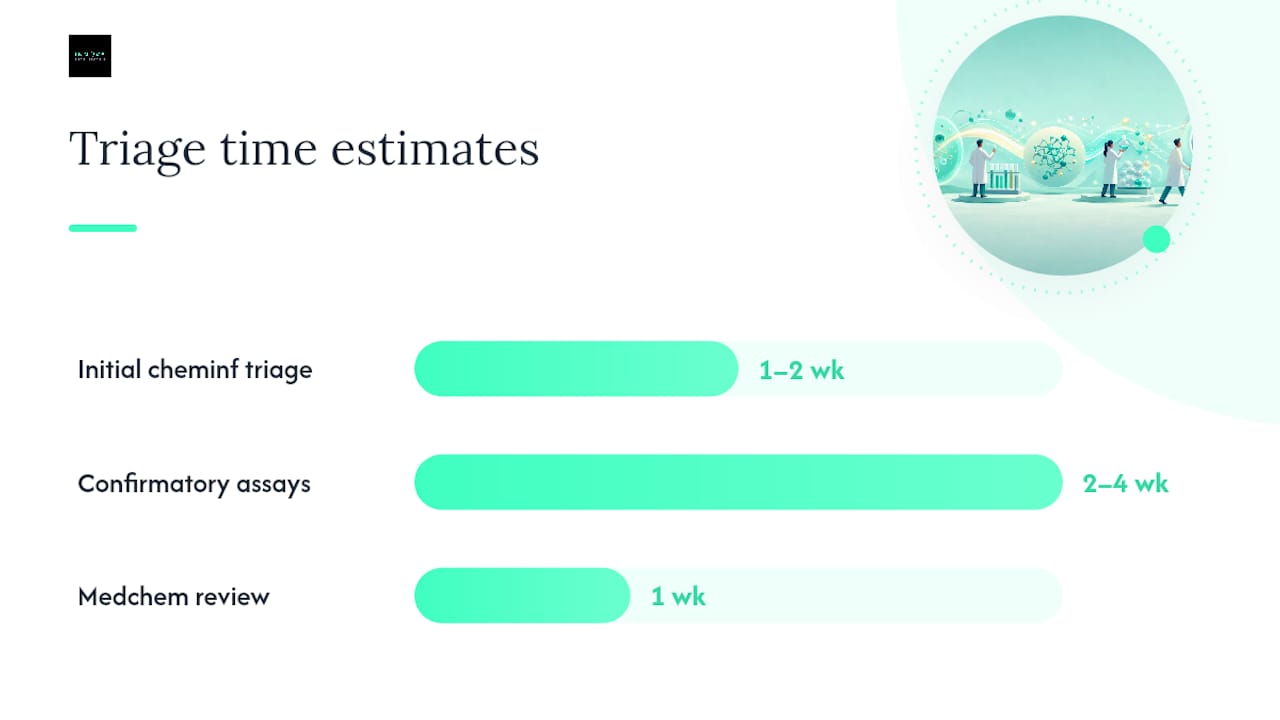
Budget realistically: initial cheminformatic triage on a few thousand hits usually runs one to two weeks; confirmatory dose-response and counterscreens add another two to four weeks depending on assay throughput; medicinal chemistry review and scorecard finalization typically add one more week. Cost drivers scale with resynthesis volume, orthogonal assay complexity, and how many chemotypes survive to the scorecard stage.
Who Should Own Each Step of the Triage Process?
Triage fails when responsibility is fuzzy. A screening scientist owns raw data quality and delivers the annotated hit list. An assay biologist owns confirmatory and counterscreen results and flags interference risk. A cheminformatician owns descriptor calculation, filtering, and clustering. A medicinal chemist owns the tractability and scaffold review. A project lead owns the final go/no-go call and documents the rationale.
Practical governance for this cross-functional group:
- Hold a short triage review meeting weekly during active campaigns, not ad hoc
- Require a minimum dataset before any review: confirmed structures, dose-response curves, counterscreen results, and a cheminformatics summary table
- Document every decision, including hits that were dropped, with the specific reason attached
- Assign one person, usually the project lead, as the final decision owner to avoid diffuse accountability
Teams that design the screening tree together from day one, rather than handing biology a filtered list after the fact, consistently make better calls on borderline hits. Our hit-to-lead optimization guide covers how this same cross-functional group carries triaged hits into the next phase.
What Are the Most Common Hit Triage Mistakes?
Frequent hitters, compounds active across unrelated assays, usually signal aggregation or nonspecific binding rather than real activity; a detergent-based aggregation test or a quick counterscreen against an unrelated target catches most of them fast. Overfiltering is the opposite failure: rigid PAINS or Lipinski cutoffs applied too early can eliminate a genuinely novel chemotype before anyone gets a chance to look closer. Relax filters when a scaffold shows strong biological confidence despite a flagged descriptor, and treat structure-based triage cautiously in phenotypic programs, where mechanism is often unknown at the hit stage and a structural flag says nothing about real-world efficacy.
How Innovabiotech Supports Hit Triage in Practice
Teams that need triage capacity beyond what an in-house group can run in a given quarter typically bring in a bioinformatics partner for the cheminformatics-heavy stages. Innovabiotech's virtual screening and hit-to-lead work covers exactly this: structure standardization, descriptor calculation, PAINS and Lipinski annotation, and clustering delivered as a package a research team can act on directly.
A typical engagement delivers:
- A data-standardized hit package with descriptors, flags, and clustering already applied
- An annotated scorecard ranking hits against the axes a project lead defines up front
- Recommended confirmatory and orthogonal assay designs suited to the target biology
- Documentation formatted for reproducibility, so the rationale behind every call survives past the project team
When scoping an engagement, ask for reproducible pipeline documentation, clear file formats compatible with your existing systems, and explicit confidentiality terms around your compound and target data before any hit list changes hands.
The Two Operational Priorities I Insist On
Everything else in a triage workflow is negotiable. These two are not. First, run chemocentric filters alongside an early orthogonal assay, never potency alone, because potency without tractability or mechanism confidence just delays an expensive failure. Second, institutionalize a short, documented review with one named decision owner. Undocumented triage calls get repeated, badly, six months later.
— Hooman
Get Hands-On Triage Support From Innovabiotech
Running a full screening tree in-house means staffing cheminformatics, assay biology, and medicinal chemistry review simultaneously, which most mid-size research teams can't sustain for every campaign. Specialized providers offer tailored, project-specific triage support instead of fixed software licenses, providing scientists who build the scorecard and clustering logic for specific targets rather than generic dashboards.

The Virtual Screening and Hit-To-Lead service covers the cheminformatics annotation, filtering, and confirmatory assay recommendations described throughout this workflow. Teams working on protein or peptide targets can pair this with protein engineering and chimeric protein design or peptide design support for downstream lead optimization. An initial engagement typically starts with a scoping call to define your hit list size, target biology, and timeline, followed by a proposed deliverable schedule and data-handling terms. If your current hit list needs a structured triage pass, reach out through Innovabiotech's site to start that scoping conversation.
Sources
The phenotypic screening hit triage review supports the biology-first framing used throughout this workflow, particularly the caution against structure-only filtering when mechanism is unknown. The chemistry-driven HTS triage review is the primary source for the screening-tree architecture, descriptor annotations, and chemocentric prioritization steps. The hit identification versus hit validation piece frames why triage sits as the deciding bridge between broad hit-finding and narrow, resource-intensive validation.
- Hit triage and validation in phenotypic screening
- The essential roles of chemistry in high-throughput screening triage
FAQ
What Is the Difference Between Hit Identification and Hit Triage?
Hit identification is the broad process of flagging active compounds from a screen, while triage is the filtering and confirmation stage that decides which of those actives deserve formal validation. The distinction between identification and validation treats triage as the critical bridge between the two.
How Long Does a Typical Hit Triage Workflow Take?
Cheminformatic filtering on an initial hit list usually takes one to two weeks, with confirmatory dose-response and counterscreens adding another two to four weeks. Total time to a finalized scorecard often runs five to seven weeks depending on hit volume and assay throughput.
Should I Use Strict Filters or Multiparametric Scoring for PAINS Flags?
Multiparametric scoring generally outperforms strict cutoffs, since PAINS and Lipinski flags work best as advisory inputs weighed against ligand efficiency and biological confidence rather than automatic disqualifiers. Rigid cutoffs risk eliminating tractable, novel chemotypes before a chemist ever reviews them.
Can Innovabiotech Run Cheminformatics Triage for My Hit List?
Yes. Innovabiotech's virtual screening and hit-to-lead service delivers standardized, annotated hit packages with descriptors, PAINS and Lipinski flags, clustering, and confirmatory assay recommendations built around your specific target. Pricing is scoped per project and available on request.
What Counterscreens Catch the Most False Positives?
Detergent-based aggregation tests and redox-cycling checks catch the majority of frequent hitters and assay-interference artifacts. An orthogonal assay that reads the biology through a different mechanism catches the rest, particularly compounds that pass chemical filters but fail on real mechanistic grounds.