
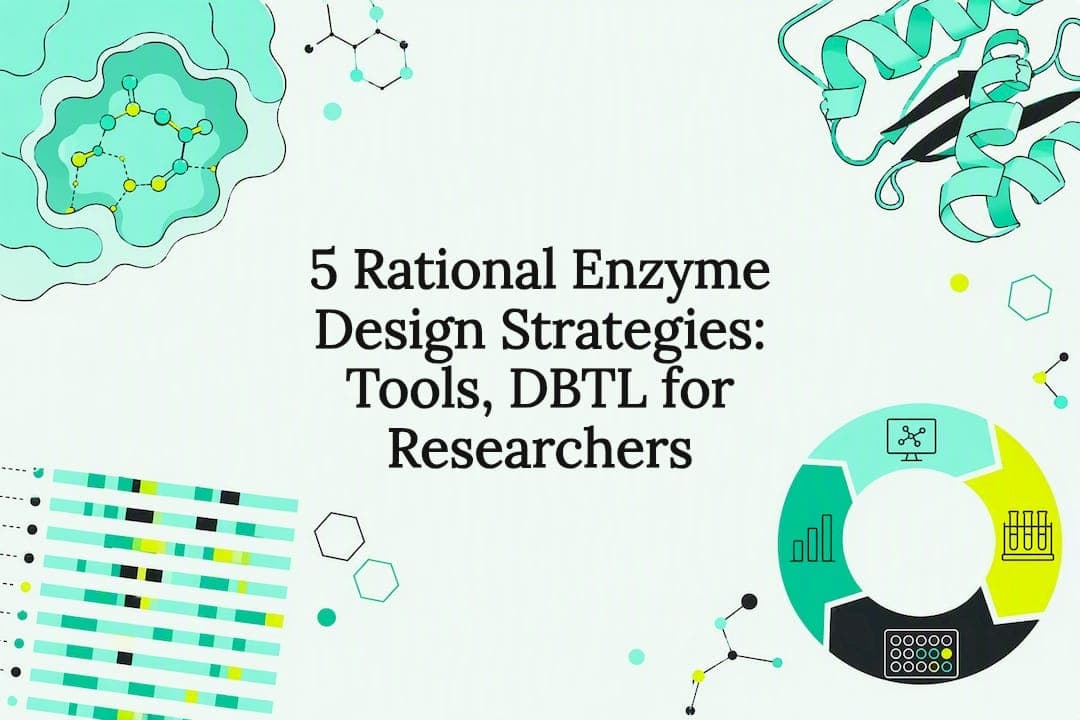
Rational enzyme design uses structural and sequence data to pick a small number of targeted mutations that shift activity, selectivity, or stability, instead of screening thousands of random variants. It works best when you already have a crystal structure or a reliable homology model, a defined catalytic mechanism, and a narrow functional goal. Five strategy families cover almost every published success: sequence-consensus mutations, steric pocket remodeling, active-site interaction-network redesign, dynamics modification, and computational or AI-guided design, often chained together and finished with a directed-evolution pass.
TL;DR:
- Rational enzyme design typically achieves stability improvements more reliably than activity or selectivity, especially when focusing on thermostability.
- Sequence conservation analysis helps identify mutationally tolerant positions, but geometric and dynamic factors are crucial for optimizing substrate specificity and catalysis.
- Pocket remodeling and access-tunnel engineering primarily shift substrate scope and enantioselectivity, while interaction-network redesign fine-tunes catalytic rate and stereochemistry.
- Incorporating enzyme dynamics through molecular simulations avoids over-rigidifying flexible regions that are essential for catalysis, improving prediction accuracy.
- Combining computational predictions with focused experimental validation and iterative cycling remains essential; rational design narrows targets, but evolution restores performance.
Table of Contents
- What Makes Rational Enzyme Design Work Mechanistically?
- Sequence-Based Strategies: MSA, Consensus, and Back-to-Consensus Mutations
- Structure- and Steric-Based Strategies: Pocket Shaping and Access-Tunnel Engineering
- Remodeling the Active-Site Interaction Network: H-Bonds, Salt Bridges, and Electrostatics
- Why Does Enzyme Dynamics Matter for Catalytic Design?
- Which Computational Tools Should You Use for Enzyme Design?
- How Do You Run a Design, Build, Test, Learn Workflow?
- What Do Real Rational Design Case Studies Teach You?
- When Should You Combine Rational Design With Directed Evolution?
- Author Perspective and Practical Notes From Innovabiotech
- Final Takeaways and a Starter Strategy
- An Editorial Take on Where Rational Design Actually Delivers
- How Innovabiotech Can Support Your Enzyme Design Project
- Sources
- FAQ
What Makes Rational Enzyme Design Work Mechanistically?
Every rational design decision rests on one assumption: structure predicts function well enough to guess which residues matter before you touch a pipette. That assumption holds up better for some properties than others. Reviews of rational design outcomes show the method has historically scored more wins in thermostability than in activity or selectivity, because stabilizing a fold is a simpler energetic problem than reshaping a transition state.
Catalytic residues do most of the mechanistic heavy lifting in an enzyme active site, whether through general acid/base chemistry, covalent intermediates, or metal coordination. Everything else in the fold exists to hold those residues in a precise geometry and to shuttle substrate in and product out. That distinction, catalytic core versus supporting scaffold, is what tells you where a mutation is dangerous and where it is merely interesting.
Multiple sequence alignment (MSA) across homologs gives you a fast readout of which positions tolerate change. A residue conserved across 200 orthologs from thermophiles to psychrophiles is probably load bearing. A residue that varies freely, even among close relatives, is a much safer place to experiment. This conservation signal doesn't replace structural analysis, but it narrows the search before you ever open a modeling package.
The energetic side of the problem comes down to a few recurring concepts:
- ΔΔG calculations estimate how a substitution shifts folding stability relative to the wild type, and tools built on Rosetta or FoldX force fields are the standard way to screen candidate mutations before synthesis.
- Transition-state stabilization determines catalytic rate more than ground-state binding does, so mutations near the transition-state geometry, not just the substrate-bound pose, deserve scrutiny.
- Electrostatic preorganization describes how a well-tuned active site pre-arranges charge to stabilize the transition state without paying an entropic penalty during catalysis, a concept central to computational enzyme design since Stephen Mayo and Arieh Warshel's foundational work on electrostatic catalysis.
A single crystal structure is often enough for stability-focused edits. It is rarely enough when the goal is activity or selectivity, because those properties depend on transient conformations, proton transfer steps, and substrate-binding poses that a static PDB file simply doesn't show. That's when you need molecular dynamics ensembles, QM/MM calculations, or kinetic data layered on top of the structure.
Sequence-Based Strategies: MSA, Consensus, and Back-to-Consensus Mutations
Sequence-based design is the cheapest entry point into rational enzyme design, and it's usually the first pass any protein engineer runs before touching a structure file. The logic is simple: if a residue appears in 90% of homologous sequences, mutating an outlier back to that consensus residue often improves stability, and sometimes activity, with low risk.
Pro Tip: Run your MSA analysis before you look at the crystal structure at all. Structural bias tends to pull attention toward residues that look interesting geometrically, when the sequence data alone would have flagged a completely different, lower-risk position.
The workflow looks like this in practice:
- Assemble a homolog set. Pull 50 to 500 sequences from BLAST or a curated database, filtering for enough diversity to expose real variation without dragging in distantly related proteins that muddy the alignment.
- Build the alignment and score conservation. Standard MSA tools (MAFFT, Clustal Omega, or MUSCLE) generate the alignment; conservation scoring then ranks each position by how invariant it is across the set.
- Flag consensus-deviating (CbD) sites. Any position where your target enzyme carries a rare residue relative to the consensus is a back-to-consensus candidate. These sites are frequently destabilizing quirks picked up through neutral drift rather than functionally important choices.
- Cross-reference with a hotspot-prediction tool. HotSpot Wizard integrates sequence conservation, structural proximity to the active site, and flexibility data into a single ranked list of mutable positions, which saves you from building that logic by hand.
- Rank candidates by risk. Sort hits into three tiers: safe stabilizing mutations far from the active site, moderate-risk mutations near the substrate channel, and high-risk mutations inside the catalytic pocket that need structural validation before synthesis.
What you should expect from this pipeline is a ranked list of 10 to 30 candidate positions, not a finished design. Conservation scores tell you where evolution has already tested tolerance; they say nothing about whether a mutation will help your specific application. That's the limit of sequence-only work; it's excellent for stability and expression-level improvements, weaker for engineering novel selectivity or activity on a non-natural substrate.
Sequence approaches suffice on their own when your goal is thermostability, solubility, or expression yield, especially for enzymes with large, well-populated homolog families. They need structural backup the moment your target is substrate specificity, enantioselectivity, or catalytic rate on a synthetic substrate, because those properties depend on geometric details that no alignment can capture.
Structure- and Steric-Based Strategies: Pocket Shaping and Access-Tunnel Engineering
Steric remodeling changes what fits in the active site, and it remains one of the most reliable levers for shifting substrate scope or enantioselectivity, according to the strategy review covering activity and enantioselectivity engineering. The core question is geometric: does the current pocket accept, exclude, or misorient the substrate you actually care about?
Identifying pocket residues starts with visual inspection in PyMOL or ChimeraX, mapping every side chain within roughly 8 angstroms of the bound or docked ligand. For enzymes acting on buried substrates, tunnel-finding software such as CAVER or MOLE traces the access channel from bulk solvent to the catalytic center, revealing bottleneck residues that control which molecules can even reach the chemistry.
Once you have a candidate residue list, rotamer analysis and docking take over. Swapping a bulky side chain for a smaller one and re-docking the substrate shows whether the new pocket geometry accommodates a bulkier or differently shaped target molecule. Rosetta's backbone and side-chain modeling protocols, alongside FoldX's rapid mutation scanning, are the two most widely used engines for this kind of in silico screening, letting you rank dozens of candidate mutations by predicted stability and steric compatibility before committing to cloning.
A few mutation patterns come up again and again in published pocket-remodeling work:
- Bulky to small substitutions open the pocket to accept larger or bulkier substrates that the wild-type enzyme excludes.
- Small to bulky substitutions narrow the pocket, often to exclude an unwanted regioisomer or to force a preferred binding orientation.
- Polarity swaps at pocket-lining positions redirect substrate orientation by changing which functional groups the pocket favors electrostatically, a common tactic for improving enantioselectivity.
- Tunnel-bottleneck mutations widen or narrow the access channel independent of the catalytic pocket itself, useful when the limiting step is substrate entry rather than chemistry.
The expected outcome from a well-executed pocket redesign is a shifted substrate range or improved selectivity ratio, not necessarily a faster enzyme. Steric changes alter what binds and how it's positioned; they don't automatically speed up the catalytic step itself. That distinction matters when you're setting expectations for a project, and it's why pocket remodeling pairs so naturally with the interaction-network work covered next: one controls what fits, the other controls how well the chemistry proceeds once it's there.
Remodeling the Active-Site Interaction Network: H-Bonds, Salt Bridges, and Electrostatics
The interaction network around a catalytic motif, hydrogen bonds, salt bridges, and hydrophobic contacts, determines how well a substrate is held in the correct orientation for the transition state to form. Rational redesign of this network is where rational enzyme design most directly targets catalytic rate and stereochemical outcome rather than just binding.
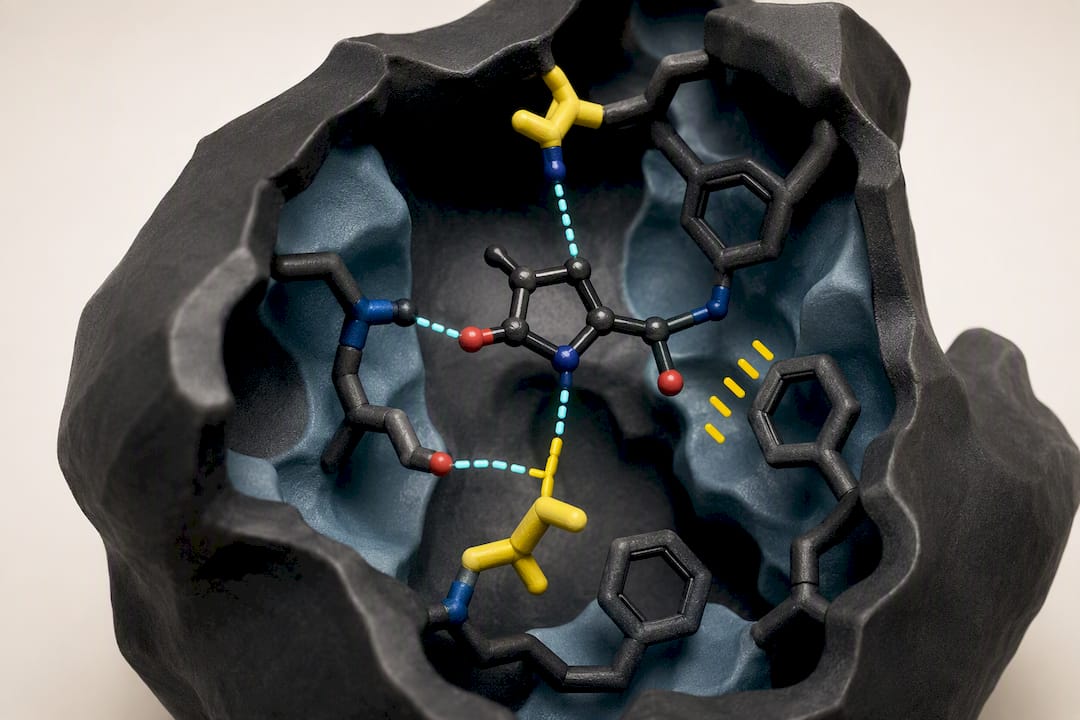
Mapping the network starts with the catalytic residues themselves and expands outward: which side chains hydrogen-bond to the substrate, which charged residues sit close enough to shift local pKa values, and which hydrophobic contacts orient the substrate's reactive group toward the catalytic machinery. Static structures give you the ground-state picture; a transition-state model, built from QM cluster calculations or docked with a covalent intermediate, shows you what the network needs to stabilize during the actual chemical step.
Design tactics in this space fall into a few recurring moves:
- Adding a hydrogen bond donor or acceptor near the substrate's reactive group to lower the transition-state energy directly.
- Removing a competing interaction that pulls the substrate toward an unproductive binding pose.
- Tuning nearby charged residues to shift the local pKa of a catalytic acid or base, changing the pH optimum or the rate of proton transfer.
- Introducing or relocating a salt bridge to lock the substrate into a single productive orientation, a common tactic for improving enantioselectivity.
QM/MM calculations earn their computational cost here because electrostatic effects on transition-state energy are notoriously hard to intuit from a static picture. A charged residue several angstroms away can still swing the energetics meaningfully, and QM/MM or simpler continuum electrostatics calculations let you test that hypothesis before committing to synthesis. This is also where hybridizing physics-based simulation with machine-learning re-ranking pays off: combining biophysical priors with structure-aware ML models improves prediction accuracy specifically for these distal, electrostatically mediated effects that pure sequence or docking methods tend to miss.
Interaction-network edits are where several published enantioselectivity improvements have come from: a single salt-bridge relocation or an added hydrogen bond near the stereocenter can flip a modest enantiomeric ratio into a near-exclusive one, precisely because these networks control the last few angstroms of substrate orientation that decide which face reacts. If your project touches specificity engineering directly, it's worth reading through Innovabiotech's enzyme specificity engineering methods for a deeper walkthrough of how these network edits combine with pocket remodeling in practice.
Why Does Enzyme Dynamics Matter for Catalytic Design?
A crystal structure captures one conformational snapshot; the enzyme in solution samples an ensemble of related shapes, and catalysis often depends on which shapes are accessible and how fast the protein moves between them. Loop closure over an active site, domain breathing that opens a substrate channel, and correlated motions between distal residues all shape catalytic rate and selectivity in ways a single static model cannot show.
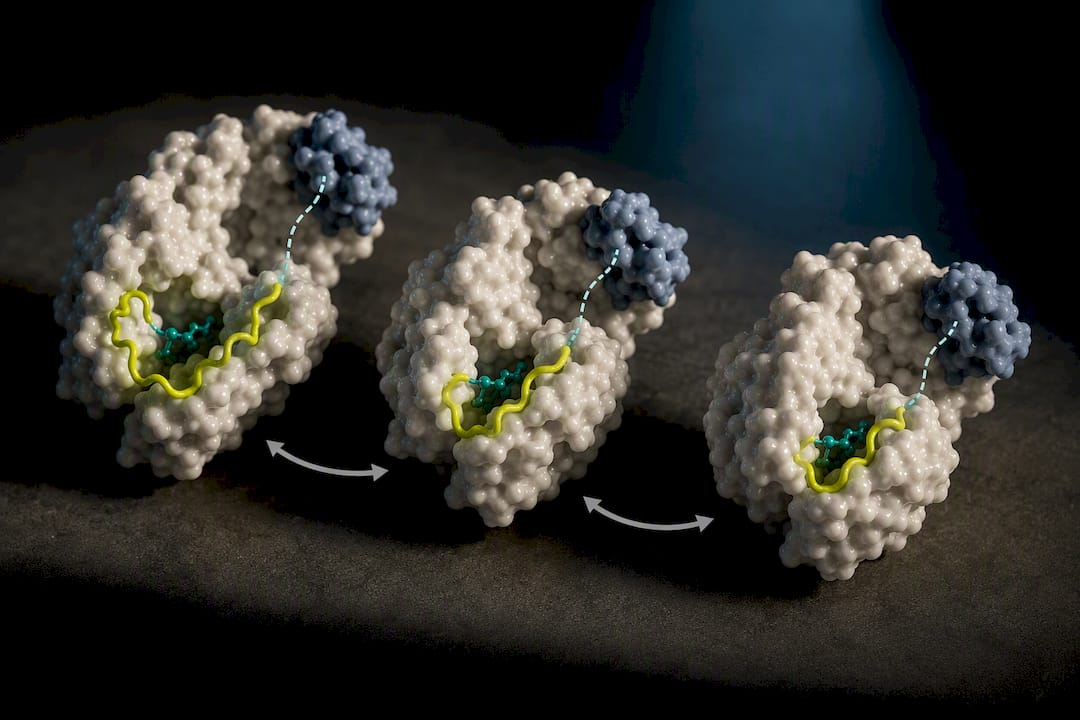
Design levers for tuning dynamics fall into a handful of practical moves. Proline insertions rigidify flexible loops by removing backbone rotational freedom, useful when an overly mobile loop is letting substrate escape before the reaction completes. Disulfide bonds lock two regions together across a larger distance, often used to stabilize an open or closed conformational state that favors the desired chemistry. Improving core packing reduces unwanted local flexibility without touching the surface at all, and surface salt-bridge engineering can shift the equilibrium between conformational substates by stabilizing one over another.
Pro Tip: Don't run one long MD trajectory and call it done. Multiple short replica simulations launched from different starting rotamers reveal alternative substates that a single long run can easily miss, and comparing RMSF profiles and principal-component projections across replicas is the fastest way to spot which regions are genuinely flexible versus artifacts of one trajectory's random walk.
Molecular dynamics is the standard tool for probing these ensembles, and it earns its computational cost specifically because it can reveal long-range coupling between residues that sit nowhere near each other in the structure but move together functionally. This is also where epistasis shows up experimentally: a mutation that looks neutral in isolation can become destabilizing, or surprisingly beneficial, once combined with a second distal mutation that shifts the same conformational network. MD-based ensemble analysis is one of the few tools that can flag this risk before you've built a combinatorial library and discovered it the expensive way.
The most common failure mode in dynamics-focused design is over-rigidifying a region that needed some flexibility to function. Locking down a loop with a disulfide bond can kill activity entirely if that loop's motion was part of the catalytic cycle, not just a source of instability. Test for this early, with a small pilot set of variants and an activity assay, before you invest in a larger library built around the same rigidification logic.
Which Computational Tools Should You Use for Enzyme Design?
Every major rational-design project now leans on a stack of computational tools, and knowing which one to use for which sub-problem matters more than knowing all of them exist. Here's how the field's core toolset breaks down by job:
- Rosetta handles backbone and side-chain modeling, ΔΔG estimation, and full protein design calculations; it's the most versatile engine in the stack but also the slowest and most compute-intensive for large screens.
- FoldX offers faster, lighter-weight stability and mutation-effect predictions, making it a practical first-pass filter before committing candidates to Rosetta's heavier calculations.
- HotSpot Wizard combines sequence conservation, structural proximity, and flexibility data into ranked mutable-position lists, ideal for the earliest hotspot-selection stage of a project.
- ProteinMPNN generates sequences predicted to fold into a given backbone, useful when you're redesigning a scaffold or stabilizing a novel active-site geometry rather than making point mutations.
- RFdiffusion generates entirely new backbone structures and binding sites from scratch, the generative end of the spectrum for projects that need a new scaffold rather than an edited one.
A practical hybrid workflow chains these tools rather than picking just one. Start with sequence priors from MSA and HotSpot Wizard to shortlist candidate positions, move into Rosetta or FoldX for structural modeling and ΔΔG screening, layer molecular dynamics onto the top candidates to check for dynamics-driven surprises, and finish with ML-based re-ranking to catch patterns the physics-based tools miss. AI tools like ProteinMPNN and diffusion-based generative models have shifted the field's central question from how to design a mutation to what target is worth designing for in the first place, since the generation step itself is now largely solved by open tools.
The biggest pitfall in this stack is overfitting to predicted energetics. A mutation that scores well on ΔΔG or a docking energy function can still fail experimentally, because these scoring functions are approximations, not ground truth. Treat computational rankings as a way to prioritize a shortlist, never as a substitute for expression and assay data. Reproducibility also suffers when force-field versions and parameter sets aren't logged; document exact tool versions and settings for every design round, or you won't be able to explain why round three's top hit doesn't match round one's logic.
De novo generative approaches (RFdiffusion, ProteinMPNN) are worth reaching for when no existing scaffold gets you close to the target function. Targeted mutation approaches remain the better choice when you already have a working enzyme and need incremental gains in stability, selectivity, or substrate range, since generative design still lags evolved enzymes in raw catalytic efficiency for many reactions.
How Do You Run a Design, Build, Test, Learn Workflow?
A disciplined DBTL cycle turns computational predictions into validated variants, and the practical steps matter as much as the modeling choices behind them.
- Prioritize your hypotheses. Rank candidate mutations by data quality (crystal structure versus homology model), mechanistic confidence, and risk to the catalytic core, then commit to testing the top 10 to 20 rather than everything the models flagged.
- Design focused libraries, not exhaustive ones. Iterative saturation mutagenesis approaches such as CAST/ISM and the newer FRISM method deliberately shrink library size by saturating only the highest-confidence hotspots first, then iterating.
- Build variants with standard molecular biology. Site-directed mutagenesis via Q5-based or Gibson-assembly protocols remains the workhorse method; optimize expression conditions (temperature, induction time, chaperone co-expression) alongside the mutation itself, since a perfect design expressed poorly will look like a failed design.
- Design assays that match the real question. Activity assays confirm the enzyme still works; kinetics assays (Km, kcat) tell you if you actually improved catalysis; chiral HPLC or equivalent readouts are non-negotiable for enantioselectivity claims.
- Escalate when rational predictions stall. If two or three rounds of targeted mutation fail to move the needle, that's the signal to shift toward broader screening or directed evolution rather than continuing to guess.
Focused, mutability-landscaped libraries built around a handful of hotspot residues have produced multi-fold improvements in catalytic rate and selectivity in published work, at a fraction of the screening burden a blind random-mutagenesis campaign would require. That efficiency gain is the entire economic argument for starting rational, even on projects where you expect to finish with a round of directed evolution.
What Do Real Rational Design Case Studies Teach You?
Published rational-design projects tend to teach the same handful of lessons, no matter which enzyme family they touch.
- Consensus-guided stability projects consistently show that back-to-consensus mutations at CbD sites raise melting temperature with low risk to activity, precisely because these positions were rarely load-bearing for catalysis in the first place.
- Pocket-remodeling projects targeting substrate scope succeed most often when steric changes are paired with a docking-validated binding pose, confirming the new substrate actually sits in a catalytically productive orientation rather than just fitting geometrically.
- Interaction-network edits aimed at enantioselectivity work best when the design targets the last shell of residues around the stereocenter rather than distant scaffold positions, since orientation near the reactive center is what ultimately decides which face reacts.
- Dynamics-focused projects repeatedly surface epistasis: a stabilizing mutation and a distal activity mutation that look independent on paper often interact, sometimes canceling each other's benefit, sometimes compounding it.
The mechanistic thread across all four patterns is the same: rational design succeeds when the mutation targets the specific energetic or geometric bottleneck limiting the property you care about, and it fails when it targets a bottleneck that was never actually limiting. That's why assay choice matters as much as design logic. If your kinetics assay measures the wrong step, you'll draw the wrong conclusion about why a mutation helped or didn't. These patterns generalize well across enzyme families, hydrolases, oxidoreductases, transferases, because they describe energetics and geometry, not any single fold's quirks. Innovabiotech's enzyme engineering guide for industrial biotech walks through several of these patterns applied to enzymes under harsh reaction conditions.
When Should You Combine Rational Design With Directed Evolution?
Rational design runs into real limits, and pretending otherwise wastes project time. Incomplete mechanistic knowledge means you sometimes can't predict which residue actually controls the property you're chasing. Epistasis means mutations that look independent on paper interact unpredictably in combination. Data scarcity, no structure, a poor homology model, thin homolog coverage, can undercut every strategy family at once.
Risk mitigation starts with conservative heuristics: favor single-site mutations over combinatorial ones until you've confirmed the effect direction, stay outside the catalytic core unless structural or QM/MM evidence directly supports an active-site edit, and validate computational predictions against a small pilot set before scaling up a library.
- Combine with CAST/ISM or FRISM when you've identified the right hotspot region but can't confidently predict which specific substitution will help, letting saturation mutagenesis explore the space rational logic narrowed down.
- Shift to full directed evolution when structural data is poor, mechanistic understanding is thin, or two rounds of targeted design have failed to move the target property.
- Stay purely rational when you have a solid structure, a clear catalytic mechanism, and a narrow, well-defined goal like stability or a known selectivity switch.
Integrating rational design with directed evolution is now the norm in successful projects rather than the exception, with rational logic narrowing the search space and evolutionary screening providing the robustness rational predictions can't guarantee alone.
Author Perspective and Practical Notes From Innovabiotech
This piece was written from Innovabiotech's vantage point inside applied protein engineering work, where the gap between a promising Rosetta score and a variant that actually performs in an assay shows up constantly. A specialized biotechnology firm works with biopharmaceutical and biotechnology R&D teams on enzyme optimization, protein engineering, and related computational biology projects, typically as contracted engagements scoped to a specific target and property.
The strategies above, sequence consensus, pocket remodeling, interaction-network redesign, dynamics tuning, and computational or AI-guided design, map directly onto how Innovabiotech structures a typical enzyme engineering engagement: hotspot identification first, structural and dynamics modeling second, focused experimental validation third. Readers working through their own hotspot shortlists may find Innovabiotech's industrial enzyme optimization strategies or directed evolution guide useful next steps for the later stages of a project.
Teams weighing whether to run this work internally or bring in outside computational support are welcome to reach out to Innovabiotech directly to discuss project scope, timelines, and specific target enzymes.
Final Takeaways and a Starter Strategy
Three things matter more than any single tool: conservation data narrows risk before structure ever enters the picture, dynamics deserve ensemble analysis rather than a single static model, and interaction-network edits control selectivity more precisely than pocket remodeling alone. For a first target, run MSA and HotSpot Wizard to shortlist hotspots, model the top candidates in Rosetta or FoldX, then validate a small pilot set with activity and kinetics assays before committing to a larger library. From there, Innovabiotech's practical optimization list is a useful reference for expanding the design space.

An Editorial Take on Where Rational Design Actually Delivers
The conventional pitch for rational enzyme design oversells precision and undersells iteration. Structural insight narrows the search space; it does not guarantee the first designed mutation works, and treating a Rosetta or FoldX score as a verdict rather than a hypothesis is the single most common mistake I see in project planning. The tools have gotten dramatically better at generating candidates. They have not gotten proportionally better at telling you which candidate is right on the first try.
What's underrated is dynamics analysis. Most teams still default to static structural reasoning because it's faster and the tools are more familiar, but the projects that stall are disproportionately ones where a distal, dynamics-driven effect never got modeled until after a library failed. Run ensemble analysis earlier than feels necessary.
What should change first: stop treating "how to design" as the hard problem. Open tools have mostly solved it. The harder, more valuable problem is choosing which target property actually moves the needle for your application, and building a validation plan that can tell a real success from a lucky one.
— Hooman
How Innovabiotech Can Support Your Enzyme Design Project
Innovabiotech is the practical alternative to building an in-house computational protein engineering team from scratch. Instead of hiring separate specialists for MSA analysis, Rosetta modeling, MD simulation, and assay design, you contract one team that already runs this full pipeline across biopharma and biotech projects.
Our enzyme optimization work covers everything this article walked through: sequence-consensus screening, pocket and interaction-network remodeling, dynamics-aware modeling, and computational or AI-guided design chained into a validated experimental workflow. If your project also touches protein or chimeric construct design more broadly, our protein engineering and modeling services extend the same computational rigor to scaffold-level decisions, not just point mutations. For teams specifically focused on catalytic performance, stability, or selectivity gains, our enzyme solutions page outlines how a typical engagement scopes hotspot selection through validation.
If you have a target enzyme and a defined property to improve, consulting with specialized enzyme optimization providers can help discuss project scope and develop a tailored plan for your first design round.
Sources
- Making enzymes suitable for organic chemistry by rational protein design
- Enzyme engineering: from classical strategies to AI
- Recent advances in rational approaches for enzyme engineering
FAQ
What Is Rational Enzyme Design?
Rational enzyme design uses structural and sequence data, rather than random mutagenesis, to predict a small set of mutations likely to improve stability, activity, or selectivity, reducing screening burden compared with blind directed evolution.
How Is Rational Design Different From Directed Evolution?
Rational design targets specific residues based on structural or sequence reasoning, while directed evolution screens large randomly mutated libraries; most successful projects now combine both approaches rather than choosing one exclusively.
Which Computational Tools Are Most Important for Rational Design?
Rosetta and FoldX handle stability and mutation-effect modeling, HotSpot Wizard ranks candidate mutable positions from sequence and structural data, and newer tools like ProteinMPNN and RFdiffusion support generative scaffold and binding-site design for projects that need more than point mutations.
When Should I Combine Rational Design With Semi-Rational Methods Like CAST/ISM?
Combine them when you've identified a promising hotspot region through rational analysis but can't confidently predict the best substitution, then saturate that narrowed region efficiently with approaches like CAST/ISM and FRISM.
Can Rational Design Improve Enzyme Enantioselectivity?
Yes. Redesigning the active-site interaction network, hydrogen bonds and salt bridges near the stereocenter, along with steric pocket remodeling, has produced documented enantioselectivity improvements across multiple enzyme families.
Does Innovabiotech Offer Rational Enzyme Design Services?
Innovabiotech provides contracted enzyme optimization and protein engineering services for biopharmaceutical and biotechnology R&D teams, covering hotspot selection, computational modeling, and experimental validation support for stability, activity, and selectivity targets.