
TL;DR:
- Companion diagnostics are in vitro tests developed alongside therapies to identify patients who will benefit or be harmed. They are essential for drug approval, patient selection, and safety monitoring, with most FDA oncology approvals now linked to these devices. Their co-development involves rigorous validation, regulatory coordination, and early planning to ensure clinical utility and successful market entry.
Companion diagnostic development is the co-development of a diagnostic test alongside a therapeutic product so that the test can reliably identify which patients will benefit from, or be harmed by, that therapy. The U.S. Food and Drug Administration (FDA) defines a companion diagnostic as an in vitro medical device that provides information essential for the safe and effective use of a corresponding drug or biologic. That definition carries real regulatory weight: when a CDx is deemed essential, it must be approved or cleared concurrently with the drug, and the drug label must reference the test.
Why does this matter to you as a developer or clinician?
- Drug approval depends on it. When FDA determines a CDx is essential, the drug cannot be approved without a cleared or approved diagnostic. Missing that alignment delays or blocks the entire program.
- Patient selection is the mechanism. CDx tests direct therapy by identifying tumor gene changes or biomarkers, as the NCI defines, concentrating benefit in the patients most likely to respond and reducing exposure in those who will not.
- Safety is the other side of the coin. CDx tests can also flag patients at elevated risk of serious adverse events, making them a patient-protection tool, not just an efficacy filter.
Three biomarkers illustrate the stakes concretely: HER2 amplification in breast and gastric cancer, EGFR mutation in non-small cell lung cancer, and PD-L1 expression across multiple tumor types. Each one anchors a major drug approval and a cleared diagnostic. Foundation Medicine's comprehensive genomic profiling panels are among the commercial CDx platforms that now cover multiple biomarkers in a single assay, reflecting how far the field has moved from single-analyte tests.
CDx-associated approvals reached 43% of FDA oncology indications by 2022, highlighting why companion diagnostic development is increasingly essential for precision oncology teams.
Table of Contents
- What Is Companion Diagnostic Development, Exactly?
- Why CDx Co-Development Matters in Precision Oncology
- How Does CDx Development Work, Stage by Stage?
- What Is the U.S. Regulatory Pathway for a CDx?
- What Analytical Validation Does FDA Expect?
- How Do You Design Clinical Validation Studies for a CDx?
- How Do You Operationalize a Cleared CDx in Clinical Labs?
- What Commercial and Reimbursement Challenges Should You Anticipate?
- Practical Checklist and Timeline for a CDx Co-Development Program
- How Bioinformatics Accelerates CDx Development
- Key Takeaways
- The Part of CDx Development Most Teams Get Wrong
- Innovabiotech Supports Your CDx Program at Every Computational Stage
- Useful Sources
- FAQ
What Is Companion Diagnostic Development, Exactly?
The formal FDA definition states that a companion diagnostic is an in vitro medical device where the device's labeling includes an indication for use with a specific therapeutic product. The key phrase is "essential for the safe and effective use" — when FDA applies that standard, the CDx and the drug are co-regulated, meaning neither can be approved in isolation.
All CDx are in vitro diagnostics (IVDs), but the reverse is not true. A general IVD measures a biomarker; a CDx result specifically directs a therapeutic decision. That distinction shapes every regulatory and development choice you make.
The EU's In Vitro Diagnostic Regulation (IVDR 2017/746) imposes similarly strict requirements for scientific validity, analytical and clinical performance, and post-market surveillance for IVDs including CDx, as documented in the PMC regulatory overview. For U.S.-focused programs, the FDA framework governs, but sponsors with global ambitions need to plan for IVDR compliance in parallel.
Regulatory consequences of CDx designation:
- The diagnostic sponsor typically pursues a Premarket Approval (PMA) pathway, the most rigorous FDA review class for IVDs.
- Drug labeling must reference the specific CDx, including the test name and the biomarker threshold used for patient selection.
- Co-submission timing is binding: FDA expects the drug and CDx applications to be submitted and reviewed together, with coordinated approval dates.
- Post-market surveillance obligations apply to both the drug and the diagnostic, including reporting requirements for assay failures or label updates.
Pro Tip: Engage FDA before you file an Investigational New Drug (IND) or Investigational Device Exemption (IDE) application. A Pre-Submission (Q-Submission) meeting lets you align on the biomarker, the intended use statement, and the co-development plan before you invest in pivotal studies. The regulatory lead on the sponsor side should own this interaction, not outsource it to a CRO.
Why CDx Co-Development Matters in Precision Oncology
The clinical rationale for CDx co-development is straightforward: unselected trials enroll patients who cannot respond, diluting the treatment effect and requiring larger sample sizes to detect a signal. A well-validated CDx fixes that problem at the design stage.
HER2 is the canonical example. Trastuzumab showed modest activity in unselected breast cancer populations but transformative benefit in HER2-amplified tumors. Without a reliable HER2 test, the drug would have looked marginal. EGFR mutation testing in non-small cell lung cancer follows the same logic: first-generation EGFR inhibitors produced response rates above 60% in mutation-positive patients versus single digits in unselected populations. PD-L1 expression, while a more complex biomarker with acknowledged limitations, still drives prescribing decisions for pembrolizumab across multiple tumor types.
Development and patient benefits of CDx co-development:
- Enriched trial designs reduce the number of patients needed to demonstrate efficacy, cutting enrollment time and cost.
- Targeted approvals mean the drug reaches the right patients faster, with a cleaner benefit-risk profile in the label.
- Negative predictive value data from CDx studies can protect patients from ineffective or toxic therapies.
- Biomarker-stratified designs generate evidence for both biomarker-positive and biomarker-negative populations, informing post-approval label expansions.
CDx adoption correlates strongly with specific biomarker characteristics. Springer Nature's analysis found that low-prevalence biomarkers (odds ratio 49.07) and enzyme or kinase targets (odds ratio 14.56) are the strongest predictors of CDx adoption, which means biotech sponsors working on rare-mutation or kinase-driven oncology programs should treat CDx co-development as the default, not the exception.
Key figure: Strategic CDx integration is associated with a mean reduction in development time of 379.5 days for new molecular entities, a magnitude comparable to receiving Breakthrough Therapy Designation.
How Does CDx Development Work, Stage by Stage?
Companion diagnostic development runs in parallel with drug development, not after it. The stages below represent a practical roadmap; the exact sequence and duration depend on the biomarker type, the platform, and the regulatory strategy.
Stage 1: Biomarker discovery and selection
The program starts with identifying a biomarker that predicts response, resistance, or toxicity. This involves retrospective analysis of banked tumor samples, genomic profiling, and statistical modeling to establish the biological plausibility of the biomarker-drug relationship. Key deliverables: a candidate biomarker with a proposed threshold, a sample repository plan, and a preliminary intended use statement.

Stage 2: Analytical assay design and platform selection
Once the biomarker is selected, the assay format is chosen based on the biomarker's nature and the clinical workflow. NGS panels suit multi-gene or variant-level biomarkers (EGFR mutation subtypes, TMB, MSI). IHC is standard for protein expression biomarkers like HER2 and PD-L1. PCR-based assays work well for defined point mutations or fusions. Molecular imaging, as documented in PMC, offers a complementary CDx modality for measuring tumor heterogeneity and early pharmacodynamic responses noninvasively, particularly when biopsy access is limited.

Stage 3: Analytical validation
This is where you prove the assay measures what it claims to measure, consistently, across sites and operators. The core experiments are precision, accuracy, limit of detection (LOD), linearity, specificity, and reproducibility. Acceptance criteria must be pre-specified and justified.
Stage 4: Clinical validation
Clinical validation establishes that the biomarker, as measured by the assay, predicts the clinical outcome of interest. This requires prospectively collected or prospectively defined retrospective samples from clinical trials, with pre-specified endpoints and analysis populations.
Stage 5: Clinical utility demonstration
Clinical utility goes beyond statistical association. It asks whether using the test to guide treatment decisions leads to better patient outcomes than not using it. Payers and regulators both require this evidence.
Stage 6: Regulatory submission and review
The CDx PMA is submitted in coordination with the drug's NDA or BLA. FDA reviews both applications in parallel, and the approval dates are coordinated.
Stage 7: Manufacturing scale-up and commercialization
The assay transitions from a research or clinical-trial format to a commercially manufactured IVD. This involves design transfer, quality system compliance (21 CFR Part 820), and supply chain qualification.
Stage 8: Post-market surveillance
Post-approval, sponsors must monitor assay performance in the real-world setting, report failures, and update labeling when the drug's indication changes.
Typical stage durations:
| Stage | Typical Duration | Key Dependency |
|---|---|---|
| Biomarker discovery | 12–24 months | Sample availability, genomic data |
| Assay design and prototype | 6–12 months | Biomarker type, platform selection |
| Analytical validation | 6–18 months | Number of sites, platform complexity |
| Clinical validation | 12 months | Trial enrollment, sample collection |
| Regulatory submission and review | 12–18 months | Co-submission timing with drug |
| Manufacturing scale-up | 6–12 months | Design transfer, QMS readiness |
| Post-market surveillance | Ongoing | Label updates, real-world data |
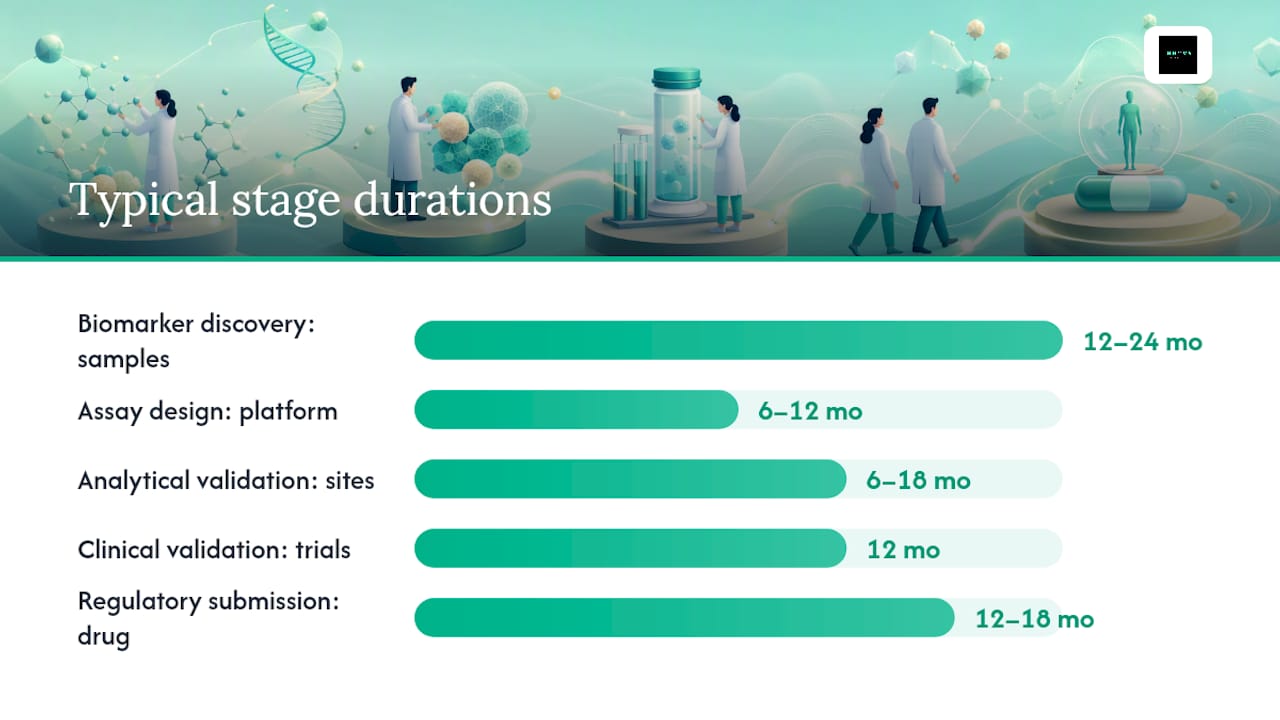
Parallel execution of stages 2–4 with early-phase drug trials is where bioinformatics-accelerated drug discovery pays off most: computational biomarker modeling can compress the discovery and assay design phases significantly.
What Is the U.S. Regulatory Pathway for a CDx?
The FDA's regulatory route for a CDx depends on the risk class and the novelty of the device. For most CDx tied to novel therapeutics, the PMA pathway applies because the device is Class III and there is no legally marketed predicate.
| Pathway | When It Applies to CDx | Key Requirement |
|---|---|---|
| PMA | Novel CDx for a new drug; no predicate; Class III designation | Full analytical and clinical evidence package; co-submission with drug |
| De Novo | Novel CDx with low-to-moderate risk; no predicate but not Class III | Risk-based classification request; may establish a new predicate for future submissions |
| — | CDx that is substantially equivalent to a cleared predicate | Substantial equivalence demonstration; less common for truly novel CDx |
For most precision oncology programs, PMA is the realistic path. The FDA's cleared and approved CDx device list is the first place to search for predicates and to understand what evidence packages have been accepted for similar biomarkers.
Regulatory interaction checklist for CDx sponsors:
- Pre-IND meeting: Align on the biomarker strategy, intended use statement, and co-development plan before IND filing.
- Pre-IDE meeting: Discuss the analytical validation plan and clinical study design for the CDx before IDE filing.
- Q-Submission (Pre-Submission): Get FDA feedback on specific technical questions (e.g., LOD acceptance criteria, bridging study design) without triggering a formal review clock.
- PMA application: Submit with the drug's NDA or BLA; include the full analytical and clinical validation package, manufacturing information, and labeling.
- Post-approval supplements: Required when the assay is modified, the drug indication changes, or new platforms are added.
Documentation the co-submission package must include:
- Intended use statement aligned with the drug label
- Analytical validation study reports
- Clinical validation data from pivotal trial samples
- Clinical utility evidence (trial endpoints, patient outcomes)
- Manufacturing and quality system documentation
- Proposed labeling, coordinated with the drug sponsor
Pro Tip: Draft the intended use statement and the drug label's biomarker language at the same time, with the same team in the room. Misaligned language between the CDx label and the drug label is one of the most common causes of FDA information requests during co-review, and fixing it late is expensive.
What Analytical Validation Does FDA Expect?
Analytical validation proves that the assay performs as claimed, independent of clinical outcomes. FDA expects a pre-specified validation plan with defined acceptance criteria before you run the studies. Changing acceptance criteria after seeing the data is a critical finding in review.
Core analytical validation experiments:
| Experiment | What It Measures | Typical Acceptance Criteria |
|---|---|---|
| Precision (repeatability) | Within-run variability | CV ≤ 10–15% for quantitative assays |
| Precision (reproducibility) | Between-run, between-site variability | CV ≤ 15–20%; concordance ≥ 95% for categorical |
| Accuracy | Agreement with reference method or known samples | ≥ 95% overall agreement |
| Limit of detection (LOD) | Lowest reliably detected analyte level | detection at stated LOD |
| Linearity | Proportional response across the analytical range | R² ≥ 0.99 across claimed range |
| Specificity | Freedom from interference | No false positives from specified interferents |
| Analytical sensitivity | Ability to detect low-level variants | Defined by clinical cutoff requirements |
Pre-analytical variables are where programs most often stumble. Formalin fixation time, tissue age, tumor cellularity, and nucleic acid extraction method all affect results, sometimes dramatically. Platform biases are equally real: the same FFPE sample can yield different variant allele frequencies on different NGS platforms, which is why the NCI's standardization guidance emphasizes early harmonization.
Common pre-analytical and platform pitfalls:
- Variable formalin fixation time causing DNA degradation artifacts in NGS assays
- Tumor heterogeneity causing sampling bias in biopsy-based assays
- Platform-specific biases in variant calling algorithms producing discordant calls at low allele frequencies
- Operator variability in IHC scoring, particularly for PD-L1 where scoring algorithms differ by antibody clone
- RNA degradation in FFPE samples affecting fusion detection assays
Pro Tip: If your CDx program involves multiple testing sites or multiple platforms, design bridging studies at the start of analytical validation, not as an afterthought. A bridging study that fails late in development can force a platform restriction in the label, limiting commercial reach.
How Do You Design Clinical Validation Studies for a CDx?
Clinical validation requires prospectively planned studies with pre-specified biomarker thresholds, analysis populations, and statistical criteria. The trial design choice shapes both the evidence strength and the regulatory burden.
| Trial Design | Description | Pros | Cons |
|---|---|---|---|
| Enrichment design | Only biomarker-positive patients enrolled | Maximizes power; smaller trial | No data on biomarker-negative patients; label restricted to positive |
| Stratified/randomized design | All patients enrolled; randomized within biomarker strata | Generates data for both populations; supports broader label | Larger trial; requires more samples |
| Biomarker-strategy design | Patients randomized to biomarker-guided vs. unguided treatment | Directly tests clinical utility of the testing strategy | Complex; requires large sample sizes |
| Adaptive design | Biomarker threshold or population adapted during trial | Efficient; can rescue a program with a suboptimal initial threshold | Regulatory complexity; pre-specification requirements are strict |
For most precision oncology CDx programs, the enrichment design is the fastest route to approval, but it limits the label. Stratified designs are preferred when the sponsor wants to understand the biomarker-negative population or anticipate label expansion.
Endpoints used in CDx clinical validation studies:
- Objective response rate (ORR): the most common primary endpoint in enrichment trials; directly links biomarker status to tumor response.
- Progression-free survival (PFS): preferred when ORR is insufficient to demonstrate clinical benefit; requires longer follow-up.
- Overall survival (OS): the gold standard for clinical utility; often required for full approval rather than accelerated approval.
- Negative predictive value (NPV): critical when the CDx is used to exclude patients from a toxic therapy; regulators scrutinize NPV closely.
- Concordance between CDx and reference method: required when the CDx is compared to an existing test or LDT used in the pivotal trial.
Pro Tip: Pre-specify the biomarker threshold in the statistical analysis plan before unblinding any efficacy data. Threshold optimization after seeing the data is a major regulatory red flag. If you genuinely need to explore thresholds, use a training set/validation set split with pre-specified rules, and document the decision before any outcome data are reviewed.
How Do You Operationalize a Cleared CDx in Clinical Labs?
Moving from FDA clearance to routine clinical use is an operational challenge that many sponsors underestimate. A cleared CDx is not automatically available in every hospital lab; it requires training, quality systems, and supply chain infrastructure.
Operational implementation checklist:
- Establish assay SOPs covering sample receipt, processing, testing, and result reporting.
- Train laboratory personnel on the assay procedure, QC interpretation, and result reporting.
- Implement a QC/QA program with defined acceptance criteria for each run.
- Set up sample logistics: specimen type requirements, collection kits, shipping conditions, and turnaround time targets.
- Enroll in proficiency testing programs (CAP, AACC, or manufacturer-sponsored) to demonstrate ongoing competency.
- Build data pipelines for result delivery to oncologists and integration with electronic health records.
- Plan for inter-laboratory comparability studies when the CDx is deployed across multiple sites.
CLIA vs. FDA: understanding the dual regulatory framework
The FDA regulates the CDx as a medical device, approving or clearing it for a specific intended use. CLIA (the Clinical Laboratory Improvement Amendments) regulates the laboratory performing the test, setting standards for personnel, quality control, and proficiency testing. A lab must hold a CLIA certificate of the appropriate complexity level to run a high-complexity CDx. Laboratory-developed tests (LDTs) are assays designed and used within a single CLIA-certified lab; they are not FDA-cleared but are subject to CLIA oversight. Commercial IVDs are FDA-cleared or approved and can be deployed across multiple labs. For a CDx tied to a drug label, FDA generally expects a commercial IVD rather than an LDT, because the label references the specific cleared device.
Pro Tip: Document training records and QA procedures with the same rigor you applied to the validation studies. FDA inspections of CDx manufacturing and testing sites look for evidence that the cleared assay is being run exactly as validated. Gaps in training documentation are among the most cited observations in 483s.
What Commercial and Reimbursement Challenges Should You Anticipate?
A cleared CDx that payers will not cover is clinically useless. Reimbursement and adoption challenges are where many otherwise successful CDx programs stall, and they require planning that starts years before approval.
Payer evidence requirements:
- Clinical utility data showing that testing changes treatment decisions and improves outcomes, not just that the biomarker predicts response.
- Cost-effectiveness analysis demonstrating that the cost of testing is justified by downstream savings (avoided ineffective treatments, reduced adverse events).
- Real-world evidence (RWE) from post-approval use showing that the CDx performs in routine clinical practice as it did in the trial.
- Diagnostic accuracy data in the intended-use population, including sensitivity, specificity, and predictive values at the prevalence of the biomarker in that population.
Co-launch timing: the most common commercial failure mode
A CDx that is approved months after the drug creates a window where oncologists prescribe the drug without testing, establishing prescribing habits that are hard to reverse. Conversely, a CDx approved before the drug has no commercial market yet. The target is simultaneous approval and simultaneous commercial availability, which requires coordinating two separate supply chains, two separate sales forces, and two separate reimbursement strategies.
A realistic co-launch timeline looks like this:
- Align drug and CDx regulatory submission dates 18–24 months before target approval.
- Engage payers with clinical utility data 12–18 months before approval.
- Negotiate reimbursement codes (CPT, LCD/NCD) 6–12 months before launch.
- Train oncology sales teams on the testing requirement and the CDx ordering process 3–6 months before launch.
- Establish lab network and supply chain 3–6 months before launch.
- Launch drug and CDx simultaneously; monitor testing rates as a leading indicator of drug uptake.
Pro Tip: Engage the Medical Evidence Development and Coverage (MED) teams at major payers during Phase 2, not at submission. Payers that see your clinical utility data early are far more likely to have a coverage policy in place at launch. An RWE plan filed with the drug's post-market commitments also signals to payers that you are serious about real-world performance.
Practical Checklist and Timeline for a CDx Co-Development Program
A CDx program that starts without a written co-development plan almost always drifts. The checklist below is designed for a sponsor team starting from a candidate biomarker and a Phase 1 drug program.
Immediate next steps for a new CDx program:
- Form a cross-functional CDx team: biomarker lead, assay development scientist, regulatory affairs (device and drug), clinical operations, bioinformatics, and commercial/market access.
- Inventory available samples: banked tumor tissue, plasma, or other biospecimens from Phase 1 cohorts; assess quantity, quality, and consent coverage.
- Select the assay platform based on biomarker type, clinical workflow requirements, and regulatory precedent.
- Draft the intended use statement and align it with the drug's proposed indication.
- File a Pre-Submission (Q-Submission) with FDA to align on the co-development plan, analytical validation approach, and clinical study design.
- Initiate biomarker discovery and threshold optimization in parallel with Phase 1 dose escalation.
- Engage a bioinformatics partner for variant calling, threshold modeling, and data harmonization.
- Begin payer landscape analysis and identify the evidence gaps for coverage.
- Establish a sample collection plan for Phase 2 that prospectively collects CDx-qualified specimens.
- Set a go/no-go decision point for assay lock before Phase 3 enrollment begins.
Program timeline and resource overview:
| Phase | Calendar Time | Key Milestones | Core Team Needs |
|---|---|---|---|
| Discovery and assay design | Year 1–2 | Biomarker selected; platform chosen; prototype assay | Biomarker scientist, bioinformatics, assay development |
| Analytical validation | Year 2–3 | Validation package complete; FDA Pre-Submission filed | Assay development, regulatory, QA |
| Clinical validation (Phase 2/3) | Year 3–5 | CDx performance in pivotal trial samples demonstrated | Clinical operations, biostatistics, regulatory |
| Regulatory submission | Year 5–6 | PMA filed; co-submission with NDA/BLA | Regulatory affairs, medical writing |
| Manufacturing and launch | Year 6–7 | Commercial IVD available; payer coverage in place | Commercial, supply chain, market access |
Essential team competencies:
- Biomarker lead: biological rationale, threshold selection, biomarker-drug relationship
- Assay development: platform expertise, analytical validation design, SOPs
- Regulatory affairs (device): PMA strategy, FDA interactions, labeling
- Clinical operations: sample collection, trial design, CDx-specific protocol elements
- Bioinformatics: variant calling, data harmonization, threshold optimization, RWE analytics
- Commercial/market access: payer strategy, reimbursement, co-launch coordination
How Bioinformatics Accelerates CDx Development
Bioinformatics is not a support function in CDx development; it is a core technical discipline. The decisions made in biomarker discovery and threshold optimization directly determine whether the CDx will perform in a pivotal trial, and those decisions are computational.
Consider a typical scenario: a sponsor has whole-exome sequencing data from 200 Phase 1 patients and wants to identify a genomic biomarker that predicts response to a kinase inhibitor. The raw data contains thousands of variants. Filtering for clinically relevant variants, harmonizing calls across sequencing batches, and modeling the relationship between variant allele frequency and response requires a purpose-built bioinformatics pipeline, not a spreadsheet. Getting the threshold wrong at this stage means the CDx will either miss responders (low sensitivity) or include non-responders (low specificity), and neither outcome survives a pivotal trial.
Computational services that directly support CDx programs:
- Biomarker discovery: multi-omic data integration, feature selection, and predictive modeling to identify candidate biomarkers from genomic, transcriptomic, or proteomic datasets.
- Variant calling and harmonization: standardized pipelines (GATK, DeepVariant, or custom workflows) that produce consistent calls across sequencing platforms and batches.
- Threshold optimization: statistical modeling (ROC analysis, Youden index, decision curve analysis) to identify the biomarker cutoff that maximizes clinical utility.
- Bridging study analytics: concordance analysis across platforms or sites to support multi-platform CDx labels.
- RWE analytics: post-approval analysis of real-world testing rates, biomarker prevalence, and treatment outcomes to support payer submissions and label expansions.
Bioinformatics pipelines that are not locked and documented before pivotal enrollment create a reproducibility problem that can surface during FDA review. The pipeline version, reference genome, and variant filtering criteria used to generate the clinical validation dataset must be archived and reproducible on demand.
Innovabiotech's tailored bioinformatics services are designed to integrate directly into CDx co-development programs at the biomarker discovery and analytical validation stages. The team brings expertise in variant calling, threshold modeling, and data harmonization, working within the sponsor's existing regulatory and data governance framework. For teams exploring precision biotech solutions for drug discovery, the computational infrastructure built during CDx development also supports broader pipeline decisions.
Pro Tip: Lock your bioinformatics pipeline before you analyze the pivotal trial samples. Document the exact software versions, reference databases, and filtering parameters. FDA reviewers increasingly ask for pipeline reproducibility packages, and a pipeline that cannot be re-run on the original data is a serious analytical validity concern.
Key Takeaways
Companion diagnostic development requires co-development of the diagnostic and therapeutic from biomarker discovery through regulatory submission, with analytical rigor and early FDA alignment as the two highest-leverage investments a sponsor can make.
| Point | Details |
|---|---|
| CDx drives 43% of oncology approvals | CDx-associated approvals reached 43% of FDA oncology indications by 2022, making co-development the norm in precision oncology. |
| 379.5-day development advantage | CDx integration reduces mean development time by 379.5 days, comparable to Breakthrough Therapy Designation. |
| PMA is the standard CDx pathway | Most CDx tied to novel therapeutics require PMA; co-submission timing with the drug's NDA or BLA is binding. |
| Analytical validation must come first | Assay failure during a pivotal trial can nullify the entire efficacy dataset; lock the platform and pipeline before Phase 3 enrollment. |
| Innovabiotech supports CDx programs | Innovabiotech provides bioinformatics services for biomarker discovery, variant calling, threshold optimization, and bridging study analytics at any stage of CDx co-development. |
The Part of CDx Development Most Teams Get Wrong
The conventional wisdom in CDx development is that the hard part is the science: finding the biomarker, validating the assay, running the trial. The science is hard. But the programs that fail most visibly fail on governance, not biology.
What I see repeatedly is a CDx program that runs as a subproject of the drug program, with no dedicated decision-making authority and no pre-specified rules for when to freeze the assay versus when to re-optimize. The biomarker team wants to keep improving the threshold. The clinical team wants to start enrolling. The regulatory team has not yet filed the Pre-Submission. Everyone is waiting for someone else to call it.
The governance decision that matters most is the assay lock decision before Phase 3. Once you enroll the first pivotal patient, the assay is locked. Any post-lock change requires a bridging study, a protocol amendment, and potentially a new regulatory interaction. Teams that treat the assay lock as a formality, rather than as a binding technical and regulatory commitment, are the ones that end up with discordant results between their Phase 2 and Phase 3 datasets.
My recommendation: establish a CDx steering committee with representation from assay development, clinical, regulatory, and bioinformatics at program initiation. Set a formal go/no-go meeting for assay lock at least six months before Phase 3 enrollment opens. Define the criteria in advance: what analytical performance thresholds must be met, what regulatory interactions must be complete, what sample inventory must be confirmed. Then hold the line.
The other underappreciated governance issue is payer engagement. Most teams treat reimbursement as a post-approval problem. By the time the CDx is cleared, the payer evidence package should already be in front of the major national payers. That requires a commercial representative on the CDx steering committee from Year 2, not Year 6.
Innovabiotech Supports Your CDx Program at Every Computational Stage
CDx programs that reach pivotal trials with a weak biomarker model or an unlocked bioinformatics pipeline face a specific kind of risk: the kind that does not show up until the trial is already running. Innovabiotech's computational biology team works with biotech and pharma sponsors to eliminate that risk early, at the stages where it is still fixable.
The services most relevant to CDx co-development include biomarker discovery from multi-omic datasets, variant calling and harmonization across sequencing platforms, threshold optimization using decision curve analysis and ROC modeling, bridging study analytics for multi-site or multi-platform programs, and RWE data pipelines for post-approval payer submissions. Innovabiotech operates as an integrated project team, not a black-box vendor, with transparent deliverables and documented pipelines that hold up under FDA review.
For sponsors working on peptide-based or probe-based CDx assays, Innovabiotech also brings peptide design and optimization capabilities that can support assay reagent development alongside the computational work.
If your team is at the biomarker selection stage, the assay design stage, or preparing for a Pre-Submission meeting with FDA, reach out to Innovabiotech for a project consultation at innovabiotech.com.
Useful Sources
The sources below are primary references for CDx development, regulation, and clinical evidence. Each is worth bookmarking for your regulatory and scientific teams.
| Source | Why It's Useful |
|---|---|
| FDA Companion Diagnostics page | The authoritative FDA definition, co-development guidance (2014 principles), and labeling requirements. Start here for any U.S. regulatory strategy. |
| FDA List of Cleared/Approved CDx Devices | Searchable list of cleared and approved CDx, including imaging tools. Use for predicate searches and to understand accepted evidence packages. |
| NCI CDx Definition | Plain-language clinical definition; useful for protocol language and patient-facing materials. |
| Springer Nature: CDx in Precision Oncology | Quantifies development-time benefits (379.5-day reduction) and biomarker characteristics associated with CDx adoption. |
| PubMed: CDx Impact on Development Timelines | Peer-reviewed evidence on how CDx co-development affects NME development timelines. |
| PMC: Regulatory Framework and Challenges | Covers FDA and IVDR regulatory frameworks, post-market surveillance, and development challenges. |
| PMC: Molecular Imaging as CDx | Documents the role of molecular imaging as a CDx modality, including PD measurement and heterogeneity assessment. |
| NCI Assay Standardization Technical Report | Technical guidance on assay standardization, platform harmonization, and bridging study design. |
FAQ
What is an example of a companion diagnostic?
The HER2 IHC/FISH assay used to select patients for trastuzumab (Herceptin) in HER2-positive breast cancer is one of the earliest and most widely cited CDx examples. EGFR mutation testing for EGFR inhibitors in non-small cell lung cancer and PD-L1 IHC testing for pembrolizumab across multiple tumor types are two additional high-profile cases.
How do you develop a companion diagnostic?
CDx development follows a staged co-development process alongside the therapeutic: biomarker discovery, analytical assay design, analytical validation, clinical validation in trial samples, clinical utility demonstration, and co-submission of the CDx PMA with the drug's NDA or BLA to FDA. The process typically spans five to seven years from biomarker selection to commercial launch.
Why does a companion diagnostic test matter in cancer care?
A CDx test identifies whether a patient's tumor carries the gene change or biomarker that a drug targets, concentrating treatment benefit in the patients most likely to respond and protecting patients who would not respond from unnecessary toxicity. CDx-associated approvals reached 43% of FDA oncology indications by 2022, reflecting how central testing has become to oncology prescribing.
What is the difference between a companion diagnostic and a standard IVD?
All companion diagnostics are in vitro diagnostics, but not all IVDs are companion diagnostics. A standard IVD measures a biomarker; a CDx result specifically directs a therapeutic decision, and the drug label references the specific cleared or approved test. That distinction triggers co-regulatory obligations: the CDx must be approved or cleared concurrently with the drug, and neither can be approved without the other when FDA deems the CDx essential.
What is the FDA's role in companion diagnostic development?
FDA regulates CDx as medical devices, typically through the PMA pathway for novel diagnostics tied to new drugs. FDA expects co-development and co-submission of the CDx and the drug, coordinated labeling, and post-market surveillance for both products. The FDA companion diagnostics guidance documents the co-development principles FDA has applied since 2014.