
TL;DR:
- Competitive intelligence in bioinformatics involves analyzing biological and regulatory data to anticipate competitor moves. It leverages early signals like patent filings and trial registrations, enhanced by AI pattern recognition, to provide a strategic advantage over years. This intelligence guides R&D decisions by identifying white spaces, assessing risks, and enabling faster, more informed drug discovery progress.
Competitive intelligence in bioinformatics is defined as the continuous, predictive process of collecting and analyzing biological, regulatory, and market data to anticipate competitor moves and guide drug discovery decisions. Unlike traditional market research, this practice integrates clinical trial registries, patent filings, FDA and EMA regulatory updates, and AI-powered genomic analytics into a single, forward-looking intelligence workflow. Biotech professionals who apply this discipline gain a measurable advantage: they identify white spaces, benchmark pipelines, and reduce R&D risk before competitors make public announcements. Innovabiotech builds this kind of bioinformatics data analysis into its client engagements from day one, treating intelligence as a core scientific input rather than an afterthought.
What data sources and signals form the foundation of competitive intelligence in bioinformatics?
Competitive intelligence in bioinformatics is a continuous, predictive process, not a quarterly report. That distinction changes which data sources matter most. The highest-value signals arrive early, before a competitor's strategy becomes public knowledge.

Primary signal categories
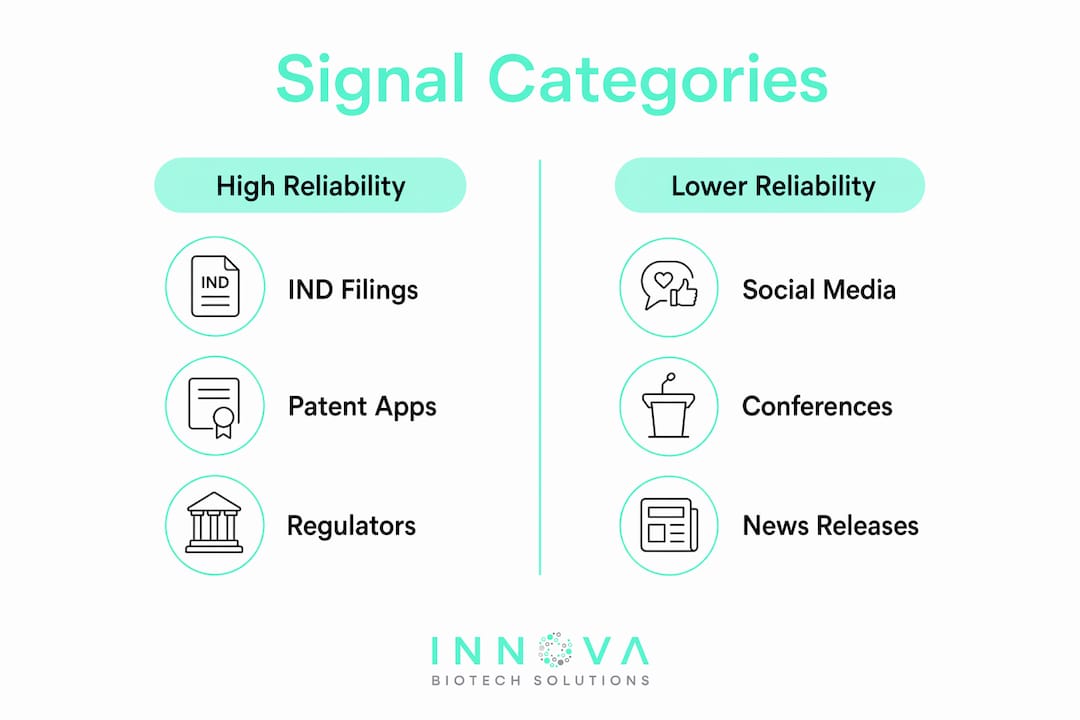
Clinical trial registries such as ClinicalTrials.gov and the EU Clinical Trials Register reveal Phase 1 activity, dose escalation decisions, and patient stratification choices months before peer-reviewed publication. Investigational New Drug filings with the FDA expose a company's therapeutic commitment at the earliest regulatory checkpoint. Patent filings add a second layer: patents file 18 months after their priority date, meaning the underlying R&D decision was made roughly two years earlier. Monitoring both IND filings and patent footprints together gives you a high-confidence read on where a competitor is actually investing.
Scientific publications, conference abstracts from meetings like ASHP or AACR, and regulatory agency press releases round out the core signal set. Digital signals, including preprint servers like bioRxiv and medRxiv, add speed. They surface findings weeks before formal publication and often telegraph a competitor's next clinical hypothesis.
| Signal type | Lead time | Reliability | Strategic value |
|---|---|---|---|
| IND filings | 12–18 months | High | Confirms R&D commitment |
| Patent applications | 18–24 months | High | Reveals technology direction |
| Phase 1 trial registrations | 6–12 months | Medium-high | Shows therapeutic focus |
| Conference abstracts | 1–3 months | Medium | Signals near-term publications |
| Social media and preprints | Days to weeks | Low-medium | Early hypothesis detection |
Pro Tip: Prioritize IND filings and patent applications over social media signals. The former represent legal and financial commitments; the latter represent intent that may never materialize.
How does artificial intelligence enhance competitive intelligence in bioinformatics?
AI transforms bioinformatics competitive analysis from a manual, retrospective task into a real-time, pattern-detecting operation. The global outsourced bioinformatics market will reach $38.6 billion by 2035, driven largely by AI-powered genomic analysis that improves variant prioritization accuracy to 85–95%. That accuracy gain directly reduces the false positives that waste wet-lab resources and delay timelines.
Machine learning models trained on genomic, proteomic, and clinical datasets can flag statistically unusual patterns in competitor trial designs or publication clusters. Those patterns often reveal a therapeutic pivot or a new target class before any press release confirms it. Competitive signals hide in patterns across multiple data points, not in individual events. A single patent filing means little. A cluster of filings in the same target family, combined with a new IND and a conference abstract, signals a coordinated program.
The most effective CI workflows balance two distinct modes of analysis:
- Always-on monitoring: Automated pipelines that continuously ingest clinical trial updates, patent publications, and regulatory decisions without human intervention
- Variant prioritization: AI models that rank genomic variants by functional impact, reducing the candidate list for downstream wet-lab validation
- Natural language processing: Algorithms that extract structured data from unstructured sources like FDA briefing documents and scientific abstracts
- Predictive modeling: Machine learning that projects likely competitor timelines based on historical trial progression rates
- Anomaly detection: Statistical tools that flag unusual spikes in publication activity or patent filings within a specific target class
Pro Tip: Automated data collection produces volume, not insight. Pair every AI output with a domain expert who can distinguish a meaningful signal from a data artifact. The interpretation layer is where competitive advantage actually lives.
Effective CI balances always-on monitoring with scenario-based projections that ask "what if?" questions about future competitive states. Always-on provides the data stream. Scenario analysis converts that stream into a decision.
What are the strategic applications of competitive intelligence in biotech R&D and drug development?
Understanding bioinformatics competitive signals is only half the work. Translating those signals into R&D and corporate decisions is where the discipline pays off. Healthcare CI operates on multi-year to decade decision horizons, which means the intelligence you gather today shapes programs that will reach the clinic in three to seven years.
-
Pipeline benchmarking. Mapping competitor programs by target, modality, and clinical stage lets your team identify where the field is crowded and where it is not. A target with four Phase 2 programs and no approved therapy signals high competition but also validated biology. A target with one early-phase program and strong patent coverage signals a potential first-mover opportunity.
-
Patent landscape analysis. Patent landscape analysis in biotech reveals freedom-to-operate risks and licensing opportunities simultaneously. A competitor's patent cluster around a specific protein engineering approach tells you both what they are protecting and what they believe is commercially valuable.
-
Regulatory intelligence. Tracking FDA and EMA decisions on competitor products reveals the evidentiary standards regulators are applying to your therapeutic class. A Complete Response Letter issued to a competitor's NDA exposes the safety or efficacy bar your own program must clear.
-
White space identification. CI analysis of unmet needs across patient populations, combined with patient stratification methods, surfaces disease subtypes where no competitor has staked a claim. Those white spaces become the basis for differentiated program design.
-
Partnership and licensing decisions. When CI reveals a competitor is advancing a complementary technology, it creates a licensing or co-development opportunity. Conversely, when a competitor acquires a platform you were considering, CI gives you early warning to pivot.
-
Risk mitigation. Knowing that two well-funded programs are ahead of yours in the same indication does not automatically mean you should stop. It means you need a differentiation strategy, whether through biomarker selection, dosing regimen, or patient population, before you reach Phase 3.
CI outputs in healthcare include pipeline trackers, therapy area landscapes, conference intelligence reports, launch readiness packs, and payer profiles. Each format serves a different stakeholder: R&D teams need pipeline trackers; commercial teams need launch readiness packs; executives need therapy landscapes.
What differentiates competitive intelligence in bioinformatics from general competitive intelligence?
General competitive intelligence tracks pricing, market share, and product positioning. Bioinformatics CI tracks genomic targets, clinical endpoints, regulatory pathways, and molecular modalities. The data ecosystems are entirely different, and so are the skills required to interpret them.
| Dimension | General CI | Bioinformatics and healthcare CI |
|---|---|---|
| Primary data sources | Financial filings, news, customer reviews | Clinical trials, patents, FDA/EMA filings, genomic databases |
| Decision horizon | Months to 1–2 years | 3–10 years |
| Key stakeholders | Sales, marketing, strategy | R&D, regulatory affairs, medical affairs, corporate development |
| Output formats | Competitive dashboards, pricing reports | Pipeline trackers, therapy landscapes, launch readiness packs |
| Regulatory constraints | Minimal | Sunshine Act, off-label rules, HIPAA, GDPR |
| Interpretation complexity | Moderate | High: requires domain expertise in biology and clinical science |
The regulatory layer is the sharpest distinction. Healthcare CI teams must navigate off-label promotion rules, the Sunshine Act's transparency requirements for physician interactions, and data privacy frameworks like HIPAA and GDPR. A CI analyst in a general industry can freely discuss a competitor's product features. A healthcare CI analyst must carefully separate scientific exchange from promotional activity.
Biological nuance adds another layer of complexity. Two companies may be targeting the same receptor, but with different binding sites, different patient populations, and different biomarker strategies. Interpreting those differences requires structured, ongoing strategic analysis, not just data access. The primary challenge in bioinformatics CI is not finding the data. It is knowing what the data means in a biological and clinical context.
Bioinformatics platforms compete increasingly on integrated value and speed rather than cost alone. Smaller, specialized firms focus on AI-driven annotation and rapid customization, which matters when your CI workflow requires domain-specific models rather than general-purpose tools.
Key Takeaways
Competitive intelligence in bioinformatics delivers its greatest value when pattern recognition across multi-source data replaces single-point monitoring, giving biotech teams a 2–3 year strategic lead over publicly available information.
| Point | Details |
|---|---|
| CI is continuous and predictive | Treat it as an ongoing workflow, not a one-time report, to capture early signals. |
| Patents and INDs are the highest-value signals | Combined monitoring reveals competitor R&D commitment roughly two years before public disclosure. |
| AI improves accuracy, not judgment | AI-powered variant prioritization reaches 85–95% accuracy but requires expert interpretation to generate real insight. |
| Bioinformatics CI has unique regulatory constraints | Sunshine Act, off-label rules, and HIPAA create compliance requirements absent in general competitive intelligence. |
| White spaces drive program differentiation | Pipeline benchmarking and patient stratification together reveal uncontested therapeutic opportunities. |
Why pattern recognition beats data collection in bioinformatics CI
I have seen biotech teams build elaborate data pipelines and still miss the signal that mattered most. The problem is almost never data volume. It is the absence of a structured interpretation layer sitting between the raw feed and the decision-maker.
The teams that consistently get this right share one habit: they look for patterns across signal types before drawing any conclusion. A single IND filing is noise. An IND filing, a patent cluster in the same target family, and a conference abstract from the same group is a program. That distinction sounds obvious in writing. In practice, under deadline pressure, most teams react to the loudest single signal rather than waiting for the pattern to emerge.
The future of bioinformatics CI points toward multimodal data integration, combining genomics, proteomics, and imaging data into unified competitive models. That integration is technically demanding and requires validated, regulatory-compliant workflows. Innovabiotech's approach treats structural bioinformatics in pharma R&D as a core input to CI, not a separate analytical track. The teams that build that integration now will have a compounding advantage as the data sources multiply.
The uncomfortable truth is that most organizations underinvest in the interpretation function while overinvesting in data subscriptions. The data is increasingly commoditized. The expert who can read a patent cluster, a trial design, and a regulatory decision simultaneously and synthesize them into a program-level insight is the actual competitive asset.
— Hooman
Innovabiotech's bioinformatics services for competitive intelligence
Innovabiotech supports biotech teams that need more than raw data. The firm's services span peptide design and optimization, protein engineering, computational modeling, and bioinformatics validation, each designed to integrate directly with CI-informed R&D decisions.
When your pipeline benchmarking identifies a white space in a specific target class, Innovabiotech's de novo peptide design and protein engineering services translate that insight into a validated molecular program. The team works from initial consultation through project delivery, maintaining scientific integrity and regulatory compliance at every stage. If your CI workflow has surfaced an opportunity and you need a bioinformatics partner to act on it, Innovabiotech provides the technical depth to move from signal to candidate.
FAQ
What is competitive intelligence in bioinformatics?
Competitive intelligence in bioinformatics is the continuous process of collecting and analyzing biological, regulatory, and market data to predict competitor actions and guide drug discovery decisions. It integrates clinical trial data, patent filings, FDA and EMA updates, and AI-powered genomic analysis into a single forward-looking workflow.
How does AI improve bioinformatics competitive analysis?
AI-powered genomic analysis improves variant prioritization accuracy to 85–95%, reducing false positives and accelerating candidate selection. Machine learning models also detect patterns across patent filings, trial registrations, and publications that reveal competitor intent before public announcements.
What are the most reliable competitive signals in biopharma?
IND filings and patent applications are the highest-reliability signals because they represent legal and financial commitments. Patent filings reflect R&D decisions made roughly two years earlier, giving CI teams a significant lead time advantage over publicly announced programs.
How does bioinformatics CI differ from general competitive intelligence?
Bioinformatics CI uses specialized data sources including clinical trial registries, genomic databases, and regulatory filings, and operates on decision horizons of 3–10 years. It also requires compliance with healthcare-specific regulations like the Sunshine Act, HIPAA, and off-label promotion rules that do not apply in general CI.
What outputs does competitive intelligence produce for biotech teams?
Healthcare CI outputs include pipeline trackers, therapy area landscapes, conference intelligence reports, launch readiness packs, and payer profiles. Each format serves a different function: R&D teams use pipeline trackers, while commercial and executive teams rely on therapy landscapes and launch readiness packs.